
 PV
 TG
 MN
 EM
 EI
 ND
 NM
 SR

 CT Scan
 PET CT
 Digital X-ray
 Ultrasound
 Amniocentesis

 Fetal Reduction
 Thermalytix Breast Screening
 Cardiology
 Lab Tests
 GAMCA Pre-Medical

A Singapore flag medical is the seafarer medical examination you need before working on a Singapore-registered ship. The Maritime and Port Authority of Singapore (MPA) accepts certificates from doctors recognised by Singapore, by an STCW “White List” country or by an MLC 2006 country — and India is both.
You have just been told: “Your next vessel is Singapore flag. Get your medical done.” Straight away, the questions start. Is a Singapore flag medical different from my DG medical? Can I do it in India? Which doctor? What will they test? How long will the certificate last?
This guide answers all of that in simple language. It is written for captains, officers, engineers, ratings and cadets — and for families who help them prepare. Every rule mentioned here is taken from MPA’s own published guidance and the international conventions behind it, with links at the end so you can check them yourself. There is also a short Hinglish section for those who prefer it.
Many seafarers search for “Singapore flag medical in Delhi”, “MPA medical certificate” or simply “Singapore flag medical kaise hota hai?”. If that is you, read on.
Singapore flag medical at a glance
- Who needs it: every seafarer working on a Singapore-registered ship must hold a valid medical fitness certificate
- Rule book: MPA Shipping Circular No. 11 of 2021, which adopts the IMO/ILO guidelines on medical examination of seafarers as Singapore’s national requirements
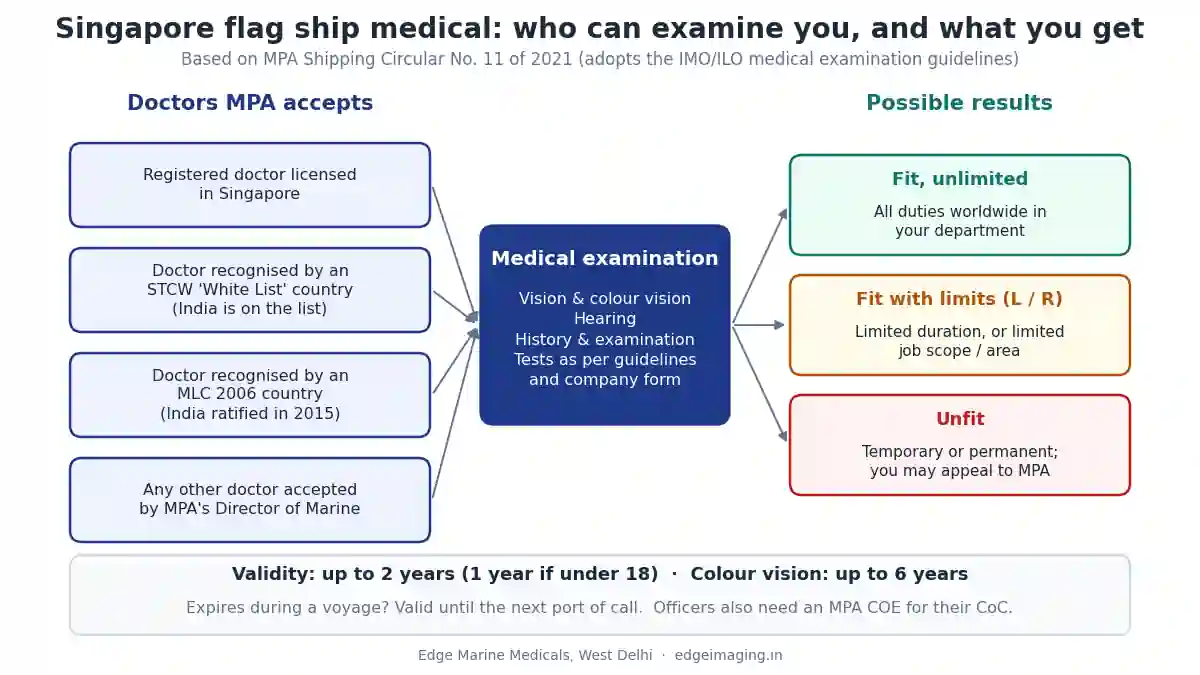
- Who can examine you: a doctor licensed in Singapore, a doctor recognised by an STCW White List country, a doctor recognised by an MLC 2006 country, or another doctor accepted by MPA’s Director of Marine
- India’s position: India is on the IMO STCW White List and ratified MLC 2006 on 9 October 2015
- Results: fit with no limits, fit with limits (L or R), or unfit (temporary or permanent)
- Validity: up to 2 years; up to 1 year if you are under 18; colour vision certification up to 6 years
- Officers: also need an MPA Certificate of Endorsement (COE) for their certificate of competency — a separate, non-medical document
What this guide covers
- What a Singapore flag medical is
- Who needs it
- Is it different from your DG Shipping medical?
- Which doctors MPA accepts
- Why a doctor recognised in India can qualify
- MPA Shipping Circular 11 of 2021 in simple words
- The medical standards used
- Documents to bring
- How to prepare the day before
- What happens on the day
- The tests, explained simply
- Eyesight and colour vision
- Hearing
- Blood pressure, sugar and long-term conditions
- The three possible results
- What a limited (L or R) certificate means
- If you are found unfit: your right to appeal
- How long the certificate is valid
- If it expires during a voyage
- Company forms and extra tests
- Officers: the MPA COE is separate
- When to book before joining
- Common mistakes that delay joining
- Singapore flag medical checklist
- For masters and senior officers
- For ratings, cadets and first-timers
- Myths and facts
- Seedhi baat: Singapore flag medical Hinglish mein
- Singapore flag medical in Delhi
- References
- Frequently asked questions
What a Singapore flag medical is
Every ship is registered in a country, called its flag State. The flag State sets the rules for that ship, including the health standard every crew member must meet. A ship registered in Singapore follows the rules of the Maritime and Port Authority of Singapore, known as MPA.
A Singapore flag medical is simply a seafarer medical examination done to the standard MPA requires, ending in a medical certificate that MPA accepts. It checks that you are fit for duty at sea and for the duties of your department — deck, engine or catering. Some companies and agents simply call it a Singapore seafarer medical or an MPA medical; they all mean the same thing.
The good news is that Singapore did not invent a completely new standard. MPA has adopted the international IMO/ILO guidelines on the medical examination of seafarers as its national requirements. These are the same international guidelines that sit behind most seafarer medicals worldwide, so the examination will feel familiar if you have done a DG Shipping medical before.
Who needs it
MPA’s crewing guidance is clear: all seafarers on Singapore-registered ships must hold a valid medical fitness certificate. That includes:
- Masters and deck officers — captains, chief officers, second and third officers
- Engineers — chief engineers, second, third and fourth engineers, electro-technical officers
- Ratings — bosuns, able seafarers, ordinary seamen, oilers, wipers and fitters
- Catering crew — cooks and stewards
- Cadets and trainees joining a Singapore-flag ship for sea time
Your company or manning agent will usually tell you the flag of your next vessel when your joining is confirmed. If they have not, ask — it decides which medical certificate and which forms you need.
Is it different from your DG Shipping medical?
This is the question almost every Indian seafarer asks first. The honest, simple answer: the examination is very similar, but what matters is that the certificate is acceptable to MPA.
Your DG Shipping medical is done to India’s rules for Indian seafarers. A Singapore flag medical is done so that the certificate meets MPA’s requirements for a Singapore-registered ship. Because both countries follow the same international conventions — STCW and MLC 2006 — and the same IMO/ILO guidelines, the tests overlap heavily.
| Point | DG Shipping medical | Singapore flag medical |
|---|---|---|
| Who sets the rules | Directorate General of Shipping, India | Maritime and Port Authority of Singapore |
| International basis | STCW, MLC 2006, IMO/ILO guidelines | STCW, MLC 2006, IMO/ILO guidelines (adopted as national requirements) |
| Who can examine | DG Shipping-approved doctor | Singapore-licensed doctor, or doctor recognised by an STCW White List or MLC country, or as accepted by MPA |
| Maximum validity | 2 years (1 year under 18) | 2 years (1 year under 18) |
| Typical tests | Vision, colour vision, hearing, blood, urine, X-ray, ECG, examination | Similar, plus anything on the company’s form |
So you do not need to fly to Singapore. What you need is a recognised doctor, the right form, and a certificate that carries the information MPA expects. Your company will tell you if they want a particular format.
Which doctors MPA accepts
MPA Shipping Circular No. 11 of 2021 lists the medical practitioners whose certificates MPA accepts for seafarers on Singapore ships. In simple words, they are:
- A registered doctor licensed to practise in Singapore who is familiar with the guidelines.
- A doctor recognised by an STCW State Party on the IMO “White List” — the list of countries the IMO has confirmed give full and complete effect to the STCW Convention.
- A doctor recognised by a State Party to MLC 2006 who is familiar with the guidelines.
- Any other doctor accepted by MPA’s Director of Marine.
The circular also asks recognised doctors to use the certificate format set out in its annex and to keep the record of each examination for at least three years. These are details for the doctor, but it helps to know them: a proper Singapore flag medical comes with a proper record behind it.
Why a doctor recognised in India can qualify
India meets both of the international tests in MPA’s list:
- STCW White List: India appears in the IMO’s list of Parties confirmed to give full and complete effect to the STCW Convention (MSC.1/Circ.1163, revision 13, dated 18 October 2021).
- MLC 2006: India ratified the Maritime Labour Convention on 9 October 2015, according to the Directorate General of Shipping.
A doctor approved by India’s Directorate General of Shipping is a doctor recognised by India for seafarer medical examinations. That is why a properly done examination by a DG Shipping-approved doctor in India can produce a certificate acceptable for a Singapore-flag ship — as long as it follows the guidelines and the format the company and MPA expect.
You can check whether a doctor is DG Shipping-approved yourself. Our guide on how to verify a DG Shipping approved doctor shows you how.
MPA Shipping Circular 11 of 2021 in simple words
MPA publishes its rules for ship owners and seafarers as “shipping circulars”. The one that matters here is Shipping Circular No. 11 of 2021, dated 30 September 2021, titled “Guidelines on the medical examination of seafarers and seafarer’s medical certificate”. It replaced the earlier Circular No. 5 of 2020.
Here is what it says, in plain language:
- The standard: MPA has adopted the IMO/ILO guidelines on the medical examination of seafarers as Singapore’s national requirements.
- The certificate: it must carry the minimum information required by the STCW Convention and follow the medical standards in the guidelines, in line with MLC 2006.
- The doctors: the four groups listed above.
- Validity: not more than two years; not more than one year for seafarers under 18.
- Expiry at sea: if it expires during a voyage, it remains valid until the next port of call.
- Results: fit for all duties, fit with limitations, or unfit — temporarily or permanently.
- Appeal: a seafarer who is refused a certificate or given a limitation can ask the Director of Marine for a review by another independent doctor.
- Deployment: managers and masters must only assign seafarers to duties they are medically fit for — for example, only those meeting deck eyesight, colour vision and hearing standards should keep a bridge watch or lookout.
The medical standards used
The IMO/ILO guidelines that MPA has adopted are a long, detailed document written for doctors. They do three main things:
- Set minimum standards for eyesight, colour vision and hearing, which are different for deck and engine duties.
- Guide the doctor on hundreds of medical conditions — whether each is compatible with sea service, needs a limitation, or is a reason for temporary or permanent unfitness.
- Ask the doctor to think about life at sea: long periods far from hospitals, heavy physical work, emergencies, heat, cold and motion.
The key idea is individual assessment. Very few conditions mean automatic failure. Most decisions depend on how severe a condition is, how well it is controlled, and what your job on board involves. That is why bringing your medical records helps you.
Documents to bring
Bring originals and one set of photocopies of:
- CDC (Continuous Discharge Certificate)
- Passport
- INDoS number
- Certificate of competency, if you are an officer
- Previous medical certificate(s), DG Shipping and any flag medicals
- The company’s medical form or letter mentioning the vessel and flag, if they gave you one
- Recent passport-size photographs
- Glasses or contact lenses you use
- A list of your regular medicines and any recent reports, discharge summaries or specialist letters
The company form is the single most useful document. It tells the doctor exactly which tests and which format your employer wants, so everything can be done in one visit.
How to prepare the day before
- Fasting: follow the instruction you are given. Blood sugar is usually tested fasting, so do not eat from the night before. Water is fine.
- Sleep well. Tiredness can raise blood pressure and affect eye tests.
- Avoid alcohol for at least a day before. It affects blood tests and blood pressure.
- Take your regular medicines — especially blood pressure tablets — unless a doctor tells you otherwise.
- Avoid loud noise such as loud music through earphones, as it can temporarily affect hearing tests.
- Keep documents in one folder the night before, so nothing is left behind.
What happens on the day
The exact order can vary, but a Singapore flag medical usually follows these steps:
- Registration: your documents are checked and your details entered.
- Health questionnaire: you answer questions about past illnesses, operations, medicines and your health at sea. Answer honestly.
- Samples: blood and urine are collected, usually fasting.
- Vision and colour vision: distance and near vision with and without glasses, and colour vision.
- Hearing: a hearing check, often audiometry.
- Chest X-ray and ECG as required by the guidelines and your company form.
- Doctor’s examination: heart, lungs, abdomen, joints, skin, mental well-being and general fitness.
- Decision and certificate: once every result is reviewed, the doctor decides and, if you are fit, issues the certificate.
If you arrive early with everything ready and your results are normal, this is often completed the same day. Our guide to the same-day DG medical explains what helps and what delays it.
The tests, explained simply
| Test | What it checks | What you should know |
|---|---|---|
| Vision | How clearly you see at a distance and close up | Bring and wear your glasses or lenses |
| Colour vision | Whether you can tell colours apart, for lights and signals | Especially important for deck officers and lookouts |
| Hearing | How well you hear speech and sounds | Avoid loud noise before the test |
| Blood tests | Sugar, blood count and other values as required | Usually fasting |
| Urine test | Sugar, protein and signs of infection or kidney problems | A simple sample |
| Chest X-ray | Lungs and heart shadow | Tell staff if you might be pregnant |
| ECG | Heart rhythm and electrical activity | Painless, takes a few minutes |
| Physical examination | Overall fitness for the work and emergencies at sea | Done by the doctor |
Some companies add extra tests on their own form. These are in addition to the flag medical and are explained in the section on company forms below.
Eyesight and colour vision
Good eyesight is one of the most important parts of any seafarer medical, because lookouts and watchkeepers must see lights, buoys and other ships in time. The IMO/ILO guidelines set minimum vision standards, which are stricter for deck duties than for engine duties.
- Glasses and contact lenses are allowed for meeting the standard in most cases, but you must carry a spare pair on board.
- Colour vision is critical for deck officers and lookouts, who must recognise navigation lights.
- Near vision often changes after 40. Bring your reading glasses.
MPA’s circular makes the practical point clearly: only seafarers who meet the deck department’s eyesight, colour vision and hearing requirements should keep a bridge watch or act as lookout. For the detailed numbers, read our guide to DG Shipping medical eyesight requirements, which uses the same international standard.
Hearing
Hearing matters for responding to orders, alarms, radio messages and emergencies. The guidelines set a minimum hearing standard, and many centres use audiometry — a simple test with headphones in a quiet room — to measure it accurately.
Long years in engine rooms can reduce hearing gradually, often without you noticing. If your hearing has changed, it is better to know early. Our guide to the audiometry test explains what the test involves and how to read the result.
Blood pressure, sugar and long-term conditions
High blood pressure and diabetes are common among experienced seafarers. Having one of these conditions does not automatically make you unfit. The doctor looks at how well it is controlled, what medicines you take, whether there are complications, and what your job on board involves.
To give yourself the best chance:
- Take your medicines regularly in the weeks before the medical, not just the day before.
- Bring recent readings, reports and your doctor’s notes.
- Do not stop a medicine on your own to “look normal” — it can make readings worse and is unsafe.
Other long-term conditions — thyroid problems, asthma, past heart disease, epilepsy, mental health conditions — are also assessed individually. Complete papers help the doctor decide quickly. Our guide to blood pressure and diabetes limits for the seafarer medical covers this in more detail.
The three possible results
MPA’s circular describes three categories of result:
| Result | What it means |
|---|---|
| Fit, without limitations | Fit for all duties worldwide within your designated department |
| Fit, with limitations | Fit for some, but not all, routine and emergency duties, or only for certain areas — for example, within 30 miles of a port. This includes certificates of limited duration (L) and restricted job scope (R). |
| Unfit | Not fit for sea service, either temporarily or permanently |
Most seafarers who prepare well and have no serious health problem receive the first result. The other two exist to protect you and your crew, not to punish you.
What a limited (L or R) certificate means
A limited certificate is not a failure. It means the doctor has found you fit to work, but with a condition attached:
- Limited duration (L): the certificate is valid for a shorter time than usual, for example because a condition needs to be checked again soon.
- Restricted job scope (R): you can do some duties but not others, or only in certain areas, such as near a port.
What this means for your job depends on your company and your vessel. A restricted certificate may not suit an ocean-going ship that needs every crew member for all emergency duties. Talk to your company openly. In many cases, treatment and a repeat assessment can lead to an unlimited certificate later.
If you are found unfit: your right to appeal
Being told you are unfit is upsetting, especially when a joining is waiting. Remember two things:
- Many unfit decisions are temporary. A raised blood pressure, high sugar, an infection or an unclear X-ray can often be treated or clarified, and you can be re-examined.
- You have a right to a review. Under MPA’s circular, a seafarer who is refused a certificate, or given a limitation, may appeal to the Director of Marine for a review by another independent medical practitioner.
Ask the doctor to explain the reason clearly, and what would need to change. Keep copies of all your reports. Our guide on common unfit reasons and how to prepare explains the most frequent causes and what you can do.
How long the certificate is valid
Under MPA’s circular, which follows MLC 2006:
- A seafarer’s medical certificate is valid for not more than two years.
- If you are under 18, it is valid for not more than one year.
- Under the IMO/ILO guidelines, colour vision certification can remain in force for up to six years.
A doctor can issue a certificate for a shorter period if your health needs to be reviewed sooner. Always check the expiry date printed on your certificate — it is the date that counts. Our guide to seafarer medical certificate validity explains how to check it before you sign on.
If it expires during a voyage
MPA’s circular says that if your medical certificate expires in the course of a voyage, it remains valid until the next port of call. Under MLC 2006, this extension applies until the next port where a recognised doctor is available, and cannot be longer than three months.
This is a safety net, not a plan. Companies and port inspectors look closely at certificate dates. The simplest approach is to renew your medical before you sign on if it will expire during your contract.
Company forms and extra tests
Many shipping companies and managers ask for their own pre-employment medical examination (PEME) form in addition to the flag medical. These forms can add tests such as:
- Additional blood tests
- Drug and alcohol screening
- Fitness or exercise tests
- Dental checks
- Vaccination records
These are the company’s requirements, not MPA’s, but you will need them to join. Ask for the company form in advance and bring it with you, so all tests can be done in one visit. Our guide to pre-employment medical tests explains common company add-ons.
Officers: the MPA COE is separate
If you are an officer, there is one more document to think about. MPA requires officers on Singapore ships to hold a certificate of competency (CoC) from a country Singapore recognises and a Certificate of Endorsement (COE) issued by MPA.
The COE is not a medical document, but it often travels with the medical in the same joining checklist. According to MPA’s crewing guidance:
- The COE is valid for five years from the date of issue, but not beyond the expiry of your CoC.
- Applications are made through MPA’s online system, usually by your company.
- A receipt of acknowledgement can be used to sign on for up to three months while the COE is being processed.
Your company handles most of this. Just make sure they have your CoC details early, alongside your medical.
When to book before joining
- Ideal: as soon as your joining and vessel are confirmed, and ideally a week or more before travel. This leaves time for any repeat test.
- If your current certificate is expiring: plan the renewal a few weeks before expiry, especially if it would expire during your next contract.
- If joining is urgent: come early in the morning, fasting, with every document. Many seafarers complete it the same day.
Leaving the medical to the last day is the most common reason for stress. A small delay — one missing form, one high reading — can then affect your flight.
Common mistakes that delay joining
- Not knowing the flag. Doing the wrong format and having to repeat it.
- Forgetting the company form. The extra tests then need another visit.
- Arriving late in the day. Blood reports need time.
- Eating before blood tests when fasting was required.
- Stopping medicines before the medical, causing high readings.
- Not bringing glasses for the vision test.
- Hiding a past illness, which can cause bigger problems later.
- Not checking the certificate for spelling, numbers and dates before leaving.
Singapore flag medical checklist
Take a screenshot of this list and tick it off the night before.
| Item | Done? |
|---|---|
| Vessel flag confirmed as Singapore | ☐ |
| Company medical form or letter | ☐ |
| CDC, passport, INDoS number (originals and copies) | ☐ |
| CoC (officers) | ☐ |
| Previous medical certificates | ☐ |
| Passport-size photographs | ☐ |
| Glasses or contact lenses | ☐ |
| List of medicines and recent reports | ☐ |
| Fasting from the night before (if told) | ☐ |
| Good sleep, no alcohol, regular medicines taken | ☐ |
For masters and senior officers
Captains and senior officers take the same examination as everyone else, but a few points matter more with age and command responsibility:
- Vision and colour vision for navigation and lookout duties are checked carefully.
- Heart health: if you have had any heart problem, bring your cardiologist’s notes and recent ECG or echo reports.
- Blood pressure and sugar: bring your readings and medicines.
- Emergency fitness: the doctor considers whether you can lead in an emergency, because the master must.
Age alone is not a reason to be found unfit. What matters is your health on the day and how well any condition is controlled.
For ratings, cadets and first-timers
If this is your first flag medical, do not worry. The process is the same as your DG medical. A few tips:
- Answer the questionnaire honestly. Most conditions are compatible with sea service when declared and controlled.
- Know your colour vision. If you have been told before that you have a colour vision problem, mention it, as it affects deck duties.
- Keep copies of every certificate and report. They become your health history.
- Ask questions. If you do not understand a result, ask the doctor to explain it simply.
Myths and facts
| Myth | Fact |
|---|---|
| “A Singapore flag medical can only be done in Singapore.” | MPA accepts certificates from doctors recognised by STCW White List and MLC countries. India is both. |
| “It is a completely different, much harder test.” | MPA uses the international IMO/ILO guidelines, which are the same basis as most seafarer medicals. |
| “If I have BP or diabetes, I will fail.” | Well-controlled conditions are assessed individually and are often compatible with sea service. |
| “Unfit means my career is over.” | Many unfit decisions are temporary, and MPA allows an appeal for review by an independent doctor. |
| “My certificate expired at sea, so I am breaking the rules.” | It remains valid until the next port of call, within the MLC three-month limit. |
| “The COE is part of the medical.” | The COE is a separate MPA endorsement for officers’ CoCs, not a medical document. |
Seedhi baat: Singapore flag medical Hinglish mein
Singapore flag medical kya hai? Agar aapka jahaz Singapore me registered hai, to aapko ek medical certificate chahiye jo Singapore ki authority, MPA, accept kare. Isi ko Singapore flag medical kehte hain.
Kya India me ho sakta hai? Haan. MPA un doctors ka certificate accept karta hai jo STCW White List wale ya MLC 2006 wale desh se recognised hon. India dono me hai. Isliye DG Shipping-approved doctor sahi format me yeh medical kar sakta hai.
Singapore flag medical kaise hota hai? Bilkul DG medical jaisa: registration, khali pet blood aur urine test, aankh aur colour vision, hearing test, chest X-ray, ECG aur doctor ka examination. Company ka form ho to uske extra tests bhi saath me.
Kitne din me milta hai? Agar aap subah jaldi, khali pet, saare documents ke saath aate ho aur reports normal hain, to aksar usi din mil jata hai. Koi report dobara check karni pade to thoda time lag sakta hai.
Kitne time valid rehta hai? Maximum 2 saal. 18 saal se kam umar ho to maximum 1 saal. Colour vision certification 6 saal tak.
Kya laana hai? CDC, passport, INDoS number, purana medical certificate, company ka form, photos, chashma aur dawaiyon ki list.
Singapore flag medical in Delhi
Edge Marine Medicals is the seafarer medical centre of Edge Imaging & Diagnostics, at B-568-569, Raghubir Nagar, Tagore Garden Extension, New Delhi 110027. Our DG Shipping-approved doctor in Delhi examines seafarers for Singapore-flag ships, with vision and colour vision testing, audiometry, pathology, chest X-ray, ECG and the doctor’s examination under one roof.
If you also need your Indian medical, see our DG Shipping ILO medical in Delhi. For a full overview of the rules, our DG Shipping approved medical guide is a good place to start. Joining a Marshall Islands ship instead? Read our Marshall Island medical (MI-105M) guide.
Joining a Singapore-flag ship? Send us a WhatsApp message with your rank, vessel flag, joining date and company form. We will confirm the earliest slot, what to bring, how to prepare, and today’s actual pricing.
💬 WhatsApp Edge Marine Medicals for your Singapore flag medical | Call 9599941470
References
- Shipping Circular No. 11 of 2021: Guidelines on the medical examination of seafarers and seafarer’s medical certificate — Maritime and Port Authority of Singapore.
- Overview of crewing a Singapore ship — Maritime and Port Authority of Singapore.
- MSC.1/Circ.1163/Rev.13: Parties to the STCW Convention — International Maritime Organization.
- Maritime Labour Convention — Directorate General of Shipping, India.
- Guidelines on the medical examinations of seafarers — ILO/IMO.
Frequently asked questions
What is a Singapore flag medical?
It is the seafarer medical examination needed to work on a Singapore-registered ship, ending in a medical certificate accepted by the Maritime and Port Authority of Singapore (MPA).
Can I do a Singapore flag medical in India?
Yes. MPA accepts certificates from doctors recognised by an STCW White List country or an MLC 2006 country. India is both, so a recognised doctor in India can examine you in the required format.
Is my DG Shipping medical valid for a Singapore ship?
The examination is very similar, but the certificate must meet MPA’s requirements and the company’s format. Ask your company which form they need before your medical.
Which doctors can issue an MPA medical certificate?
A doctor licensed in Singapore, a doctor recognised by an STCW White List country, a doctor recognised by an MLC 2006 country, or any other doctor accepted by MPA’s Director of Marine.
Which MPA rule covers seafarer medicals?
MPA Shipping Circular No. 11 of 2021, dated 30 September 2021. It adopts the IMO/ILO guidelines on medical examination of seafarers as Singapore’s national requirements.
How long is a Singapore flag medical certificate valid?
Up to two years, or up to one year if you are under 18. Colour vision certification can remain in force for up to six years. The expiry date on your certificate is what counts.
What happens if my certificate expires at sea?
It remains valid until the next port of call. Under MLC 2006, this extension cannot be longer than three months.
Which tests are done in a Singapore flag medical?
Usually vision and colour vision, hearing, blood and urine tests, chest X-ray, ECG and a full examination by the doctor, plus any tests on your company’s form.
Do I need to fast?
Usually yes, from the night before, because blood sugar is tested. Water is allowed. Take your regular medicines unless told otherwise.
Can I pass with high blood pressure or diabetes?
Often yes, if the condition is well controlled. The doctor assesses each case individually. Bring your medicines, readings and reports.
What does an L or R certificate mean?
L means a certificate of limited duration. R means restricted job scope or area, such as work near a port. Both mean you are fit, but with a limitation.
Can I appeal if I am found unfit?
Yes. Under MPA’s circular, a seafarer refused a certificate or given a limitation may appeal to the Director of Marine for a review by another independent doctor.
Is the COE part of the medical?
No. The Certificate of Endorsement (COE) is a separate MPA document for officers’ certificates of competency. It is valid for five years, but not beyond your CoC’s expiry.
How early should I book my Singapore flag medical?
As soon as your vessel and joining are confirmed, ideally a week or more before travel. If it is urgent, come early in the morning, fasting, with all documents.
Singapore flag medical kaise hota hai?
DG medical jaisa hi hota hai: registration, khali pet blood aur urine test, aankh aur colour vision, hearing, chest X-ray, ECG aur doctor ka examination. Company form ho to uske tests bhi.
Singapore flag medical kitne din me milta hai?
Agar aap subah jaldi saare documents ke saath aate ho aur reports normal hain, to aksar usi din mil jata hai. Koi report dobara check karni pade to time lag sakta hai.
Where can I get a Singapore flag medical in Delhi?
Edge Marine Medicals, Raghubir Nagar, Tagore Garden Extension, West Delhi. WhatsApp or call 9599941470 for the earliest slot, what to bring and today’s actual pricing.
The bottom line
A Singapore flag medical is not a mystery. MPA follows the same international IMO/ILO guidelines that sit behind most seafarer medicals, and it accepts certificates from doctors recognised by STCW White List and MLC 2006 countries — which includes India.
Confirm your vessel’s flag, get your company’s form, bring every document, arrive early and fasting, and be honest about your health. Do that, and for most seafarers the Singapore flag medical is a smooth, one-day process.
Written by the medical team at Edge Marine Medicals and Edge Imaging & Diagnostics, West Delhi. Medically reviewed by Dr. Nishant Thapar. Last reviewed: October 2026.
Disclaimer: this article is general information for seafarers based on MPA’s published guidance at the time of writing. Rules can change; always confirm current requirements with your company and MPA. Fitness decisions are made by the examining doctor according to the applicable standards for your rank and duties.