
 PV
 TG
 MN
 EM
 EI
 ND

 CT Scan
 PET CT
 Digital X-ray
 Ultrasound
 Amniocentesis

 Fetal Reduction
 Thermalytix Breast Screening
 Cardiology
 Lab Tests
 GAMCA Pre-Medical
An audiometry test is a hearing test that measures the softest sounds you can hear at different pitches in each ear. The most common type, pure tone audiometry, is done in a sound-treated booth with headphones and produces an audiogram, a chart of your hearing thresholds in decibels.
You may need an audiometry test because you are struggling to follow conversations, because of ringing in the ears, because you work around noise, or because it is a required part of a seafarer or pre-employment medical. Whatever the reason, the result is usually handed over as an audiogram — a graph with circles, crosses and shaded bands that few people are ever taught to read.
This guide explains what an audiometry test is, the different hearing tests, how to prepare, what happens in the booth, how to read your audiogram, what the grades of hearing loss mean, how noise damages hearing, and the hearing standards used for seafarers and occupational medicals. It is general information; your doctor or audiologist interprets your own result.
Audiometry test at a glance
- What it measures: the quietest sound you can hear at each pitch (frequency), separately in each ear
- Main type: pure tone audiometry, often with speech tests and tympanometry
- Time: about 20 to 30 minutes for a standard pure tone test
- Pain: none — you listen for beeps and press a button
- Result: an audiogram, with thresholds in decibels hearing level (dB HL)
- Normal hearing: thresholds of 20 dB or better
- Seafarers (ILO/IMO guideline): unaided average of at least 30 dB in the better ear and 40 dB in the other ear, at 500 to 3,000 Hz
What this guide covers
- What an audiometry test is
- How hearing works, in brief
- Who needs an audiometry test
- Types of hearing test
- How to prepare
- What happens during pure tone audiometry
- How to read an audiogram
- Grades of hearing loss
- Conductive, sensorineural and mixed hearing loss
- Noise-induced hearing loss and the 4 kHz notch
- Age-related hearing loss
- Tinnitus and the audiometry test
- Audiometry for seafarers: the hearing standard
- Audiometry for seafarers: practical tips before your medical
- Engine room and deck: why hearing matters differently
- What the audiogram tells a hearing aid fitter
- Audiometry in pre-employment and occupational medicals
- If your audiometry is abnormal: what next
- Sudden hearing loss: an urgent problem
- Hearing tests in babies and children
- How to protect your hearing
- Myths and facts
- Questions to ask
- Audiometry test in Delhi
- References
- Frequently asked questions
What an audiometry test is
Audiometry means the measurement of hearing. In an audiometry test, sounds of known pitch and loudness are played to each ear in turn, and the quietest sound you can reliably hear — your threshold — is recorded. The threshold is formally the lowest level at which you detect the tone about half the time it is played.
Pitch is measured in hertz (Hz). Low notes, like a drum, are around 250 to 500 Hz; most speech sounds sit between about 500 and 4,000 Hz; high-pitched sounds, like a whistle or the consonants “s” and “f”, are 4,000 Hz and above. Loudness is measured in decibels hearing level (dB HL), where 0 dB represents the quietest sound that a young adult with normal hearing can just detect. The higher the threshold in dB, the louder a sound has to be before you hear it — and the poorer the hearing at that pitch.
The test is objective in its equipment but relies on your responses, so a calm, attentive approach and a quiet environment matter. Done properly, it is quick, painless and highly informative.
How hearing works, in brief
Sound passes through three parts of the ear:
- The outer ear — the ear canal — channels sound to the eardrum.
- The middle ear — the eardrum and three tiny bones — amplifies the vibrations and passes them inwards.
- The inner ear — the cochlea — turns vibrations into nerve signals, which travel along the hearing nerve to the brain.
A problem in the outer or middle ear, such as wax, fluid or a perforated eardrum, causes conductive hearing loss. Damage to the cochlea or the hearing nerve, from age, noise, some medicines or other causes, causes sensorineural hearing loss. Audiometry can tell these apart by testing hearing in two ways, through the air and through the bone, as explained below.
Who needs an audiometry test
Common reasons for an audiometry test include:
- Difficulty hearing conversations, especially in noisy places or on the phone
- Family members complaining that the television is too loud
- Ringing, buzzing or hissing in the ears (tinnitus)
- Ear infections, discharge or a blocked feeling that does not settle
- Dizziness or vertigo with hearing symptoms
- Hearing that is different in the two ears
- Working in noise — engine rooms, factories, construction, airports, the armed forces
- Seafarer medicals and many pre-employment and periodic occupational medicals
- Monitoring hearing during treatment with medicines that can affect the ear
- Before and after ear surgery, and to fit hearing aids
The World Health Organization estimates that more than 430 million people worldwide have disabling hearing loss, and that over a quarter of people older than 60 are affected. Much of it is gradual, which is why many people do not realise how much they are missing until it is measured.
Types of hearing test
| Test | What it does | Typical use |
|---|---|---|
| Pure tone audiometry (air conduction) | Tones through headphones at 250 to 8,000 Hz to find the threshold in each ear | The standard hearing test for adults, occupational and seafarer medicals |
| Pure tone audiometry (bone conduction) | A small vibrator behind the ear bypasses the outer and middle ear | Separating conductive from sensorineural loss |
| Speech audiometry | Recorded words at different volumes to test understanding | How well speech is understood; hearing aid planning |
| Tympanometry (impedance) | Measures how the eardrum moves with air pressure changes | Fluid behind the eardrum, Eustachian tube problems, perforations |
| Otoacoustic emissions (OAE) | Detects tiny echoes produced by a healthy cochlea | Newborn hearing screening; children |
| Brainstem evoked response audiometry (BERA) | Records the hearing nerve’s electrical response to clicks | Babies, people who cannot respond reliably, nerve problems |
| Whisper and speech tests | Hearing whispered or spoken words at set distances | Quick screening, including for deck duties at sea |
For most adults, “audiometry test” means pure tone audiometry, sometimes combined with tympanometry and speech testing.
How to prepare
- Rest your ears. Avoid loud noise — machinery, loud music, firecrackers, shooting — for at least the day before the test. Recent noise can cause a temporary dip in hearing that makes the result look worse than your true baseline. For occupational baseline tests, a quiet period of about half a day or more is commonly advised.
- Ear wax. Heavy wax can block sound. If your ears feel blocked, have them checked beforehand; do not push cotton buds into the canal.
- Colds and ear infections can temporarily reduce hearing. If you have one, mention it; a repeat test may be advised once it settles.
- Bring previous audiograms, your hearing aids if you use them, and a list of medicines.
- Arrive on time and relaxed. No fasting or other preparation is needed.
What happens during pure tone audiometry
- A short history is taken: your symptoms, noise exposure, ear problems and medicines. The ear canals may be checked.
- You sit in a sound-treated booth and put on headphones or insert earphones.
- Tones are played to one ear at a time, starting at a comfortable level and then getting quieter, at frequencies usually from 250 to 8,000 Hz.
- You press a button or raise your hand every time you hear a beep, however faint.
- The level is moved up and down to find your threshold at each frequency.
- If needed, a bone conduction test is done with a small vibrator behind the ear.
- When the two ears differ, a gentle masking noise is played into the better ear so it cannot “help” the ear being tested.
- Speech tests or tympanometry may follow.
A tip that improves accuracy: press for every beep you think you hear, even very faint ones. Guessing occasionally is fine; the method is designed to find a reliable threshold.
How to read an audiogram
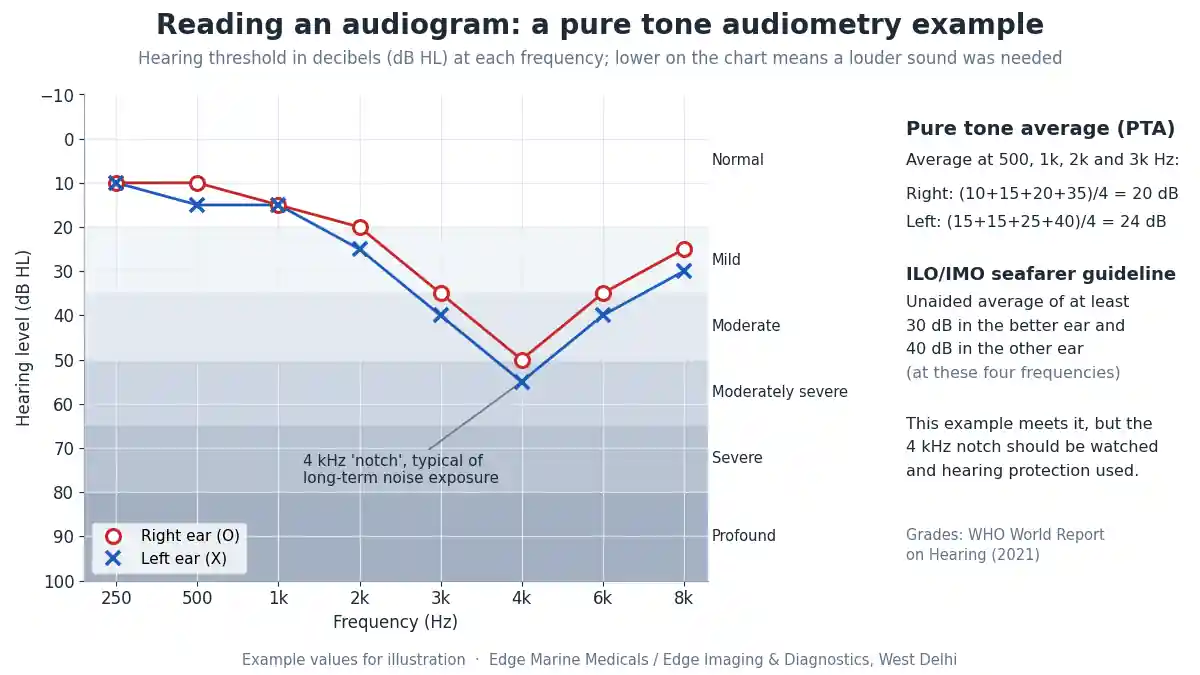
An audiogram is a graph of your hearing thresholds.
- Across the bottom is pitch (frequency), from low on the left to high on the right.
- Down the side is loudness in dB HL, with quiet sounds at the top and loud sounds at the bottom. A point lower on the chart means poorer hearing at that pitch.
- Symbols: by convention, the right ear is shown with red circles (O) and the left ear with blue crosses (X). Bone conduction results are shown with brackets or arrow-like symbols.
- Shaded bands on many audiograms show the grade of hearing loss.
The pure tone average (PTA) is the average threshold across key speech frequencies, often 500, 1,000, 2,000 and 3,000 or 4,000 Hz. It condenses the audiogram into a single number for each ear, which is how many standards are applied. In the example above, the right ear averages 20 dB and the left 24 dB across 500 to 3,000 Hz.
Look also at the shape: a dip at 4,000 Hz with recovery at 6,000 to 8,000 Hz suggests noise damage; a steady downward slope at high frequencies suggests age-related loss; a gap between air and bone results suggests a conductive problem.
Grades of hearing loss
Hearing loss is graded by the average threshold in the better ear. The World Health Organization considers a person to have hearing loss if they cannot hear as well as someone with thresholds of 20 dB or better in both ears, and describes hearing loss greater than 35 dB in the better ear as disabling. The commonly used grades are:
| Grade | Average threshold (better ear) | What it usually means in daily life |
|---|---|---|
| Normal | Up to 20 dB | No difficulty hearing speech |
| Mild | 20 to under 35 dB | Usually fine in quiet; may struggle in noise |
| Moderate | 35 to under 50 dB | Difficulty with conversational speech, especially in noise |
| Moderately severe | 50 to under 65 dB | Difficulty with most conversation; raised voices needed |
| Severe | 65 to under 80 dB | Most speech not heard without amplification |
| Profound | 80 to under 95 dB | Extreme difficulty hearing even loud sounds |
| Complete | 95 dB or more | No usable hearing |
Conductive, sensorineural and mixed hearing loss
- Conductive hearing loss: air conduction is reduced but bone conduction is normal, creating an “air-bone gap”. Causes include wax, fluid behind the eardrum, infection, a perforated eardrum and stiffening of the middle-ear bones (otosclerosis). Many are treatable medically or surgically.
- Sensorineural hearing loss: air and bone thresholds are both reduced, with no gap. Causes include ageing, noise, some medicines, infections, genetic factors and, rarely, a tumour on the hearing nerve. It is usually permanent, but hearing aids and other devices help.
- Mixed hearing loss: a combination of both.
Tympanometry adds information about the middle ear: a flat tracing suggests fluid behind the eardrum or a perforation, while a normal tracing points away from a middle-ear cause.
Noise-induced hearing loss and the 4 kHz notch
Long-term exposure to loud noise damages the delicate hair cells of the cochlea. The damage typically shows first as a dip — a “notch” — around 3,000 to 6,000 Hz, classically at 4,000 Hz, with better hearing again at 8,000 Hz. At first, speech frequencies may be largely spared, so the person may not notice; later the loss spreads and conversations in noise become difficult. Ringing in the ears often accompanies it.
Noise-induced hearing loss is permanent but preventable. It is common among engine-room crew, factory and construction workers, drivers of heavy vehicles, musicians and people who use firearms. Regular audiometry in noisy jobs picks up early changes before they affect daily life, so that hearing protection and exposure can be improved.
Age-related hearing loss
Hearing naturally declines with age, starting with the highest frequencies and usually affecting both ears equally. On the audiogram this appears as a gradual downward slope towards the right. People often first notice difficulty following conversations in restaurants, missing the end of words, or hearing women’s and children’s voices less clearly. Untreated hearing loss in later life is linked with social isolation, and modern hearing aids can make a significant difference. An audiometry test is the first step towards a properly fitted aid.
Tinnitus and the audiometry test
Tinnitus — ringing, buzzing or hissing in the ears — is very common, and an audiometry test is one of the first investigations. Most people with tinnitus have some hearing loss, often noise- or age-related, and the audiogram helps identify it. Tinnitus in only one ear, especially with hearing loss on the same side, needs further assessment by an ENT specialist and sometimes imaging. Pulsing tinnitus in time with the heartbeat also needs specialist review.
Audiometry for seafarers: the hearing standard
Good hearing is a safety requirement at sea: seafarers must hear alarms, radio messages, orders on deck and in the engine room, and warnings in an emergency. Hearing is therefore assessed in every seafarer medical, and audiometry is part of the DG Shipping-approved medical examination performed in India.
The international ILO/IMO Guidelines on the medical examinations of seafarers recommend that hearing be tested with a pure tone audiometer, and set the following benchmark:
- An average of at least 30 dB (unaided) in the better ear and 40 dB (unaided) in the less good ear, across 500, 1,000, 2,000 and 3,000 Hz — roughly equivalent to hearing speech at 3 metres and 2 metres respectively
- Those on deck or bridge duties should be able to hear whispered speech at 3 metres
- Hearing aids are acceptable only for serving seafarers — not new entrants — and only when the person can perform their duties safely, with a back-up aid and arrangements to be woken reliably by an emergency alarm
- National authorities specify which tests are used, and different criteria apply where noise-induced hearing loss is assessed within a health surveillance programme
The DG Shipping-approved doctor applies the standard prescribed for your certificate, rank and department. If a result is borderline, common practical steps are to have ear wax removed, rest the ears from noise and repeat the test, and to obtain an ENT opinion where needed. Our guide to why seafarers are declared unfit and how to pass covers hearing among other common issues, and our page on the DG Shipping ILO medical in Delhi explains the full examination.
Engine-room crew in particular should keep copies of every audiogram. Comparing them over the years shows whether hearing is stable, and an early 4 kHz notch is a signal to take hearing protection seriously long before it threatens fitness for duty.
Audiometry for seafarers: practical tips before your medical
Most failed or borderline hearing results in seafarer medicals have a simple, avoidable cause. These steps help audiometry for seafarers reflect true hearing:
- Come off a noisy duty period rested. If you have just signed off from engine-room work or travelled on a noisy journey, allow your ears a full day of quiet before the test where possible.
- Clear ear wax beforehand. Wax is one of the commonest reasons for an unexpectedly poor result.
- Do not test with a cold or ear infection. Mention it to the doctor; the test can be deferred or repeated.
- Bring old audiograms and medical certificates. They show whether any change is new or long-standing.
- Respond to every faint beep. Waiting until you are completely sure tends to make thresholds look worse than they are.
- Be honest about hearing aids or past ear surgery. The doctor can then apply the correct standard and arrange any specialist opinion.
Engine room and deck: why hearing matters differently
Engine-room ratings and engineers spend long periods in some of the noisiest workplaces at sea, which is why noise-induced hearing loss is most often seen in this group and why periodic audiometry matters so much for them. Wearing hearing protection consistently in machinery spaces, and keeping each audiogram for comparison, are the most effective ways to protect a career at sea.
Deck and bridge officers rely on hearing for radio communication, whistle signals, alarms and spoken orders in wind and weather. That is why the ILO/IMO guidelines add a practical whispered-speech test at 3 metres for deck and bridge duties. Catering and other departments also need to hear alarms reliably, so the core hearing benchmark applies across all departments.
What the audiogram tells a hearing aid fitter
If hearing aids are recommended, the audiogram is the blueprint for programming them. The fitter uses the thresholds at each frequency to decide how much amplification is needed at each pitch, so that speech becomes clearer without loud sounds becoming uncomfortable. Speech audiometry results help set realistic expectations, because understanding speech depends on the health of the inner ear and nerve as well as on volume. A recent, accurate audiogram is therefore essential before buying or adjusting hearing aids.
Audiometry in pre-employment and occupational medicals
Many employers include an audiometry test in pre-employment and periodic medicals, especially where staff work in noise or where hearing is essential for safety — manufacturing, mining, construction, aviation ground staff, transport, security and the armed forces. A baseline audiogram at joining records hearing before any workplace noise exposure, and later tests are compared against it. This protects both the worker, by detecting early damage, and the employer, by documenting the starting point.
For a baseline test to be accurate, the ears should have rested from loud noise beforehand, as described in the preparation section.
If your audiometry is abnormal: what next
| Finding | Usual next step |
|---|---|
| Conductive loss with wax | Wax removal, then repeat test |
| Conductive loss with fluid or infection | ENT review, tympanometry, treatment and repeat test |
| Symmetrical high-frequency sensorineural loss | Explanation, noise protection, monitoring; hearing aids if affecting daily life |
| Asymmetrical sensorineural loss (one ear clearly worse) | ENT assessment; imaging such as MRI of the internal ear canals may be advised |
| Middle-ear or bone abnormality suspected | ENT assessment; sometimes an HRCT temporal bone scan |
| Borderline result in a fitness medical | Repeat after ear rest and wax clearance; ENT opinion if still borderline |
Sudden hearing loss: an urgent problem
Hearing loss that comes on suddenly, over hours or a few days, usually in one ear, sometimes with ringing, fullness or dizziness, is called sudden sensorineural hearing loss. It is a medical urgency: seek an ENT assessment as soon as possible, ideally the same day, because early treatment gives the best chance of recovery. Do not assume it is just wax or a cold without having it checked.
Hearing tests in babies and children
Babies and young children cannot press a button, so different tests are used. Newborn hearing screening commonly uses otoacoustic emissions or automated brainstem response tests. Toddlers can be tested with play-based or visual reinforcement audiometry, and older children with conventional pure tone audiometry. Signs that a child needs a hearing test include delayed speech, not responding to their name, turning the television up loudly, or frequent ear infections. Early detection makes a large difference to speech and learning.
How to protect your hearing
- Wear well-fitted ear plugs or ear muffs in noisy workplaces, engine rooms and during loud hobbies
- Limit the volume and duration of headphone use; if others can hear your music, it is too loud
- Take breaks from noise, and move away from loudspeakers at events
- Do not put cotton buds or objects into the ear canal
- Get ear infections treated promptly
- Ask your doctor about medicines that can affect hearing if you need long-term treatment
- Have regular audiometry if you work in noise
Myths and facts
| Myth | Fact |
|---|---|
| If I can hear conversation, my hearing is fine | Noise damage often starts at high pitches that conversation in quiet does not test |
| Hearing loss only affects older people | Noise, infections and other causes affect people of all ages |
| An audiometry test is uncomfortable | It is painless; you simply listen and respond to beeps |
| One bad result means I will fail my medical | Wax, a cold or recent noise can lower a result; a repeat test after ear rest is often appropriate |
| Ringing in the ears is nothing to worry about | It often accompanies hearing loss and deserves a hearing test |
| Hearing aids are only for severe deafness | Modern aids help many people with mild to moderate loss |
Questions to ask
- What is my pure tone average in each ear?
- Is my hearing loss conductive, sensorineural or mixed?
- Is there a noise notch, and how can I protect my hearing?
- Does my result meet the standard required for my job or certificate?
- Should the test be repeated after ear rest or wax removal?
- Do I need an ENT review, imaging or a hearing aid assessment?
- When should I have my next audiometry test?
Audiometry test in Delhi
Edge Marine Medicals, part of Edge Imaging & Diagnostics, carries out pure tone audiometry in a sound-treated booth as part of DG Shipping seafarer medicals and pre-employment medicals, alongside vision and colour vision testing, chest X-ray, ECG and pathology under one roof at B-568-569, Raghubir Nagar, Tagore Garden Extension, New Delhi 110027. Our guide to seafarer medical certificate validity explains when your next medical is due.
If you need an audiometry test for a medical, or a standalone hearing test, send a photograph of your requirement or prescription on WhatsApp and we will confirm the right test, the earliest slot, and today’s actual pricing.
💬 WhatsApp Edge Marine Medicals for the earliest slot and today’s pricing | Call 9599941470
Related reading: DG Shipping ILO medical in Delhi · Why seafarers are declared unfit · Seafarer medical certificate validity · HRCT temporal bone scan · Pre-employment medical test
References
- Guidelines on the medical examinations of seafarers — International Labour Organization and International Maritime Organization (ILO/IMO).
- Deafness and hearing loss — World Health Organization fact sheet.
- Audiometry — Clinical Methods: The History, Physical, and Laboratory Examinations, NCBI Bookshelf.
Frequently asked questions
What is an audiometry test?
An audiometry test is a hearing test that measures the softest sounds you can hear at different pitches in each ear. The most common type, pure tone audiometry, is done in a sound-treated booth with headphones and produces an audiogram.
How long does an audiometry test take?
A standard pure tone audiometry test takes about 20 to 30 minutes. Additional speech testing or tympanometry may add a few minutes.
Is an audiometry test painful?
No. You wear headphones, listen for beeps and press a button whenever you hear one. Nothing is inserted deep into the ear and there is no discomfort.
How do I prepare for an audiometry test?
Avoid loud noise for at least the day before, have heavy ear wax checked beforehand, and mention any cold or ear infection. Bring previous audiograms and your hearing aids if you use them. No fasting is needed.
What is a normal audiometry result?
Hearing thresholds of 20 dB or better at the tested frequencies are considered normal. Thresholds above 20 dB indicate some degree of hearing loss, graded as mild, moderate, moderately severe, severe or profound.
How do I read an audiogram?
Pitch runs from low on the left to high on the right, and loudness from quiet at the top to loud at the bottom. The right ear is usually shown with red circles and the left with blue crosses. Points lower on the chart mean poorer hearing at that pitch.
What is pure tone average?
The pure tone average is the average hearing threshold across key speech frequencies, often 500, 1,000, 2,000 and 3,000 or 4,000 Hz. It summarises hearing in each ear as a single number used in many standards.
What is the hearing standard for seafarers?
The ILO/IMO guidelines recommend an unaided average of at least 30 dB in the better ear and 40 dB in the other ear across 500 to 3,000 Hz, and the ability to hear whispered speech at 3 metres for deck and bridge duties. The approved doctor applies the standard prescribed for your certificate.
Can a seafarer use a hearing aid?
Under the ILO/IMO guidelines, hearing aids are acceptable only for serving seafarers, not new entrants, and only if duties can be performed safely, with a back-up aid and reliable arrangements to be woken by an emergency alarm.
What is a 4 kHz notch on an audiogram?
A dip in hearing around 4,000 Hz with better hearing at 8,000 Hz is the typical early sign of noise-induced hearing loss. It is permanent but preventable from getting worse with hearing protection and reduced exposure.
What is the difference between conductive and sensorineural hearing loss?
Conductive loss comes from the outer or middle ear, such as wax, fluid or a perforated eardrum, and shows a gap between air and bone conduction results. Sensorineural loss comes from the inner ear or hearing nerve and affects both results equally.
Can ear wax affect an audiometry test?
Yes. Heavy wax can block sound and make hearing appear worse. If your ears feel blocked, have them checked and cleared before the test, and repeat the test if wax was present.
Can loud noise before the test affect the result?
Yes. Recent exposure to loud noise can cause a temporary dip in hearing. Resting the ears from loud noise for at least the day before gives a more accurate result, which matters especially for baseline and fitness tests.
What is the difference between audiometry and BERA?
Pure tone audiometry depends on you responding to sounds. BERA records the hearing nerve’s electrical response to sounds automatically, so it is used for babies, people who cannot respond reliably, and when a nerve problem is suspected.
What should I do about sudden hearing loss?
Sudden hearing loss over hours or a few days, especially in one ear, is a medical urgency. Seek an ENT assessment as soon as possible, ideally the same day, because early treatment gives the best chance of recovery.
How often should audiometry be repeated?
It depends on the reason. Workers in noise often have periodic tests as part of occupational health programmes, seafarers at each medical, and people with hearing loss as advised by their doctor or audiologist.
Where can I get an audiometry test in Delhi?
Edge Marine Medicals in Raghubir Nagar, West Delhi, carries out pure tone audiometry in a sound-treated booth as part of seafarer and pre-employment medicals. WhatsApp 9599941470 to confirm the right test, the earliest slot and today’s pricing.
The bottom line
An audiometry test is a quick, painless way to measure hearing in each ear. The audiogram shows how loud sounds must be before you hear them at each pitch, whether any loss is conductive or sensorineural, and whether noise has left its typical 4 kHz notch.
For seafarers and many jobs, it is also a fitness requirement. Rest your ears before the test, clear any wax, keep copies of your audiograms, and protect your hearing — noise damage is permanent but preventable.
Written by the clinical content team at Edge Imaging & Diagnostics and Edge Marine Medicals, West Delhi. Medically reviewed by Dr. Nishant Thapar, Consultant Radiologist. Last reviewed: October 2026.
Medical disclaimer: this article is general information about audiometry and hearing. It is not medical advice or a fitness determination. Fitness standards for seafarers and specific jobs are applied by the authorised examining doctor according to the rules that apply to your certificate or employer.