
 PV
PV TG
TG MN
MN EM
EM EI
EI ND
ND
 CT Scan
 PET CT
 Digital X-ray
 Ultrasound
 Amniocentesis
 Fetal Reduction
 Thermalytix Breast Screening
 Cardiology
 Lab Tests
 GAMCA Pre-Medical
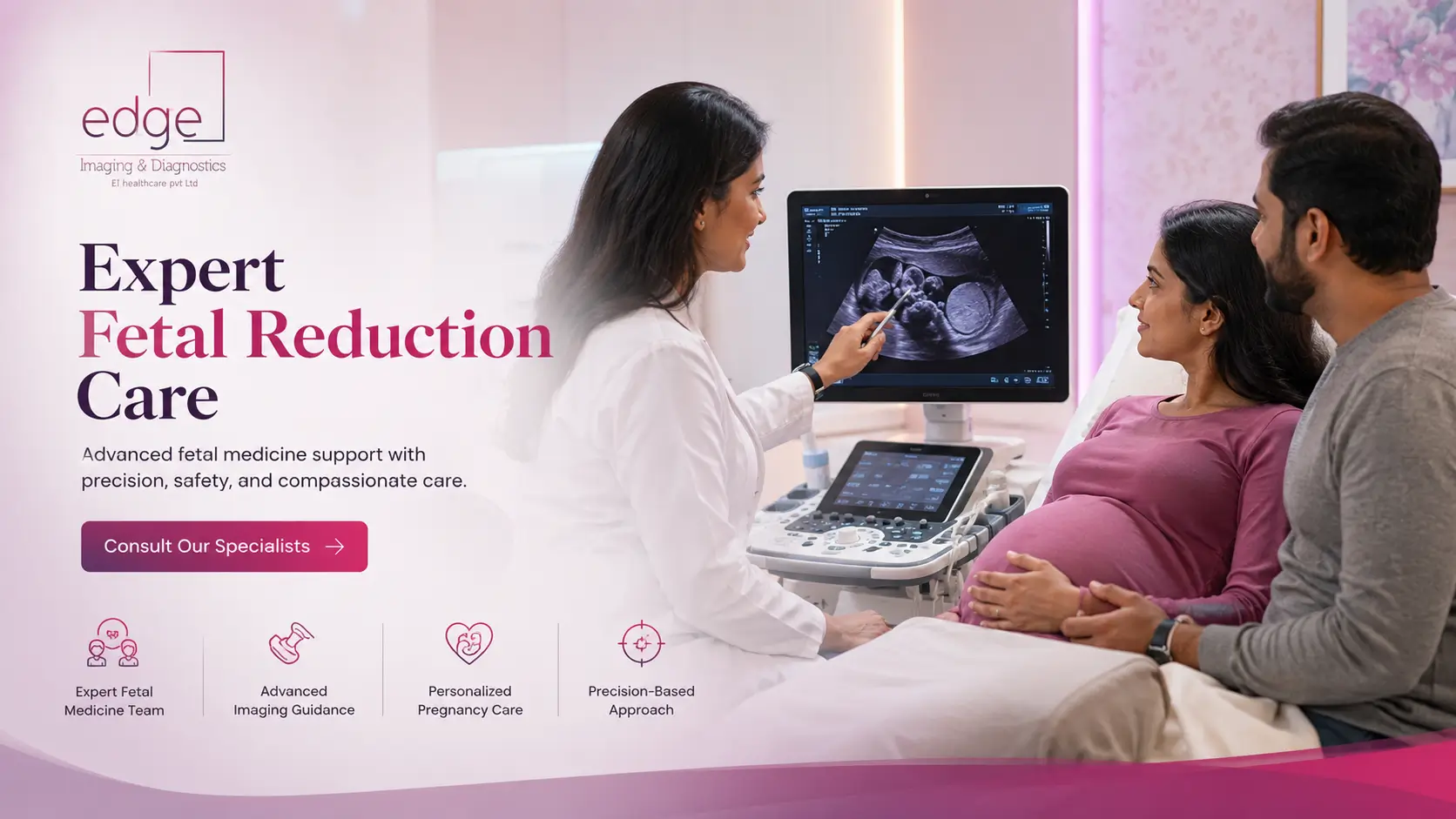
Fetal Reduction (Multifetal Pregnancy Reduction) in Delhi – Specialist Care with Compassion
Performed only on your obstetrician’s written referral, under continuous high-resolution ultrasound guidance, within the legal framework of Indian law. Speak to our coordinator before you decide anything.
Multifetal pregnancy reduction (commonly called fetal reduction) is a specialised, ultrasound-guided medical procedure advised in certain higher-order pregnancies — most often triplets or higher, and in specific medically indicated twin pregnancies — to improve the chances of a healthy outcome for the mother and the continuing pregnancy. With the rise of IVF and fertility treatments, multifetal pregnancies have become more common, and reduction is an established part of modern fetal medicine practised worldwide.
Fetal reduction at Edge Imaging is performed strictly as a medically indicated procedure within the legal framework of Indian law (MTP Act), only on the advice and referral of the treating obstetrician/fetal medicine specialist, with complete documentation and informed consent. Sex selection of any kind is prohibited by law and is never a basis for any procedure at our centre.
At Edge Imaging & Diagnostics, Paschim Vihar, the procedure is performed by experienced specialists under continuous high-resolution ultrasound guidance, in sterile conditions, with complete privacy and the sensitivity this decision deserves.
When Is Fetal Reduction Medically Advised?
This is never a decision a family makes alone — it follows detailed counselling with your obstetrician or fetal medicine specialist. Common medical indications include: triplet or higher-order pregnancies (where continuing all fetuses significantly raises the risk of extreme prematurity and maternal complications), certain complicated twin pregnancies as assessed by your specialist, a fetus with a severe abnormality detected on scans in a multifetal pregnancy (selective reduction), and maternal health conditions where a multifetal pregnancy poses serious risk. International obstetric guidelines recognise reduction as a risk-reducing intervention in such situations — the goal is always a safer pregnancy and a healthier outcome.
How Is the Procedure Performed?
Before the procedure, a detailed ultrasound mapping is done to assess each fetus, placental positions and chorionicity — this mapping, along with your specialist’s advice, determines the safest approach. The procedure itself is performed transabdominally under continuous ultrasound guidance and takes a short time, followed by an observation period and a confirmation scan. Most patients go home the same day with simple precautions and a follow-up scan plan coordinated with their treating obstetrician.
Timing is typically in the late first trimester (commonly 11–14 weeks), as advised by your specialist — which is why an early referral conversation matters.
What Makes the Difference in This Procedure: Experience and Imaging
Fetal reduction is one of the most operator-dependent procedures in fetal medicine. Outcomes depend on precise ultrasound guidance, correct mapping of chorionicity, and the steadiness that comes only with regular experience. At Edge Imaging, the procedure is performed by specialists who carry out guided fetal and interventional procedures regularly — the same team that performs amniocentesis, CVS and other USG-guided interventions at our centre — supported by high-resolution ultrasound equipment.
Documentation and Process
You will need: a written referral/advice from your treating obstetrician or fetal medicine specialist, your complete antenatal records and previous scans, and consent documentation, which our coordinator walks you through in person. All procedures are performed within the legal framework applicable in India, with complete records. Our team coordinates directly with your referring doctor before and after the procedure, so your antenatal care continues seamlessly.
Support for Families
We understand that this is one of the most difficult conversations and decisions a family can face — often after a long fertility journey. Our role is to provide medically excellent, judgment-free care: clear answers to your questions, privacy throughout your visit, and coordination with your doctor at every step. You are welcome to visit the centre with your partner or family member, and to speak with our coordinator before scheduling anything.
Related Services at Edge Imaging
Complete fetal medicine support under one roof: Level 2 anomaly scans, fetal echocardiography, NT scans, Amniocentesis, CVS (Chorionic Villus Sampling), and growth/doppler studies — so your specialist has every diagnostic tool available at one trusted centre in West Delhi.
FAQs
Is fetal reduction legal in India?
Yes — as a medically indicated procedure performed within the framework of Indian law, on the advice of the treating specialist, with proper documentation and consent. It is an established part of fetal medicine practice, particularly in higher-order pregnancies.
Is the procedure safe for the continuing pregnancy?
The purpose of reduction in medically indicated cases is precisely to improve outcomes for the continuing pregnancy. Like any procedure, it carries a small risk, which your specialist will discuss with you in detail — experience of the operator and quality of ultrasound guidance are the key safety factors.
How long does the procedure take?
The procedure itself is short; the complete visit including mapping ultrasound, the procedure and observation typically takes a few hours. Most patients return home the same day.
Do I need a referral from my doctor?
Yes. Fetal reduction is performed only on the written advice of your treating obstetrician or fetal medicine specialist, and we coordinate your care with them throughout.
Will my privacy be protected?
Completely. Your visit, records and procedure details remain confidential, and our team handles every case with sensitivity.
Have Questions? Speak to Us First.
Our coordinator can answer your questions and explain the process before you decide anything. 📞 9555999960 | 💬 WhatsApp | 📍 Edge Imaging
Note: Edge Imaging & Diagnostics is registered under the PCPNDT Act. Prenatal sex determination is strictly prohibited by law and is not performed under any circumstances. This procedure is conducted only for medically indicated genetic diagnosis with appropriate documentation.
Registration No. DL/W/2020/1629
If your obstetrician has raised fetal reduction with you, talk to our coordinator first. There is no obligation to book anything, and every conversation stays confidential.