
 PV
 TG
 MN
 EM
 EI
 ND
 NM
 SR

 CT Scan
 PET CT
 Digital X-ray
 Ultrasound
 Amniocentesis

 Fetal Reduction
 Thermalytix Breast Screening
 Cardiology
 Lab Tests
 GAMCA Pre-Medical

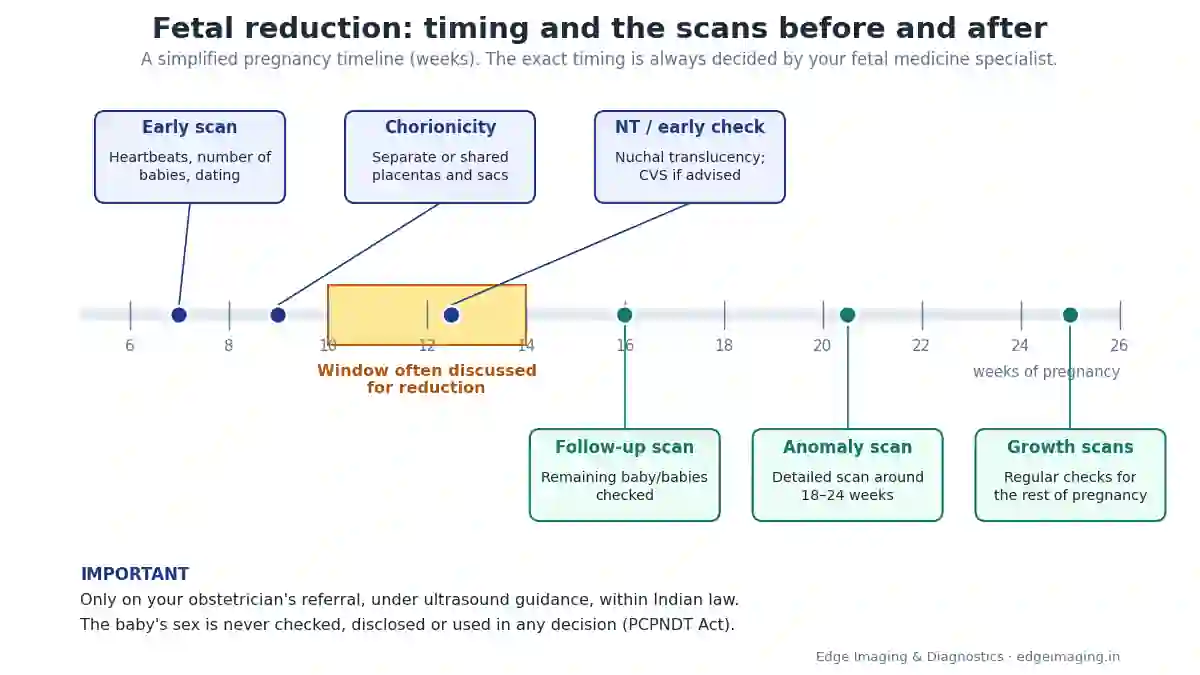
Fetal reduction (multifetal pregnancy reduction) is usually discussed towards the end of the first trimester, after early scans have confirmed how many babies there are, how the placentas are shared and how each baby is developing. The exact week is decided by your fetal medicine specialist, on your obstetrician’s referral.
If you are expecting triplets, quadruplets or, in some situations, twins, and your doctor has mentioned fetal reduction, one of your first questions will be: “When would it be done?” The second is usually: “What scans will I need before and after?”
This guide answers those two questions in simple language. It does not tell you whether to have fetal reduction — that is a deeply personal decision you make with your obstetrician and fetal medicine specialist. It explains the timing and the scans, so that you know what to expect at each step.
Many parents search for this as “best time for fetal reduction”, “fetal reduction week”, “fetal reduction kab hota hai”, “scan before fetal reduction” or “scan after fetal reduction”. All of these are answered below, with a short Hinglish section at the end.
Fetal reduction timing at a glance
- Usual window: towards the end of the first trimester; many specialists discuss it around 10–14 weeks, but practice varies and your specialist decides
- Why not too early: early scans may not yet show how every baby is developing, and some early pregnancies change on their own
- Why not too late: later procedures may carry a higher risk, so specialists usually avoid unnecessary delay
- Scans before: early viability and dating scan, chorionicity scan (shared or separate placentas), and the nuchal translucency (NT) scan with an early look at each baby
- Scans after: a follow-up scan, the anomaly scan around 18–24 weeks, and regular growth scans
- Always: only on your obstetrician’s referral, under ultrasound guidance, within Indian law; the baby’s sex is never checked, disclosed or used in any decision
What this guide covers
- Why timing matters so much
- The usual timing window
- Why it is usually not done very early
- Why specialists avoid unnecessary delay
- Scan 1: the early viability and dating scan
- Scan 2: the chorionicity scan
- If two babies share a placenta
- Scan 3: the NT scan and early check
- Is CVS needed before reduction?
- How the specialist plans which baby
- Sex is never part of the decision
- Referral, consent and the law
- The day of the procedure
- After: the follow-up scan
- After: the anomaly scan
- After: growth scans for the rest of pregnancy
- What you may see on later scans
- When to contact your doctor urgently
- A sample scan calendar
- Questions to ask your specialist
- Why the fetal reduction week differs between pregnancies
- Twins, triplets or quadruplets: does the timing change?
- Scan before fetal reduction: how to prepare
- Scan after fetal reduction: what the report usually includes
- Coming from outside Delhi
- If you are unsure or need more time
- Asking for a second opinion
- Looking after your feelings
- For partners and families
- Scan report words, explained simply
- Myths and facts
- Seedhi baat: fetal reduction kab hota hai
- Scans at Edge Imaging, West Delhi
- References
- Frequently asked questions
Why timing matters so much
In a multiple pregnancy, every week brings new information. In the first few weeks, a scan can show how many pregnancy sacs and heartbeats there are. A little later, it can show how the placentas and membranes are arranged. Later still, around the end of the first trimester, it can give a first proper look at each baby.
The timing of fetal reduction is a balance. Specialists want enough information to plan safely and carefully, but they also do not want unnecessary delay. That is why the decision is usually made towards the end of the first trimester, after the key early scans are done.
If you want to understand the procedure itself, its risks and recovery, read our main guide to fetal reduction procedure, risks and outcomes. This page focuses only on when, and on the scans.
The usual timing window
There is no single week that suits every pregnancy. Practice varies between countries and specialists. A widely used approach described in the medical literature is a transabdominal, ultrasound-guided procedure at around 10–12 weeks; some specialists prefer a little later, after the nuchal translucency scan, so that they can first take an early look at each baby. Some centres have also reported very early procedures.
In simple words: most parents will hear fetal reduction discussed towards the end of the first trimester. Your fetal medicine specialist will suggest the timing that is right for your pregnancy, based on your scans, your health and the number and arrangement of babies.
Why it is usually not done very early
Two practical reasons are often given for not doing fetal reduction in the very early weeks:
- Some early pregnancies change on their own. In a multiple pregnancy, one of the early sacs may stop developing naturally. Waiting a little allows the true number of developing babies to become clear.
- Early screening is not yet possible. The nuchal translucency scan and the early look at each baby can only be done at a certain stage. Very early procedures are done before this information is available.
A review in a leading obstetrics publication noted both points: the possibility of spontaneous reduction in early weeks, and the inability to perform early screening such as nuchal translucency at that stage.
Why specialists avoid unnecessary delay
On the other hand, the same literature notes that reduction later in pregnancy may be accompanied by an increased risk of pregnancy loss. For this reason, once the essential scans are done and you have made your decision, specialists usually aim not to delay without a good reason.
This is why the scans before reduction are planned carefully and in good time. Booking your early scans promptly, and keeping your appointments, helps your specialist keep the timing on track.
Scan 1: the early viability and dating scan
The first scan in a multiple pregnancy usually confirms:
- How many pregnancy sacs there are
- How many heartbeats can be seen
- The age of the pregnancy (dating)
- That the pregnancy is in the right place, inside the womb
In a multiple pregnancy, the UK’s NICE guideline recommends estimating the age of the pregnancy from the largest baby, to avoid underestimating it if one baby is growing a little slower. This dating matters because every later decision — including timing — is based on it.
Our pregnancy scan schedule guide explains which scan is done in which month for all pregnancies.
Scan 2: the chorionicity scan
Chorionicity simply means whether the babies have their own placentas or share one. Amnionicity means whether each baby has its own sac or shares one. These are among the most important facts in any multiple pregnancy.
NICE recommends determining chorionicity and amnionicity when a twin or triplet pregnancy is first detected by ultrasound, using:
- The number of placental masses
- The number and thickness of the membranes between the babies
- Specific ultrasound signs at the base of the membrane, known as the lambda sign or the T-sign
Your report may use words such as dichorionic (separate placentas), monochorionic (shared placenta), trichorionic (three separate placentas in triplets) or diamniotic (separate sacs). Ask your doctor to explain them — they directly affect how fetal reduction is planned.
If two babies share a placenta
When two babies share a placenta (monochorionic), their blood circulations are usually connected through the placenta. This changes how reduction can be planned, and the standard approach used for babies with separate placentas is not suitable for them. That is one reason why the chorionicity scan must come first.
If your scan shows a shared placenta, your fetal medicine specialist will explain your options in detail. Our guides to twin reduction and triplet to twin reduction explain how placenta sharing affects planning.
Scan 3: the NT scan and early check
The nuchal translucency (NT) scan measures a small fluid space at the back of each baby’s neck and gives an early look at each baby’s development. In multiple pregnancies, each baby is assessed separately.
NICE describes NT screening in triplet pregnancies when the crown–rump length (the baby’s length) is between 45 and 84 mm — roughly from 11 weeks 2 days to 14 weeks 1 day. In practice, many specialists like to have this information before planning reduction, so that the plan takes into account how each baby looks.
Read more in our guide to the NT scan.
Is CVS needed before reduction?
Chorionic villus sampling (CVS) is a test that takes a tiny sample from the placenta to check the baby’s chromosomes. It is usually done at 11–14 weeks. It is not needed for everyone.
Your specialist may discuss CVS if there is a particular reason — for example a concern on the NT scan, or a family history of a genetic condition. In multiple pregnancies, CVS needs careful mapping of which sample came from which placenta. Our guide to the CVS test explains how it works.
How the specialist plans which baby
Parents often worry about how the baby is “chosen”. In simple, honest terms, the specialist plans the procedure based only on medical and technical factors seen on the scans, such as:
- Whether any baby shows a problem on the early scans
- How the placentas and sacs are arranged
- Which sac can be reached most safely with the needle under ultrasound guidance
- Keeping the remaining pregnancy as safe as possible
A detailed early look at each baby allows a more careful, informed plan. Your specialist will explain the reasoning to you clearly before you give consent.
Sex is never part of the decision
In India, the PCPNDT Act strictly prohibits determining or disclosing the sex of a baby. At Edge Imaging & Diagnostics, the baby’s sex is never checked, never disclosed and never used in any decision about fetal reduction or any scan. Please do not ask — we cannot and will not answer, and it plays no part in medical care.
Referral, consent and the law
Fetal reduction is a specialised procedure. At Edge Imaging & Diagnostics it is performed:
- Only on your obstetrician’s written referral
- Within the legal framework of Indian law, including the Medical Termination of Pregnancy Act
- In a PCPNDT-registered centre
- With written informed consent, after counselling
- With complete privacy
Read more on our fetal reduction in Delhi page.
The day of the procedure
On the day, a careful ultrasound scan is done first to confirm the position and condition of each baby and to finalise the plan. The procedure is then performed under continuous ultrasound guidance. Afterwards, the remaining baby or babies are checked on ultrasound before you go home, and you are given clear instructions for rest and follow-up.
Questions about pain, how long it takes, rest and precautions afterwards are answered in our main fetal reduction guide.
After: the follow-up scan
A follow-up scan is usually advised after fetal reduction to check the remaining baby or babies — their heartbeat, growth and the fluid around them. Your specialist will tell you exactly when to come; follow their timing rather than any general rule.
Bring your previous scan reports to every scan. This helps the sonologist compare and give you a clear report.
After: the anomaly scan
The anomaly scan (also called the level-2 or TIFFA scan) is a detailed check of each remaining baby’s structure, usually done around 18–24 weeks. In a multiple pregnancy it takes longer, because each baby is examined separately.
Our guide to the anomaly scan (TIFFA) explains what is checked and how to prepare.
After: growth scans for the rest of pregnancy
Even after reduction, a twin pregnancy remains a higher-risk pregnancy than a single one. Your obstetrician will usually plan regular growth scans, often with Doppler, to check:
- Each baby’s growth and estimated weight
- The amount of fluid around each baby
- Blood flow to each baby
- The cervix length, if your doctor advises
How often these scans are needed depends on your pregnancy, especially on whether the remaining babies share a placenta. Always follow your obstetrician’s schedule.
What you may see on later scans
After reduction, the reduced pregnancy sac stays inside the womb and, over time, becomes less visible as the remaining baby or babies grow. Your scan report may mention it. This is expected, and the sonologist will focus on the health and growth of the remaining baby or babies.
If you find it emotionally hard to see this on the screen, tell the sonologist. They can talk you through the scan gently and keep the focus on what matters for your care.
When to contact your doctor urgently
After fetal reduction, contact your obstetrician or go to the nearest hospital straight away if you have:
- Bleeding from the vagina
- Leaking of fluid
- Fever or chills
- Strong or increasing abdominal pain or cramps
- A feeling that something is not right
Do not wait for your next scan appointment if you have any of these.
A sample scan calendar
| Approximate time | Scan | What it checks |
|---|---|---|
| Early first trimester | Viability and dating scan | Number of sacs and heartbeats, pregnancy age, location |
| First trimester, when twins or triplets are seen | Chorionicity scan | Shared or separate placentas and sacs |
| Around 11–14 weeks | NT scan and early check | Early look at each baby; CVS if advised |
| As advised by your specialist | Fetal reduction (if chosen) | Performed under ultrasound guidance |
| As advised after reduction | Follow-up scan | Remaining baby or babies |
| Around 18–24 weeks | Anomaly scan | Detailed structure of each baby |
| Rest of pregnancy | Growth and Doppler scans | Growth, fluid, blood flow |
This is a general guide only. Your own schedule will be set by your obstetrician and fetal medicine specialist.
Questions to ask your specialist
- How many babies are developing, and how are the placentas and sacs arranged?
- Do the babies share a placenta? How does that affect my options?
- Which week do you suggest for my pregnancy, and why?
- Do I need the NT scan or CVS before the procedure?
- What are the risks for my particular pregnancy?
- When should I come for the follow-up scan?
- Which symptoms should make me call you urgently?
- How often will I need growth scans afterwards?
Write the answers down, or bring your partner or a family member to help remember.
Why the fetal reduction week differs between pregnancies
Two parents with triplets may be given different dates, and both can be right. The fetal reduction week is planned around your own pregnancy, and several things can move it earlier or later within the usual window:
- Accurate dating. If the early scan shows the pregnancy is further along, or less far along, than you thought, the plan shifts accordingly.
- How the placentas are shared. A shared placenta needs a different plan and sometimes a different timing.
- What the early scans show. If the specialist wants an NT scan or CVS result first, the timing waits for that information.
- The number of babies. Higher-order pregnancies may need extra care in planning.
- Your own health. Bleeding, infection or other health issues may change the timing.
- When the referral comes. If you are referred late, the specialist will plan as soon as it is safe and appropriate.
This is why comparing your dates with a friend’s, or with something read online, is rarely helpful. Ask your specialist to explain why a particular week suits your pregnancy.
Twins, triplets or quadruplets: does the timing change?
The general principle is the same for every multiple pregnancy: complete the important early scans, then plan without unnecessary delay. What changes is the amount of detail needed. With more babies, the scans take longer, the mapping of placentas and sacs is more complex, and the specialist may want extra time to review the images carefully.
For twins, reduction is considered only in particular medical situations, and the chorionicity scan becomes even more important because twins sharing a placenta need a different approach. For triplets and quadruplets, the main aim is usually to lower the risks of very early birth for the remaining babies. Our separate guides on twin reduction and reducing triplets to twins explain these situations in more detail.
Scan before fetal reduction: how to prepare
A careful scan before fetal reduction takes time, because every baby, every sac and every placenta has to be assessed. To make the scan as smooth as possible:
- Bring all previous scan reports, in date order, including the very first scan.
- Bring your obstetrician’s referral and any blood test results.
- Follow the instructions given for the scan — for example, about a full or empty bladder.
- Allow enough time. A multiple pregnancy scan is longer than a routine scan.
- Bring one support person, if you wish, to help you remember what is explained.
Write down your questions before you come. The scan before fetal reduction is a good time to ask how the placentas are arranged and what the specialist is looking for.
Scan after fetal reduction: what the report usually includes
A scan after fetal reduction focuses on the health of the remaining baby or babies. The report will usually describe:
- The heartbeat of each remaining baby
- Measurements that show growth since the last scan
- The fluid around each baby
- The placenta position
- The cervix, if your doctor has asked for it to be checked
- A mention of the reduced sac, where relevant
Take each report to your obstetrician. If any line in the report worries you, ask the sonologist or your doctor to explain it in simple words.
Coming from outside Delhi
Many families travel to Delhi from nearby cities and states for fetal medicine care. If you are travelling:
- Plan the scans before and after in consultation with your obstetrician, so you do not miss an important appointment.
- Ask whether you should stay nearby for a short time after the procedure.
- Carry copies of all reports, and keep photos of them on your phone.
- Know which hospital near your home to go to if you develop warning symptoms after returning.
If you are unsure or need more time
It is completely normal to feel unsure. Fetal reduction is a big decision, and no one should feel rushed into it. If you need more time, tell your obstetrician and specialist honestly. They can explain how much time is reasonably available within the usual window, and what continuing the pregnancy without reduction would involve.
It can help to write down, side by side, what worries you about each option and what matters most to you. Bring this list to your next appointment. A good specialist will go through it with you patiently.
Asking for a second opinion
You are always free to ask for a second opinion, either about whether reduction is advisable or about the timing. Bring all your scan reports and images to the second consultation. Because the timing window matters, try to arrange any second opinion promptly, so that you still have all your options when you make your final decision.
Looking after your feelings
Many parents feel a mixture of hope, worry, guilt and grief around fetal reduction. These feelings are normal. It can help to:
- Ask every question you have, however small
- Take time to talk with your partner before deciding
- Ask your doctor about counselling support
- Lean on people you trust, and limit advice from people who do not know your situation
There is no “right” way to feel. Be gentle with yourself.
For partners and families
Partners and family members can help in practical ways: keeping track of scan dates, coming to appointments, writing down questions and answers, and making sure the mother can rest after the procedure. Most importantly, listen without judging. Decisions in a multiple pregnancy are medical and personal, and the parents deserve support whatever they decide.
Scan report words, explained simply
| Word on the report | What it means |
|---|---|
| Gestational sac | The fluid-filled sac in which each baby develops |
| Cardiac activity | A heartbeat seen on the scan |
| CRL (crown–rump length) | The baby’s length, used to date the pregnancy |
| Dichorionic / trichorionic | Each baby has its own placenta |
| Monochorionic | Two babies share one placenta |
| Diamniotic / triamniotic | Each baby has its own sac |
| Lambda sign / T-sign | Ultrasound signs that help tell separate from shared placentas |
| NT (nuchal translucency) | A small fluid space at the back of the baby’s neck measured at 11–14 weeks |
| Liquor / AFI | The amount of fluid around the baby |
| Cervical length | The length of the neck of the womb, checked in some pregnancies |
If you see a word that is not on this list, ask the sonologist to explain it before you leave.
Myths and facts
| Myth | Fact |
|---|---|
| “Fetal reduction must be done as early as possible.” | Many specialists prefer to wait until the key early scans are done, so the plan is based on enough information. |
| “It can be done at any time.” | Later procedures may carry more risk, so specialists usually avoid unnecessary delay. |
| “Placenta sharing doesn’t matter.” | It matters a lot. Babies sharing a placenta need a different plan. |
| “The baby’s sex can be considered.” | Never. Sex determination is prohibited under the PCPNDT Act and plays no part in care. |
| “After reduction, no more scans are needed.” | Follow-up, anomaly and growth scans remain important. |
Seedhi baat: fetal reduction kab hota hai
Fetal reduction kab hota hai? Aam taur par pehle trimester ke end ke aas-paas, jab zaroori shuruati scans ho jaate hain. Kai specialists isse lagbhag 10 se 14 hafte ke beech discuss karte hain, lekin sahi hafta aapka fetal medicine specialist hi decide karta hai.
Bahut jaldi kyun nahi? Shuru ke hafton me kabhi-kabhi ek sac apne aap develop hona band ho jaata hai, aur NT scan jaisi jaanch bhi tab tak nahi ho paati.
Bahut der se kyun nahi? Baad me karne se risk badh sakta hai, isliye bina wajah der nahi ki jaati.
Pehle kaunse scan? Early scan (kitne bachche, heartbeat, dating), chorionicity scan (placenta alag hai ya share hai) aur NT scan.
Baad me kaunse scan? Follow-up scan, 18–24 hafte par anomaly scan, aur baaki pregnancy me growth scans.
PCPNDT ka niyam: bachche ka sex kabhi check nahi hota, kabhi bataya nahi jaata, aur kisi bhi faisle me iska koi role nahi hota. Yeh kanoon ke tahat poori tarah mana hai.
Scans at Edge Imaging, West Delhi
At Edge Imaging & Diagnostics in West Delhi, our team performs the early, chorionicity, NT, anomaly and growth scans for multiple pregnancies, and fetal reduction on your obstetrician’s written referral, with complete privacy. Every scan is reviewed carefully, and we take time to explain what we see.
If your doctor has referred you, or you would like to understand the scans you need, send us a WhatsApp message with your referral and recent scan reports. We will explain the next steps, the earliest appointment and today’s actual pricing.
💬 WhatsApp Edge Imaging with your referral | Call 9555999960
References
- Twin and triplet pregnancy (NG137): Recommendations — National Institute for Health and Care Excellence (NICE), UK.
- Multifetal pregnancy reduction – first or second trimester — Contemporary OB/GYN.
- Pregnancy outcomes of different methods for multifetal pregnancy reduction: a comparative study — Journal of Korean Medical Science, 2008.
Frequently asked questions
What is the best time for fetal reduction?
There is no single best week for everyone. It is usually discussed towards the end of the first trimester, after the key early scans, and your fetal medicine specialist decides the timing for your pregnancy.
In which week is fetal reduction usually done?
Many specialists discuss it around 10 to 14 weeks. Practice varies, and some specialists prefer to do it after the NT scan so they can first look at each baby.
Why is fetal reduction not done very early?
In the very early weeks, some sacs may stop developing on their own, and early screening such as the NT scan is not yet possible.
Why is fetal reduction not delayed?
Medical literature notes that reduction later in pregnancy may carry a higher risk of pregnancy loss, so specialists usually avoid unnecessary delay.
Which scans are needed before fetal reduction?
Usually an early viability and dating scan, a chorionicity scan to see whether placentas are shared, and the NT scan with an early look at each baby. CVS only if advised.
Why is the chorionicity scan so important?
It shows whether babies share a placenta. Babies sharing a placenta have connected circulations, which changes how reduction can be planned.
Do I need CVS before fetal reduction?
Not always. Your specialist may suggest CVS if there is a specific concern, such as an NT finding or a family history of a genetic condition.
How is the pregnancy dated in twins or triplets?
NICE recommends estimating the age of the pregnancy from the largest baby, so that slower growth in one baby does not lead to underestimating it.
Which scans are needed after fetal reduction?
A follow-up scan as advised, the anomaly scan around 18 to 24 weeks, and regular growth scans for the rest of the pregnancy.
Will I still see the reduced sac on later scans?
The reduced sac stays inside the womb and becomes less visible over time. Your report may mention it; the sonologist will focus on the remaining baby or babies.
When should I call my doctor after fetal reduction?
Straight away if you have bleeding, leaking fluid, fever, chills or strong or increasing abdominal pain or cramps.
Is the baby’s sex considered?
Never. Sex determination is prohibited under the PCPNDT Act. The baby’s sex is never checked, disclosed or used in any decision.
Do I need a referral?
Yes. At Edge Imaging & Diagnostics, fetal reduction is performed only on your obstetrician’s written referral, within Indian law, with written consent.
Fetal reduction kab hota hai?
Aam taur par pehle trimester ke end ke aas-paas, lagbhag 10 se 14 hafte ke beech discuss hota hai. Sahi hafta aapka fetal medicine specialist decide karta hai.
Fetal reduction se pehle kaunse scan hote hain?
Early scan, chorionicity scan aur NT scan. Zaroorat ho to CVS bhi. Baad me follow-up, anomaly aur growth scans hote hain.
Is a twin pregnancy after reduction still high-risk?
A twin pregnancy remains higher risk than a single pregnancy, so regular growth scans and check-ups continue as advised by your obstetrician.
Where can I get these scans in West Delhi?
At Edge Imaging & Diagnostics, West Delhi. WhatsApp or call 9555999960 with your referral for the earliest appointment and today’s actual pricing.
The bottom line
Fetal reduction is usually discussed towards the end of the first trimester, after early scans have shown how many babies are developing, how the placentas are shared and how each baby looks. Not too early, not unnecessarily late — and always decided by your specialist, for your pregnancy.
Keep your scan appointments, bring your reports, ask every question, and look after yourself. Whatever you decide, you deserve clear information and kind support.
Written by the medical team at Edge Imaging & Diagnostics, West Delhi. Medically reviewed by Dr. Nishant Thapar. Last reviewed: October 2026.
Disclaimer: this article is general information for parents and does not replace advice from your obstetrician or fetal medicine specialist. Fetal reduction is performed only on medical referral, within Indian law. The sex of the fetus is never determined or disclosed (PCPNDT Act).