
 PV
 TG
 MN
 EM
 EI
 ND

 CT Scan
 PET CT
 Digital X-ray
 Ultrasound
 Amniocentesis

 Fetal Reduction
 Thermalytix Breast Screening
 Cardiology
 Lab Tests
 GAMCA Pre-Medical

Twin reduction, also called twin to singleton reduction, is a procedure in which one of two babies in a twin pregnancy is stopped from developing, so that the pregnancy continues with one baby. It is usually done at about 11 to 14 weeks, by an ultrasound-guided injection, in twins that have separate placentas.
Finding out you are carrying twins can bring joy, worry, or both. For some families, a doctor raises the possibility of reducing the pregnancy to one baby — because of the mother’s health, a problem found in one twin, or a history that makes a twin pregnancy especially risky. It is one of the most personal decisions anyone can face in pregnancy, and it deserves clear, honest information rather than pressure in either direction.
This guide explains when twin reduction is considered, why the type of twins (chorionicity) decides whether and how it can be done, what happens step by step, what the research actually shows about miscarriage and preterm birth, the emotional side, and the legal framework in India. It is general information, not a recommendation. The decision belongs to you, with your obstetrician or fetal medicine specialist.
Twin reduction at a glance
- What it is: reducing a twin pregnancy to a single baby (twin to singleton reduction)
- Who it is for: selected twin pregnancies, after detailed scanning and counselling, within the legal framework
- The key first step: confirming chorionicity — whether the twins have separate placentas (dichorionic) or share one (monochorionic)
- Dichorionic twins: an ultrasound-guided injection, usually at about 11 to 14 weeks
- Monochorionic twins: an injection is not safe; specialised cord-occlusion methods are needed in a fetal therapy centre
- Timing matters: large studies show the best outcomes when it is done before 14 weeks
- Main risk: loss of the whole pregnancy — in recent studies similar to the background risk of an ongoing twin pregnancy when done early
- The law: it is governed by the MTP Act; the sex of a fetus is never determined, disclosed or used in any decision
What this guide covers
- What twin reduction means
- Why twin pregnancies carry extra risk
- When twin reduction is considered
- Twin reduction vs selective termination for an anomaly
- Chorionicity: the scan finding that decides everything
- Timing: why before 14 weeks is preferred
- How the twin to be reduced is chosen
- Before the procedure: scans, tests and counselling
- How twin to singleton reduction is done, step by step
- Twin reduction in monochorionic twins
- Does it hurt?
- Twin reduction risks: what the research shows
- Outcomes compared: reduced twins, ongoing twins and singletons
- After the procedure
- The rest of the pregnancy
- The emotional side
- The law in India: MTP Act and PCPNDT Act
- Questions to ask before deciding
- Twin reduction in Delhi: how we can help
- References
- Frequently asked questions
What twin reduction means
Twin reduction — also called twin to singleton reduction, twin pregnancy reduction or, more broadly, fetal reduction — means ending the development of one fetus in a twin pregnancy so that the other can continue as a single (singleton) pregnancy. The baby that remains is not removed or disturbed; the reduced fetus is gradually absorbed by the body over the following weeks, and the pregnancy continues.
Fetal reduction was first developed for pregnancies with three or more babies, where the risks of extreme prematurity are very high, and triplet to twin reduction is still the most common reason for the procedure. Reduction from twins to one baby is a narrower and more sensitive situation, because a twin pregnancy usually goes well. That is why twin reduction is considered case by case, after careful scanning, testing and counselling, and never as a routine option. In short, fetal reduction in twins is an individual decision, not a standard part of twin care.
Why twin pregnancies carry extra risk
Most twin pregnancies end with two healthy babies. But compared with a single pregnancy, carrying twins raises the chance of several problems, for both mother and babies.
| Area | How twins differ from a singleton pregnancy |
|---|---|
| Preterm birth | Much more common; in one large national study, about 39% of dichorionic twins were born before 37 weeks, compared with about 5% of singletons |
| Birth weight | Twins are smaller on average, and one twin may grow poorly |
| Maternal health | Higher rates of pre-eclampsia, gestational diabetes, anaemia and bleeding after birth |
| Twin-specific complications | Monochorionic twins (sharing a placenta) can develop twin-to-twin transfusion syndrome and other complications |
| Delivery | Caesarean birth is more common |
For most women these extra risks are manageable with closer monitoring. For some, however, a pre-existing condition or past history makes them much more serious, and that is where the question of twin reduction may arise.
When twin reduction is considered
Twin reduction is discussed in a limited set of circumstances. Common reasons include:
- Serious maternal medical conditions that make a twin pregnancy significantly more dangerous — for example certain heart, kidney or blood-pressure conditions
- A high risk of very early birth — for example a previous very preterm birth or late miscarriage, a weak cervix (cervical insufficiency), or a uterus with an abnormal shape or previous major surgery
- A serious structural or genetic problem in one twin, found on scans or tests (this is usually called selective termination, explained below)
- Complications specific to monochorionic twins, in specialist fetal medicine settings
- Other personal, social or psychological circumstances, discussed with the doctor within what the law permits
Whether reduction is appropriate and lawful in an individual case is a medical and legal judgement, made with the family after full counselling. A good team will also make sure you understand the option of continuing the twin pregnancy with closer monitoring, and the realistic outlook if you do.
Twin reduction vs selective termination for an anomaly
Two terms are used, and they describe slightly different situations.
| Twin reduction (multifetal pregnancy reduction) | Selective termination | |
|---|---|---|
| Reason | To lower the risks of a twin pregnancy itself | Because one twin has a serious anomaly or genetic condition |
| Which twin | Chosen mainly on technical grounds, after screening both | The affected twin |
| Typical timing | About 11 to 14 weeks | As soon as the diagnosis is confirmed; sometimes later in pregnancy |
| Method in dichorionic twins | Ultrasound-guided injection | Ultrasound-guided injection |
Our main guide to fetal reduction in Delhi covers both, including reduction of triplets and higher-order pregnancies.
Chorionicity: the scan finding that decides everything
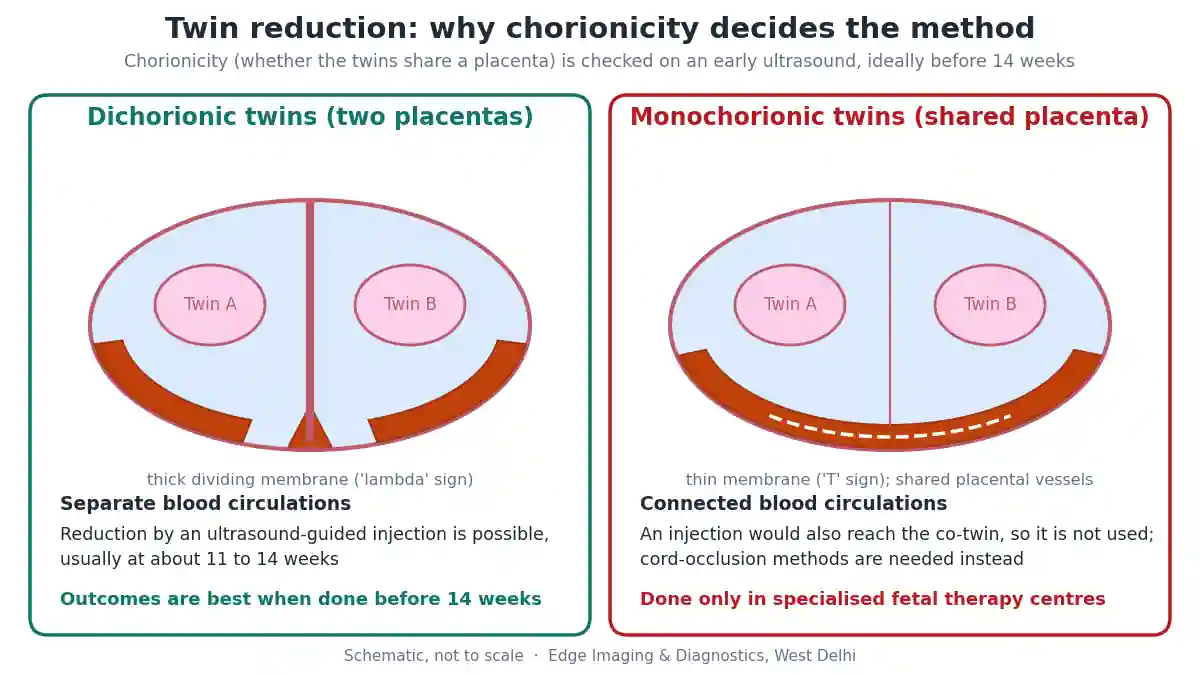
Chorionicity describes whether twins have their own placentas or share one. It is the single most important fact in any discussion of twin reduction, and it is best determined on an early ultrasound, ideally in the first trimester.
- Dichorionic twins each have their own placenta (which may lie side by side and look fused) and their own blood circulation. On ultrasound, the membrane between them is thick and meets the placenta in a triangular shape called the lambda sign. All non-identical twins and about a third of identical twins are dichorionic.
- Monochorionic twins share one placenta, and blood vessels on the surface of that placenta connect their circulations. The dividing membrane is thin and meets the placenta in a T shape. Monochorionic twins are always identical.
The shared circulation in monochorionic twins changes everything. Anything injected into one twin can reach the other, and the death of one monochorionic twin can cause sudden blood loss or brain injury in the co-twin through those connecting vessels. For this reason the standard injection technique is used only in dichorionic twins. Monochorionic twins need different methods, described below.
Chorionicity is easiest to determine between about 11 and 14 weeks, which is one more reason to have an early scan in any twin pregnancy — see our pregnancy scan schedule.
Timing: why before 14 weeks is preferred
Twin to singleton reduction in dichorionic twins is usually carried out at about 11 to 14 weeks. This window has practical advantages: the babies are large enough to be assessed in detail, the nuchal translucency scan and, if chosen, chorionic villus sampling can be done first, and some early losses that would have happened anyway have already declared themselves.
Research supports doing it early. A Danish national study of dichorionic twin pregnancies found that when reduction was performed before 14 weeks, the miscarriage rate before 24 weeks was 1.4% — similar to the 1.7% in twin pregnancies that were not reduced. When reduction was done from 14 weeks onwards, the miscarriage rate was higher, at 5.1%. Earlier reduction was also linked with the remaining baby being born later. The authors concluded that results were best when the procedure was performed before 14 weeks.
Reduction can still be done later where there is a medical reason — for example when an anomaly in one twin is found on the mid-pregnancy anomaly scan — but the trade-offs change, and later procedures are discussed individually.
How the twin to be reduced is chosen
When the reason for reduction is the twin pregnancy itself, rather than a problem with one baby, the choice is made on medical and technical grounds only:
- Screening results: if one twin has a higher nuchal translucency, a structural concern, or an abnormal result on chorionic villus sampling, that twin is usually the one reduced
- Accessibility: the twin that can be reached most safely with the needle
- Position: the sac lying over the cervix is generally left undisturbed where possible, to reduce the risk of infection and leakage
The sex of the babies plays no part whatsoever. It is not determined, not disclosed and not considered. Choosing on the basis of sex is a criminal offence in India under the PCPNDT Act, and no ethical centre will entertain it.
Before the procedure: scans, tests and counselling
A careful assessment is done before any decision is final.
- A detailed first-trimester scan confirming the number of babies, chorionicity, gestational age, heartbeats, the nuchal translucency measurement of each twin and an early check of anatomy.
- Genetic options. Some families choose chorionic villus sampling (CVS) on both twins before reduction, so that if one twin has a chromosomal condition, that twin is the one reduced. This adds time and a small risk of its own, and is discussed individually.
- Blood tests, including blood group. If you are Rh negative, an anti-D injection is given after the procedure.
- Counselling. A full discussion of the reasons, the alternatives — including continuing with twins under closer monitoring — the risks, and the legal requirements. You should never feel rushed, and you are free to change your mind at any point before the procedure.
- Written consent, as required by law.
How twin to singleton reduction is done, step by step
In dichorionic twins, the procedure is performed through the abdomen under continuous ultrasound guidance, much like an amniocentesis.
- Final scan. Both babies, their positions, heartbeats and the placentas are checked again, and the twin to be reduced is confirmed.
- Preparation. The skin of the abdomen is cleaned with antiseptic and covered with sterile drapes. Local anaesthetic is injected into the skin.
- Needle guidance. A fine needle is passed through the abdominal wall and the wall of the womb into the chest area of the selected fetus, with the needle tip watched on the screen at all times.
- Injection. A small amount of potassium chloride solution is injected, which stops the heart of that fetus.
- Confirmation. The ultrasound is continued for some minutes to confirm that the heartbeat has stopped, and that the remaining baby’s heartbeat is normal.
- Completion. The needle is removed and a small dressing applied.
The procedure itself usually takes around 20 to 40 minutes. A follow-up scan is arranged to check on the continuing pregnancy. Some centres use a transvaginal approach in very early pregnancy; the method is chosen by the specialist and explained beforehand.
Twin reduction in monochorionic twins
Because monochorionic twins share their circulation, an injection cannot be used. Instead, the blood flow in the umbilical cord of the selected twin has to be stopped completely, so that the co-twin is protected. Methods include radiofrequency ablation at the cord insertion and other cord-occlusion techniques.
These procedures are more complex, are usually performed later than in dichorionic twins (in published experience, often around 15 to 20 weeks), and carry different risks. They are performed in specialised fetal therapy centres. If your twins share a placenta and reduction is being discussed, we will explain the findings clearly and guide you on referral to an appropriate centre.
Does it hurt?
Most women describe the procedure as uncomfortable rather than painful. The local anaesthetic stings briefly, and there is a pressing sensation as the needle passes into the womb. Some cramping afterwards is common and usually settles within a day. General anaesthesia is not used. Many women find the emotional weight of the day harder than the physical sensation, and it helps to have someone you trust with you.
Twin reduction risks: what the research shows
The most important risk is loss of the whole pregnancy, including the baby that remains. Other risks include leaking of fluid, infection, bleeding and, later, preterm birth.
How big is the risk of losing the pregnancy? Recent data are more reassuring than older figures:
- In the Danish national study, miscarriage before 24 weeks was 1.4% when reduction was done before 14 weeks, compared with 1.7% in dichorionic twins that were not reduced and 0.6% in singletons. After reduction from 14 weeks, it was 5.1%.
- In a large single-centre study from China, pregnancy loss before 24 weeks was 4.8% in twins reduced to a singleton, compared with 6.5% in ongoing twin pregnancies — not a significant difference.
In plain terms: when performed early by an experienced team in dichorionic twins, twin reduction does not appear to add a large extra risk of miscarriage compared with continuing the twin pregnancy, and it greatly reduces the chance of preterm birth. Risks are higher when the procedure is done later, in monochorionic twins, or when there are other complications. Every figure depends on the centre, the timing and your own situation, so ask your specialist for the numbers that apply to you.
| Risk | What it means | How it is reduced |
|---|---|---|
| Loss of the pregnancy | Miscarriage of the remaining baby | Early timing (before 14 weeks), experienced operator, careful technique |
| Infection | Infection inside the womb | Strict sterile technique; avoiding the sac over the cervix |
| Leaking fluid or bleeding | Usually minor; occasionally significant | Fine needle, continuous ultrasound guidance |
| Preterm birth | Still somewhat higher than in a pregnancy that was always a singleton | Routine antenatal care and monitoring |
| Rh sensitisation | In Rh-negative mothers | Anti-D injection |
| Emotional distress | Grief, guilt or sadness, sometimes long-lasting | Counselling before and after; support from family and professionals |
Outcomes compared: reduced twins, ongoing twins and singletons
The main aim of twin reduction is to lower the risks that come with a twin pregnancy — above all, preterm birth. The research consistently shows a large effect.
| Outcome (Danish national study) | Reduced before 14 weeks | Ongoing dichorionic twins | Singletons |
|---|---|---|---|
| Miscarriage before 24 weeks | 1.4% | 1.7% | 0.6% |
| Born before 37 weeks | 6.9% | 39.1% | 4.9% |
| Born before 32 weeks | 2.8% | 7.3% | — |
| Typical age at birth | About 39½ weeks | About 37½ weeks | About 40 weeks |
The Chinese single-centre study showed a similar pattern: twins reduced to a singleton were born at a median of about 38.8 weeks compared with 37.0 weeks for ongoing twins, preterm birth before 37 weeks fell from 44.5% to 16.7%, and the median birth weight was about 3,080 g compared with 2,550 g.
Two honest caveats. First, a reduced pregnancy does not become exactly like a pregnancy that was always single — some risks remain slightly higher. Second, these are observational studies, not randomised trials, and women who chose reduction may differ from those who did not. Even so, the direction of the evidence is consistent.
After the procedure
After the procedure you will rest and be observed for a while, and the remaining baby’s heartbeat is checked before you leave. Most women go home the same day.
- Rest for a day or two and avoid heavy lifting and strenuous exercise.
- Avoid intercourse until your doctor advises.
- Mild cramping and light spotting can occur; paracetamol is generally considered safe for discomfort.
- Keep the follow-up scan appointment, usually within one to two weeks.
Seek prompt medical attention for fever or shivering, heavy bleeding, leaking fluid, severe or increasing abdominal pain, or offensive discharge.
The rest of the pregnancy
After an early reduction, the pregnancy is generally looked after much like a singleton pregnancy, with the usual schedule of scans including the anomaly scan (TIFFA) and growth scans as advised. The reduced fetus is gradually absorbed and usually becomes a small, flattened remnant that may be visible on scans and at delivery; this is expected and does not harm the remaining baby.
Some studies have noted small changes in certain blood screening markers after a reduction, so make sure anyone interpreting later screening tests knows that the pregnancy was originally twins. Delivery is planned in the usual way, and a reduction does not by itself mean you need a caesarean.
The emotional side
Twin reduction is not only a medical procedure. Many parents feel a mix of relief, sadness, guilt and grief — sometimes all at once, sometimes months later. These feelings are normal and do not mean the decision was wrong.
It can help to:
- Take the time you need before deciding, and ask every question you have
- Involve your partner or a trusted person in the counselling and on the day
- Speak to a counsellor or psychologist if feelings are overwhelming
- Decide for yourselves what, if anything, to tell family and friends
Whatever you decide, a respectful team will support you without judgement.
The law in India: MTP Act and PCPNDT Act
In India, fetal reduction is carried out within the framework of the Medical Termination of Pregnancy (MTP) Act and its rules, as amended in 2021. It must be performed by qualified registered medical practitioners, with the woman’s written informed consent and the documentation the law requires. Your doctor will explain the specific requirements that apply to your situation and stage of pregnancy.
Prenatal scanning and diagnosis are also governed by the Pre-Conception and Pre-Natal Diagnostic Techniques (PCPNDT) Act. Determining or disclosing the sex of a fetus is a criminal offence, and the sex of the babies is never used in any decision about reduction. We do not determine it and do not disclose it under any circumstances.
Questions to ask before deciding
- Are my twins dichorionic or monochorionic, and how certain is that?
- What is the medical reason reduction is being discussed in my case?
- What are the risks if I continue with twins, with closer monitoring?
- What is the risk of losing the whole pregnancy with reduction, at this centre and at my stage?
- Should CVS or other tests be done on both twins first?
- How will the twin to be reduced be chosen?
- Who will perform the procedure, and how many have they done?
- What support is available afterwards, including counselling?
- What documentation and consent does the law require?
Twin reduction in Delhi: how we can help
Edge Imaging & Diagnostics is a NABH-accredited diagnostic group in West Delhi, registered under the PCPNDT Act. For twin pregnancies we provide early dating and chorionicity scans, nuchal translucency assessment of each twin, CVS and amniocentesis, anomaly scans, fetal echocardiography and growth scans with Doppler. Ultrasound-guided fetal reduction in dichorionic pregnancies is performed by our consultant radiologists on an obstetrician’s referral, after counselling and with full legal documentation. Where twins share a placenta and a cord-occlusion procedure is needed, we will explain this and guide you on referral to a specialised fetal therapy centre.
If reduction is not the right step for you, we will say so plainly. Many families who come to discuss it decide to continue with twins, and we support that choice with the scans a twin pregnancy needs.
Send a photograph of your obstetrician’s referral and your latest scan report on WhatsApp for a confidential discussion of the next step, the preparation, and today’s actual pricing.
💬 Send your referral on WhatsApp for confidential guidance | Call 9555999960
Related reading: Fetal reduction in Delhi: complete guide · CVS test · Amniocentesis · Anomaly scan (TIFFA) · Fetal echocardiography · Pregnancy scan schedule
References
- Risks and pregnancy outcome after fetal reduction in dichorionic twin pregnancies: a Danish national retrospective cohort study — Kristensen SE, Ekelund CK, et al. American Journal of Obstetrics and Gynecology, 2023.
- Fetal Reduction Could Improve but Not Completely Reverse the Pregnancy Outcomes of Multiple Pregnancies: Experience From a Single Center — Zhu Y, et al. Frontiers in Endocrinology, 2022.
- Indications and techniques for multifetal pregnancy reduction — Stone J, De Bolt C. MDedge ObGyn, 2022.
- Government of NCT of Delhi: PCPNDT — Delhi.
Frequently asked questions
What is twin reduction?
Twin reduction, or twin to singleton reduction, is a procedure in which one fetus in a twin pregnancy is stopped from developing so that the pregnancy continues with one baby. In twins with separate placentas it is usually done at about 11 to 14 weeks by an ultrasound-guided injection.
Why would a doctor suggest reducing twins to one baby?
Reasons include serious maternal medical conditions, a high risk of very early birth such as a previous very preterm birth or a weak cervix, a serious anomaly or genetic condition in one twin, and certain complications of monochorionic twins. It is considered case by case after counselling and within the law.
When is twin reduction done?
In dichorionic twins it is usually done at about 11 to 14 weeks. A Danish national study found the lowest miscarriage rates and the best outcomes when reduction was performed before 14 weeks. Later reduction is sometimes done for medical reasons, such as an anomaly found later.
Can identical twins be reduced?
Identical twins who share a placenta (monochorionic) cannot be reduced by the usual injection, because their circulations are connected. They need specialised cord-occlusion methods, such as radiofrequency ablation, in a fetal therapy centre. Identical twins with separate placentas can be reduced like non-identical twins.
What is chorionicity and why does it matter?
Chorionicity describes whether twins have separate placentas (dichorionic) or share one (monochorionic). It decides whether reduction is possible by injection and which method is safe. It is best determined on an early ultrasound, ideally before 14 weeks.
How is twin to singleton reduction done?
Under continuous ultrasound guidance and local anaesthetic, a fine needle is passed through the abdomen into the chest area of the selected fetus, and a small amount of potassium chloride is injected to stop its heart. The remaining baby’s heartbeat is then checked. It usually takes 20 to 40 minutes.
What is the risk of miscarriage after twin reduction?
In a Danish national study, miscarriage before 24 weeks was 1.4% when reduction was done before 14 weeks, similar to 1.7% in ongoing dichorionic twins, and 5.1% when done from 14 weeks. A large Chinese study reported 4.8% after twin to singleton reduction versus 6.5% in ongoing twins.
Does twin reduction lower the risk of preterm birth?
Yes. In the Danish study, 6.9% of pregnancies reduced before 14 weeks delivered before 37 weeks, compared with 39.1% of ongoing dichorionic twins. Babies were born at about 39 and a half weeks on average, compared with about 37 and a half weeks for twins.
How is the twin to be reduced chosen?
On medical and technical grounds only: any abnormal screening or test result, which twin can be reached most safely, and avoiding the sac lying over the cervix. The sex of the babies is never determined, disclosed or considered, as required by the PCPNDT Act.
Is twin reduction painful?
Most women find it uncomfortable rather than painful. There is a brief sting from the local anaesthetic and pressure as the needle enters the womb, sometimes followed by mild cramping. General anaesthesia is not used.
What happens to the reduced fetus?
It is gradually absorbed by the body over the following weeks and usually becomes a small flattened remnant that may be seen on later scans or at delivery. This is expected and does not harm the remaining baby.
How much rest is needed after twin reduction?
Most women go home the same day and rest for a day or two, avoiding heavy lifting, strenuous exercise and intercourse until the doctor advises. A follow-up scan is usually arranged within one to two weeks.
Is twin reduction legal in India?
Fetal reduction in India is carried out within the framework of the Medical Termination of Pregnancy Act and its rules, by qualified registered medical practitioners, with written informed consent and the required documentation. Any selection based on the sex of a fetus is a criminal offence under the PCPNDT Act.
Should I have CVS before twin reduction?
Some families choose chorionic villus sampling on both twins before reduction so that, if one twin has a chromosomal condition, that twin is reduced. It adds time and a small risk, so it is discussed individually with your specialist.
Will the remaining baby be like a normal single pregnancy?
Mostly, but not exactly. After early reduction, outcomes are much closer to a singleton pregnancy than to twins, but some risks such as preterm birth remain slightly higher than in a pregnancy that was always single.
Can I change my mind about twin reduction?
Yes. You can change your mind at any point before the procedure. Good counselling should always include the option of continuing the twin pregnancy with closer monitoring.
Where is twin reduction done in Delhi?
Edge Imaging & Diagnostics in West Delhi provides chorionicity scans, CVS, amniocentesis and ultrasound-guided fetal reduction in dichorionic pregnancies on an obstetrician’s referral, and guides referral for monochorionic twins. Send your referral on WhatsApp to 9555999960 for confidential guidance.
The bottom line
Twin reduction is a serious, personal decision considered only in selected twin pregnancies. Chorionicity decides whether and how it can be done: dichorionic twins can be reduced by an ultrasound-guided injection, ideally before 14 weeks, while monochorionic twins need specialised fetal therapy.
When done early by an experienced team, recent studies show a miscarriage risk similar to continuing with twins and a large fall in preterm birth. Take the time you need, ask every question, and make the decision that is right for your family.
Written by the clinical content team at Edge Imaging & Diagnostics, West Delhi — a NABH-accredited diagnostic centre registered under the PCPNDT Act. Medically reviewed by Dr. Nishant Thapar, Consultant Radiologist. Last reviewed: October 2026.
Medical disclaimer: this article is general information about twin reduction. It is not medical advice, a recommendation, or guidance on any decision about a pregnancy.
Risk and outcome figures quoted here come from published studies and vary between centres, techniques, timing and individual pregnancies. Your own obstetrician and the specialist performing the procedure should give you figures specific to your situation.
Fetal reduction in India is performed within the framework of the MTP Act. Prenatal diagnosis is governed by the PCPNDT Act. Determining or disclosing the sex of a fetus is a criminal offence, and this centre does not do so under any circumstances.