
 PV
 TG
 MN
 EM
 EI
 ND
 NM
 SR

 CT Scan
 PET CT
 Digital X-ray
 Ultrasound
 Amniocentesis

 Fetal Reduction
 Thermalytix Breast Screening
 Cardiology
 Lab Tests
 GAMCA Pre-Medical
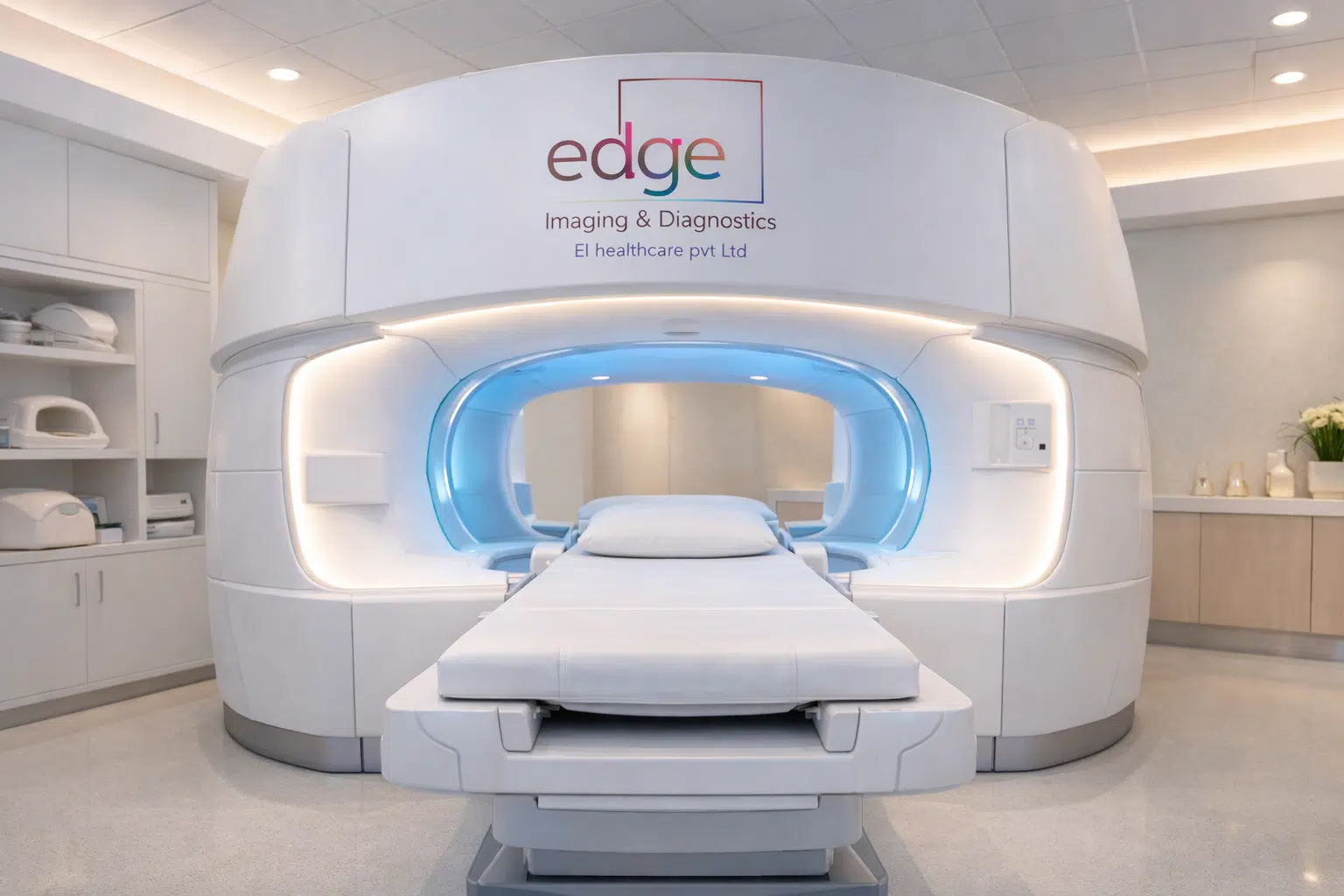
If a government hospital doctor has prescribed an MRI for you, Edge Imaging & Diagnostics in West Delhi offers a charitable MRI at ₹1,999*, with scans done from 9 PM onwards. To book, call or WhatsApp 9555999960 with your government hospital prescription, and we will confirm the centre and your slot.
*The ₹1,999 charitable rate applies to MRI Brain and MRI Spine only.
Many families in Delhi know this moment well. The doctor at the government hospital looks at you, listens to your problem, and writes “MRI” on the slip. Then comes the hard part. In a busy public hospital, the MRI date can sometimes be weeks away. And a private MRI can feel out of reach when you are already paying for travel, medicines and days away from work.
Doctors and staff in government hospitals work very hard for a very large number of patients. This service is not a replacement for that care. It is simply our way of helping patients who cannot wait, or who cannot afford private rates, to get the scan their doctor has asked for — and then go straight back to the same doctor with the report.
This guide explains, in simple words, who the charitable MRI is for, how to book it step by step, what an MRI brain and an MRI spine can show, how to stay safe, how to plan a night-time visit, and what to do after the scan. There is also a short Hinglish section for anyone searching for a “sasta MRI” or “sarkari hospital ki parchi par MRI”.
Charitable MRI at a glance
- Rate: ₹1,999* charitable rate
- Who it is for: patients who have a prescription or referral from a government hospital
- When: scans are done from 9 PM onwards
- How to book: call or WhatsApp 9555999960 and send a photo of your government hospital prescription
- Where: we will confirm the centre and slot when you book
- What to bring: we will tell you what to bring when you WhatsApp the prescription
- Contrast: if your doctor has asked for contrast, ask us about any extra charges
- After the scan: take the report back to your government hospital doctor
What this guide covers
- What the charitable MRI service is
- Who this service is for
- Why we started a charitable night MRI
- How to book, step by step
- What to bring and what to tell us
- The ₹1,999* rate: what to ask before you come
- What an MRI brain shows
- What an MRI spine shows
- Common reasons doctors order these scans
- When not to wait for any appointment
- Safety screening: implants, pacemakers and pregnancy
- Nervous in closed spaces? Open MRI
- What happens during the scan
- Coming at night: travel, family and safety
- After the scan: back to your hospital doctor
- Honest limits: what an MRI cannot do
- How this guide differs from our night MRI guide
- Patients from West Delhi government hospitals
- Plain-English glossary
- Myths and facts
- Mistakes to avoid
- Your charitable MRI checklist
- Seedhi baat: charitable MRI Hinglish mein
- Book your charitable MRI
- References
- Frequently asked questions
- The bottom line
What the charitable MRI service is
MRI (magnetic resonance imaging) is a scan that uses a strong magnet and radio waves to make detailed pictures of the inside of the body. It does not use X-ray radiation. Doctors use it to look closely at the brain, the spinal cord, the nerves, the discs of the spine and many other soft parts of the body.
The charitable MRI service at Edge Imaging & Diagnostics is a special rate of ₹1,999* for patients whose MRI has been prescribed by a doctor at a government hospital. The scans are done from 9 PM onwards. You book by calling or sending a WhatsApp message to 9555999960 with a photo of your government hospital prescription.
The scan itself is a proper diagnostic MRI. It follows the same safety checks as any other MRI at our centres, and the images are reviewed by a radiologist, who writes a report for your doctor. The only things that are different are the rate and the time of day.
If you want to read more about MRI in general before you book, our MRI scan overview explains the basics, and our guide to MRI vs CT scan explains why your doctor may have chosen an MRI and not a CT.
Who this service is for
The charitable MRI is meant for patients who have a prescription or referral from a government hospital. That is the key condition. For example, it may help:
- A patient whose government hospital doctor has written an MRI, and who cannot wait for the hospital’s MRI date
- A daily-wage worker who cannot afford private MRI rates
- A family travelling from outside Delhi for treatment at a government hospital, who would like the scan done before the next OPD visit
- An elderly parent whose son or daughter can only bring them after work, late in the evening
- Anyone with a government hospital prescription who simply finds a night slot easier
The key condition is the government hospital prescription. If you are not sure whether your hospital or your prescription counts, do not guess. Send us a photo of the prescription on WhatsApp and we will tell you clearly.
If you have a CGHS, DGHS or ESIC card and a referral from your Wellness Centre or dispensary, that is a different route with its own rules. Our guide to the CGHS and DGHS empanelled diagnostic centre in West Delhi explains how that works.
Why we started a charitable night MRI
An MRI is often the test that helps a doctor decide what to do next. Is the back pain from a disc pressing on a nerve? Is there a reason for the fits? What did the stroke do to the brain? Without the scan, the doctor may have to wait too.
Public hospitals in Delhi care for a huge number of patients, and their MRI machines are in heavy demand. So it is natural that an MRI date can sometimes be some weeks away. For many patients that is fine, and the hospital’s own MRI is the right choice. But for some, the wait is hard — because the pain is stopping them from working, because the family is worried, or because they have travelled a long way.
Private rates, on the other hand, are not possible for every family. The charitable rate of ₹1,999* is our attempt to meet patients in the middle. We use the late-night hours, from 9 PM onwards, to make this possible, so that the scan your government hospital doctor wants can be done sooner and at a rate more families can manage.
How to book, step by step
- Keep your government hospital prescription ready. Make sure the MRI is clearly written on it, and that your name is correct.
- Take a clear photo of the prescription in good light. All the words should be readable, including the hospital name and the doctor’s note.
- Call or WhatsApp 9555999960 and send the photo. Say that you are asking about the charitable MRI.
- We will check your prescription and tell you whether the charitable rate applies to your scan.
- We will confirm the centre and slot — the scans are done from 9 PM onwards.
- Answer a few safety questions about implants, devices, previous surgery and pregnancy.
- We will tell you what to bring, and whether anything special is needed for your scan.
- Call once on the day before you leave home, so your trip goes smoothly.
If your prescription mentions more than one scan, or more than one part of the body, send it anyway. We will explain clearly what applies to you before you travel, so there are no surprises at the counter.
What to bring and what to tell us
What to bring: the most important document is your government hospital prescription or referral. For anything else, we will tell you what to bring when you WhatsApp the prescription. It is always useful to keep these ready at home, in one folder:
- Your government hospital prescription or OPD slip (the original)
- Any old MRI, CT or X-ray reports and films — comparing old and new images helps the radiologist
- Any implant card or surgery papers, if you have a device or metal inside your body
- A list of the medicines you take
What to tell us when you book:
- The exact MRI written on your prescription
- Whether the prescription says “with contrast” or “plain”
- Any pacemaker, defibrillator, cochlear implant, nerve stimulator, insulin pump or other device
- Any metal in your body — clips, plates, screws, stents, a joint replacement, or metal pieces from an injury or from welding or grinding work
- Whether you are or might be pregnant
- Whether you feel afraid in closed spaces
- Whether the patient has difficulty lying flat, severe pain, confusion or hearing problems
These details help us plan your scan safely and choose the right slot.
The ₹1,999* rate: what to ask before you come
The charitable rate is ₹1,999* for patients with a prescription or referral from a government hospital, for scans done from 9 PM onwards. Please keep a few simple questions in mind when you call:
- Does my scan need contrast? Some MRIs need a dye injection, called contrast. If your doctor has asked for contrast, ask us about any extra charges for contrast before you come.
- Does the rate apply to everything on my prescription? Send the full prescription and we will confirm.
- What will I receive after the scan? Ask us about the report and images, and when they will be ready.
If your doctor has asked for an MRI with contrast, our guide to contrast MRI (CEMRI) explains why contrast is used and what safety checks are done. For our regular private pricing, see MRI scan cost in Delhi.
What an MRI brain shows
An MRI brain makes detailed pictures of the brain tissue, the fluid spaces inside the brain, and nearby structures. According to RadiologyInfo, doctors use a brain MRI to help look for:
- Stroke and the damage a stroke has caused
- Bleeding or injury after a head injury
- Tumours and growths
- Causes of epilepsy (fits), and some infections
- Long-term conditions such as multiple sclerosis
- Enlarged fluid spaces in the brain (hydrocephalus)
- Problems of the pituitary gland, the inner ear and the eye nerves
- Age-related changes in the brain
A brain MRI usually shows soft tissue in more detail than a CT scan. CT is still very useful, especially in emergencies, because it is fast. Your doctor chooses the test that best answers the question about your symptoms.
To read more, see our detailed guide to MRI brain scan in Delhi. If your doctor wants a closer look at the blood vessels of the brain, they may ask for a different test, called an MR angiography (MRA) of the brain.
What an MRI spine shows
The spine has three main parts: the neck (cervical spine), the upper and middle back (dorsal or thoracic spine) and the lower back (lumbar spine). An MRI spine shows the bones, the soft discs between them, the spinal cord and the nerves coming out of it.
RadiologyInfo describes MRI as the most sensitive imaging test available for the spine. Doctors use it to look for:
- Disc bulges and slipped discs, a common cause of back pain and sciatica
- Pressure on a nerve or on the spinal cord
- Injuries to the bones, discs or ligaments
- Infections and growths in or near the spine
- Compression fractures, for example in weak bones
- Changes after previous spine surgery
Your prescription should say which part of the spine needs scanning, for example “MRI LS spine” or “MRI cervical spine”. Read our guide to MRI spine in Delhi for the different types, and our page on MRI whole spine screening to understand when doctors look at the full spine. If the prescription is not clear about the part of the spine, send it to us on WhatsApp and we will help you check it.
Common reasons doctors order these scans
An MRI is not needed for every headache or every backache. Doctors usually ask for one when certain signs are present, or when a problem is not getting better. Here are some common reasons.
| Problem | Why the doctor may ask for an MRI |
|---|---|
| Headache with warning signs | Headache with vomiting, vision problems, or headache made worse by coughing or bending; a change in the usual pattern of headaches |
| Seizures (fits) | To look for a cause in the brain, especially after a first fit |
| Stroke follow-up | To see the area of the brain affected and help plan further care |
| Back pain with leg symptoms | Pain, numbness or weakness going down a leg (sciatica) that is not settling, or is getting worse |
| Neck pain with arm symptoms | Pain, tingling or weakness going down an arm, which may mean a nerve in the neck is being pressed |
| Dizziness, balance or memory problems | When the doctor wants to look for a cause inside the brain |
Headaches
Most headaches, including tension headaches and migraine, are not caused by anything serious and do not need a scan. The NHS lists warning signs that need urgent medical advice, such as a headache with vomiting, a headache with vision problems, or a headache that gets worse with coughing, sneezing or bending down. Your doctor will decide whether an MRI brain is the right next step.
Seizures
After a fit, doctors often want to look at the brain for a cause. An MRI brain is commonly used for this. Your doctor may also ask for a brain-wave test called an EEG; our guide to the EEG test explains what it involves.
Stroke follow-up
After a stroke, an MRI brain can show which part of the brain is affected. Doctors may also check the neck arteries with a carotid Doppler test, because narrowed neck arteries can raise the risk of another stroke. Follow your hospital’s plan for these tests.
Back pain with leg symptoms
Many backaches settle on their own with time, gentle activity and simple care. When pain spreads down the leg with numbness or weakness, and does not improve, doctors often ask for an MRI of the lower spine. Our article on back pain, sciatica and when an MRI is needed explains this in more detail.
Neck pain with arm symptoms
Neck pain is common, especially with long hours of work, heavy lifting or poor sleep. When neck pain comes with pain, tingling or weakness in an arm or hand, a nerve may be pressed in the neck. An MRI of the cervical spine can show this clearly.
When not to wait for any appointment
The charitable MRI is a planned scan. It is not an emergency service. If you or a family member has any of the signs below, go to the nearest hospital emergency department straight away. Do not wait for a night slot or for any appointment.
- A sudden, extremely painful headache
- Weakness or numbness of the face, arm or leg, especially on one side
- Slurred speech, confusion, or difficulty understanding
- A fit (seizure) for the first time, or a fit that does not stop
- Drowsiness, or loss of vision
- A headache with a high fever and a stiff neck
- Back pain with numbness around the private parts or the bottom
- New difficulty passing urine, or loss of control of the bladder or bowels
- Severe or worsening weakness in both legs
Doctors remember stroke signs with the word FAST: Face drooping, Arm weakness, Speech difficulty, Time to get help. These signs need emergency care first. The scan, if needed, will be done by the emergency team.
Safety screening: implants, pacemakers and pregnancy
The MRI magnet is very strong and it is always on. That is why every patient goes through a safety check before entering the scan room. The magnetic field does not harm the body, but it can affect some medical devices and pull on some metal objects.
Always tell us if you have:
- A pacemaker or a defibrillator (ICD)
- A cochlear implant or hearing implant
- Clips in the brain for an aneurysm
- A nerve or spinal cord stimulator
- An insulin or medicine pump
- Metal pieces in the eye or body — for example from welding, grinding or an old injury
- Any surgery with plates, screws, rods, stents or a joint replacement
Many orthopaedic implants, such as plates and screws, usually pose no problem. Some devices need careful checking, and some may mean an MRI is not safe. If you have an implant card or surgery papers, bring them. If you are unsure, tell us — our team will check before your scan.
Pregnancy: please tell us if you are pregnant or might be. According to RadiologyInfo, current data show no convincing evidence that MRI without contrast harms the unborn baby, but if the scan is not urgent, doctors may prefer to wait until after delivery. Contrast dye is generally avoided in pregnancy unless there is a strong reason. Your doctor and our team will decide together what is safest.
Other things to remove: jewellery, hair clips, belts, watches, coins, keys, mobile phones and cards with magnetic strips must not go into the scan room. You will usually be asked to change into a gown.
Nervous in closed spaces? Open MRI
Many people feel nervous about lying inside an MRI machine. This fear of closed spaces is called claustrophobia, and it is very common. Please tell us about it when you book, not when you are already on the table. You can:
- Ask about our Open MRI at Paschim Vihar, which is designed to feel less enclosed
- Bring a family member for support
- Ask your government hospital doctor whether a mild calming medicine before the scan would help
Whether the charitable slot is on the Open MRI or another scanner depends on the slot we confirm with you, so do mention your fear when you book. Our guide to Open MRI vs closed MRI explains the differences.
If you take a calming medicine, you must not drive afterwards. At night this matters even more — please come with someone who can take you home.
What happens during the scan
- You arrive, register and fill in a safety form.
- You change into a gown and put your belongings in a safe place.
- You lie on a padded table that slides into the scanner. For a brain MRI, a light frame (called a coil) is placed around your head. For a spine MRI, you usually lie on your back.
- You get ear plugs or headphones, because the machine makes loud knocking and buzzing sounds. This is normal.
- The technologist talks to you through a speaker and can hear you throughout.
- You need to lie very still so the pictures are clear.
- You may be given a call button to press if you need help.
The scan is painless. Most MRI scans take between 15 minutes and 1 hour, depending on the body part and the pictures your doctor needs. Add time for registration, the safety check and changing. If you have contrast, a small injection is given in a vein in the arm, and some more pictures are taken.
If you have severe back pain and find it hard to lie flat, tell the team. Small pillows and support under the knees can help. Taking your usual pain medicine as prescribed by your doctor before coming may also help you lie still.
Coming at night: travel, family and safety
The charitable scans are done from 9 PM onwards. A night visit needs a little planning, especially for elderly patients and anyone in pain.
Before you leave home
- Call once to confirm your slot before you travel.
- Ask for the exact address and a location pin on WhatsApp.
- Plan your trip back home before you leave. Check the timings of your metro, bus or other transport, because they can change late at night.
- Keep your phone charged, and carry a little cash for an auto or cab.
- Eat a light meal, unless you have been told otherwise.
Bring a family member
We strongly suggest that someone comes with you, especially if the patient is elderly, in a lot of pain, has had a stroke or fits, or may be given a calming medicine. A family member can help with forms, carry the papers and take the patient home safely.
For women patients
If you are coming alone late at night, share your live location with a family member and let them know when you reach and when you leave. Better still, bring someone with you.
For patients with children
Young children usually cannot go into the scan room. If you have to bring them, bring another adult who can stay with them outside.
If you are running late
Call us. We will tell you what is possible on the day. Please do not rush or drive fast to reach on time.
After the scan: back to your hospital doctor
- You can usually eat, drink and go home straight after the scan.
- If you were given a calming medicine, do not drive and have someone take you home.
- If you had contrast and feel unwell later, contact a doctor.
- Ask us when your report will be ready and how you will receive it.
After the scan, the images are reviewed by a radiologist, who prepares a written report. Take the report and images back to your government hospital doctor — the same doctor who prescribed the MRI. They know your history, they examined you, and they will decide the next step in your treatment.
Please do not start, stop or change any medicine on your own after reading the report. Some words on an MRI report can sound frightening, but many are common findings. Your doctor will explain what they mean for you.
Honest limits: what an MRI cannot do
An MRI is a very useful test, but it is not magic. It is fair to know its limits before you come.
- An MRI does not answer every question. Some causes of headache, back pain or dizziness do not show on any scan. A “normal” MRI is still useful, because it helps the doctor rule out some problems.
- Findings must match your symptoms. Many adults have disc bulges or small age-related changes on their MRI that cause no pain at all. That is why the report often says “clinical correlation advised” — your doctor must match the pictures with your examination.
- Movement blurs the pictures. If the patient cannot lie still because of pain, fear or confusion, the images may not be clear, and part of the scan may need to be repeated.
- Metal can affect the images. Implants near the area being scanned can make some parts harder to see.
- Some problems need other tests. For example, CT may show some bone fractures better, and blood tests, EEG or nerve tests may be needed alongside the MRI.
- MRI is not always safe for everyone. Some devices and implants mean an MRI cannot be done, or needs special precautions.
The most important rule is simple: follow your doctor. The scan helps your doctor; it does not replace them.
How this guide differs from our night MRI guide
We also have a guide to night MRI after 7 PM in Delhi. The two are related, but they are for different people.
| Night MRI after 7 PM guide | This charitable MRI guide | |
|---|---|---|
| Who it is for | Working professionals and anyone who prefers an evening slot | Patients with a prescription or referral from a government hospital |
| Timing | From 7 PM onwards, at your comfort time | Scans done from 9 PM onwards |
| Rate | Regular pricing; ask us for today’s price | ₹1,999* charitable rate |
| Main focus | Booking a scan around your work | Getting the scan your government hospital doctor asked for, sooner and at a rate more families can manage |
If you do not have a government hospital prescription but still need an evening MRI, the night MRI guide is the right page for you.
Patients from West Delhi government hospitals
Our centres are in West Delhi, so many patients who contact us are treated at government hospitals in this part of the city. For example, a patient’s prescription may come from Acharya Shree Bhikshu Government Hospital in Moti Nagar, Guru Gobind Singh Government Hospital in Raghubir Nagar, or Deen Dayal Upadhyay Hospital in Hari Nagar. Patients from other government hospitals in Delhi are also welcome to ask.
We name these hospitals only as examples of where a prescription may come from. Naming them does not mean any tie-up, partnership or referral arrangement with them. Your treatment stays with your hospital doctor. We only do the scan and send you back with the report.
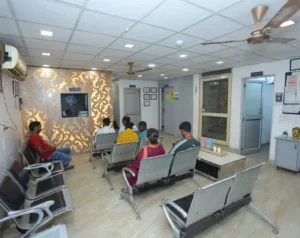
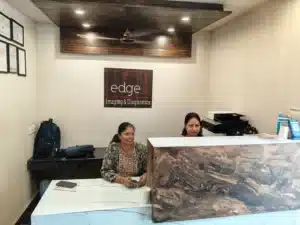
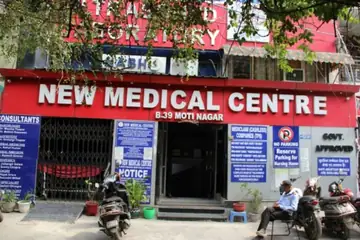
Edge Imaging & Diagnostics has three centres in West Delhi: Paschim Vihar (Bhera Enclave, opposite Radisson Blu Hotel), Raghubir Nagar (Tagore Garden Extension) and Moti Nagar. For the charitable MRI, we will confirm the centre and slot when you book. You can also see all addresses and directions on our contact page.
Plain-English glossary
| Word | Simple meaning |
|---|---|
| MRI | A scan using a strong magnet and radio waves to make detailed pictures; no X-ray radiation |
| Prescription / referral | The doctor’s written note asking for the test |
| Radiologist | A doctor trained to read scans and write the report |
| Contrast (gadolinium) | A dye injected into a vein to show some areas more clearly |
| Plain MRI | An MRI without contrast dye |
| Cervical / dorsal / lumbar spine | Neck / upper and middle back / lower back |
| LS spine | Lumbosacral spine: the lower back down to the tailbone area |
| Disc bulge / protrusion | The soft cushion between spine bones is pushing outwards |
| Nerve root compression | A nerve is being pressed, which can cause pain or numbness in a leg or arm |
| Canal stenosis | The space for the spinal cord or nerves has become narrow |
| Degenerative changes | Wear-and-tear changes, often age-related |
| Infarct | An area of brain damaged by a lack of blood supply, as in a stroke |
| White matter changes / hyperintensities | Bright spots in the brain’s wiring; they have many causes, including age and blood pressure, and your doctor will explain what they mean for you |
| Hydrocephalus | Enlarged fluid spaces inside the brain |
| Claustrophobia | Fear of closed spaces |
| Clinical correlation advised | Your doctor should match the scan findings with your symptoms and examination |
Myths and facts
| Myth | Fact |
|---|---|
| “A charitable MRI must be a lower-quality scan.” | It is a proper diagnostic MRI with the same safety checks, reviewed by a radiologist. Only the rate and the time of day are different. |
| “MRI gives radiation like an X-ray or CT.” | MRI does not use X-ray radiation. |
| “Any metal in the body means no MRI.” | Many implants are fine; some devices need checking or rule out MRI. Always tell us so we can check safely. |
| “If the MRI is normal, the doctor was wrong.” | A normal MRI is useful. It helps the doctor rule out some causes and plan the next step. |
| “A disc bulge on the report always needs surgery.” | Disc bulges are common and many cause no symptoms. Most back pain is treated without surgery. Your doctor decides. |
| “I can skip going back to my hospital doctor once I have the report.” | The report is for your doctor. Always take it back to the doctor who prescribed the scan. |
| “If I am scared of closed spaces, I can never have an MRI.” | Tell us. Options include Open MRI, a support person, or a calming medicine advised by your doctor. |
Mistakes to avoid
- Coming without the government hospital prescription.
- Sending a blurred photo of the prescription that we cannot read.
- Not mentioning a pacemaker, implant or metal piece in the body.
- Not telling us about contrast on the prescription, and then being surprised at the counter.
- Hiding a fear of closed spaces until you are on the table.
- Travelling at night without confirming your slot first.
- Not planning how to get home late at night.
- Driving yourself home after a calming medicine.
- Using the night slot instead of going to an emergency department when there are warning signs.
- Not taking the report back to your government hospital doctor.
Your charitable MRI checklist
| Item | Done? |
|---|---|
| Clear photo of the government hospital prescription sent on WhatsApp to 9555999960 | ☐ |
| Centre and slot (from 9 PM onwards) confirmed | ☐ |
| Asked about contrast charges, if contrast is written | ☐ |
| Original prescription packed | ☐ |
| Anything else we asked you to bring, packed | ☐ |
| Old reports, films or CDs packed | ☐ |
| Implant or device details ready | ☐ |
| Family member coming along | ☐ |
| Return trip home planned | ☐ |
| Called once on the day before leaving home | ☐ |
Seedhi baat: charitable MRI Hinglish mein
Ye service kiske liye hai? Jin patients ke paas sarkari (government) hospital ka prescription ya referral hai, unke liye. Edge Imaging me charitable rate ₹1,999* hai, aur scan raat 9 baje ke baad hote hain.
Book kaise karein? 9555999960 par call ya WhatsApp karo, aur sarkari hospital ki parchi (prescription) ki saaf photo bhejo. Hum centre aur slot confirm kar denge.
Kya laana hai? Sarkari hospital ka original prescription. Baaki kya laana hai, wo hum WhatsApp par prescription dekhkar bata denge. Purani reports aur films bhi saath le aao.
Contrast likha hai to? Agar doctor ne contrast likha hai, to aane se pehle humse contrast ke extra charges ke baare me pooch lo.
Raat ko aana safe hai? Kisi family member ko saath laao, ghar wapas jaane ka intezaam pehle se kar lo, aur nikalne se pehle ek baar call karke slot confirm kar lo.
Band machine se darr lagta hai? Booking ke time bata do. Open MRI ke baare me pooch sakte ho.
Report ke baad kya? Report lekar wapas apne sarkari hospital ke doctor ko dikhao. Wahi aage ka ilaaj decide karenge.
Book your charitable MRI
If your government hospital doctor has prescribed an MRI, send us the prescription. At Edge Imaging & Diagnostics, West Delhi, the charitable rate is ₹1,999*, with scans done from 9 PM onwards. We will check your prescription, confirm the centre and slot, and tell you what to bring. If your doctor has asked for contrast, ask us about any extra charges.
💬 WhatsApp your government hospital prescription | Call 9555999960
*The ₹1,999 charitable rate applies to MRI Brain and MRI Spine only.
Other numbers: 96677 41121, 95998 62737, 93199 88570; Paschim Vihar reception 011-49988416.
References
- MRI scan — NHS, UK.
- Brain MRI — RadiologyInfo.org (Radiological Society of North America and American College of Radiology).
- Spine MRI — RadiologyInfo.org.
- MRI safety — RadiologyInfo.org.
- Headaches — NHS, UK.
- Sciatica — NHS, UK.
Frequently asked questions
What is the charitable MRI at Edge Imaging?
It is a special charitable rate for patients who have a prescription or referral from a government hospital. The scans are done from 9 PM onwards at Edge Imaging & Diagnostics in West Delhi.
How much does the charitable MRI cost?
The charitable rate is ₹1,999* for patients with a prescription or referral from a government hospital, with scans done from 9 PM onwards. If your doctor has asked for contrast, ask us about any extra charges for contrast. *The ₹1,999 charitable rate applies to MRI Brain and MRI Spine only.
Who can use this service?
Patients who have a prescription or referral from a government hospital. If you are not sure whether your prescription counts, WhatsApp a photo of it to 9555999960 and we will tell you.
What time are the charitable MRI scans done?
The scans are done from 9 PM onwards. We will confirm the centre and your slot when you book.
How do I book the charitable MRI?
Call or WhatsApp 9555999960 and send a clear photo of your government hospital prescription. We will check it, confirm the centre and slot, and tell you what to bring.
What documents do I need?
The main document is your government hospital prescription or referral. We will tell you what else to bring when you WhatsApp the prescription.
Which centre will my scan be at?
We will confirm the centre and slot when you book. Edge Imaging has centres in Paschim Vihar, Raghubir Nagar and Moti Nagar in West Delhi.
Is contrast included?
If your doctor has asked for an MRI with contrast, please ask us about any extra charges for contrast when you book, so there are no surprises.
Is the charitable MRI a different quality from a regular MRI?
No. It is a proper diagnostic MRI with the same safety checks, and the images are reviewed by a radiologist. Only the rate and the time of day are different.
Can I bring an elderly parent for a night scan?
Yes. A family member can come along to the centre. Tell us about any difficulty walking or lying flat, hearing problems, confusion, implants or fears when you book.
Can I have an MRI if I have metal or a pacemaker in my body?
Always tell us first. Many orthopaedic implants are fine, but devices such as pacemakers need careful checking and may mean an MRI is not safe. Bring any implant card or surgery papers.
Can I have an MRI if I am pregnant?
Tell us if you are or might be pregnant. Current data show no convincing evidence that MRI without contrast harms the baby, but non-urgent scans may be delayed, and contrast is generally avoided. Your doctor and our team will decide what is safest.
What if I am scared of closed spaces?
Tell us when you book. You can ask about Open MRI, bring a family member, or ask your doctor about a mild calming medicine. If you take one, do not drive home.
Is it safe to come for a scan at night?
Bring a family member, plan your trip home before you leave, keep your phone charged, and call once to confirm your slot before you travel.
What should I do with the report?
Take the report and images back to the government hospital doctor who prescribed the MRI. They will explain the findings and decide your next step.
Sarkari hospital ki parchi par MRI kaise book karein?
9555999960 par call ya WhatsApp karo aur sarkari hospital ke prescription ki saaf photo bhejo. Hum centre aur slot confirm karke bata denge ki kya laana hai.
Raat ko MRI kitne baje hota hai?
Charitable MRI ke scan raat 9 baje ke baad hote hain. Nikalne se pehle ek baar call karke apna slot confirm kar lo.
The bottom line
If a government hospital doctor has asked for your MRI and you cannot wait, or cannot afford private rates, the charitable MRI at ₹1,999* may help. The scans are done from 9 PM onwards, and booking takes one message: call or WhatsApp 9555999960 with your government hospital prescription.
We will check your prescription, confirm the centre and slot, tell you what to bring, and answer your questions about contrast. Come with a family member, tell us about any implants or fears, and plan your trip home.
Most of all, remember that the scan is one step in your care, not the whole journey. Take the report back to your government hospital doctor, follow their advice, and let them guide your treatment. Our job is to help you get there a little sooner.
Written by the team at Edge Imaging & Diagnostics, West Delhi. Medically reviewed by Dr. Nishant Thapar. Last reviewed: October 2026.
Disclaimer: this article is general information and not medical advice. The ₹1,999* charitable rate is for patients with a prescription or referral from a government hospital, with scans done from 9 PM onwards; please call or WhatsApp 9555999960 to confirm the centre and slot before you travel. *The ₹1,999 charitable rate applies to MRI Brain and MRI Spine only. Government hospitals named in this article are mentioned only as examples of where a prescription may come from, and naming them does not mean any tie-up, partnership or referral arrangement. This service is not for emergencies. Always follow your doctor’s advice about which scan you need and what to do next.