
 PV
 TG
 MN
 EM
 EI
 ND

 CT Scan
 PET CT
 Digital X-ray
 Ultrasound
 Amniocentesis

 Fetal Reduction
 Thermalytix Breast Screening
 Cardiology
 Lab Tests
If the thought of sliding into a narrow MRI tunnel makes your chest tighten, you are far from alone — and it is a real reason people put off a scan their health depends on. Then you hear about an “Open MRI” and the obvious question follows: is it just more comfortable, or is it actually as good?
This guide answers that honestly. We will compare open and closed MRI on the things that genuinely matter — comfort, accuracy, who each one suits, and cost — so you can walk in for the scan you need instead of avoiding it out of fear.
The quick answer
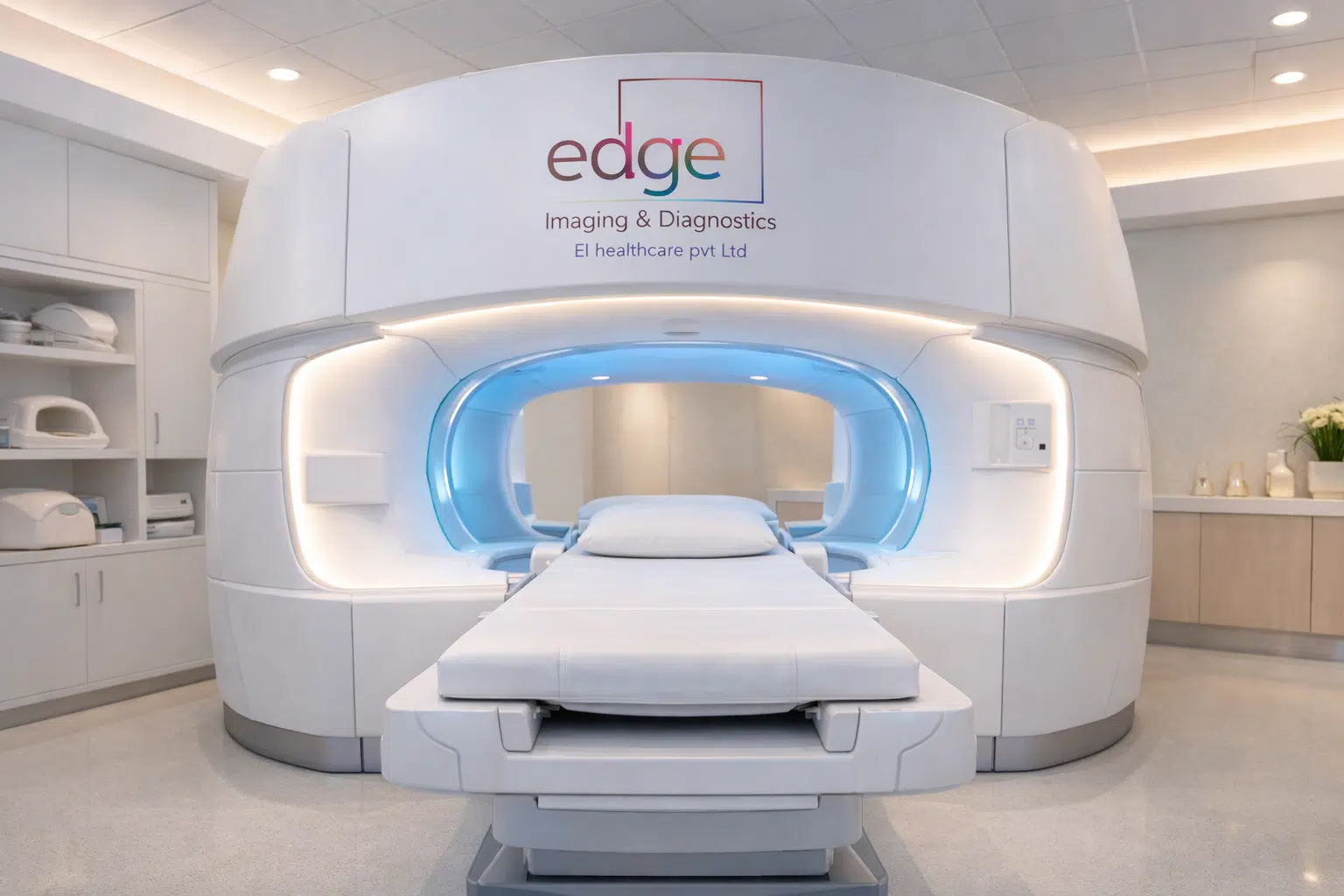
Both open and closed MRI produce the detailed, radiation-free images your doctor needs. The main difference is the design: a closed MRI is a narrow tunnel, while an open MRI is open on the sides — far more comfortable for anyone anxious about enclosed spaces. For the vast majority of everyday scans, an open MRI gives an accurate, reliable result — and at a good centre it costs the same, so you are not paying extra for comfort.
Open MRI vs closed MRI at a glance
| Open MRI | Closed MRI | |
|---|---|---|
| Design | Open on the sides, spacious | Narrow enclosed tunnel |
| Comfort / claustrophobia | Much easier — calm and open | Can trigger anxiety or panic |
| Larger body types | Roomy, accommodates more patients | Space and weight limits |
| Children & elderly | Easier — a parent can stay close | Harder to keep still and calm |
| Image quality | High-resolution, diagnostic for most scans | Excellent — traditional benchmark |
| Radiation | None | None |
| Noise | Generally quieter, less enclosed | Louder inside the tunnel |
What a closed MRI is
A closed MRI is the traditional machine — a cylindrical tunnel you lie inside. It has long been the benchmark for image quality, and for certain highly specialised studies a doctor may specifically request a high-field closed machine. The trade-off is the experience: the tunnel is narrow, enclosed and noisy, which can be genuinely distressing for anxious or claustrophobic patients, and it has practical space and weight limits that do not suit every body.
What an open MRI is
An open MRI is built to remove that stress. Instead of a tunnel, it is open on the sides — spacious, calmer and far less intimidating — while still using the same magnetic fields and radio waves to create detailed images. Crucially, it involves no radiation, making it safe for repeat scans and for every age. For most routine scans, it delivers the clarity your doctor needs, with an experience most patients can actually relax through.
Is an open MRI as accurate as a closed one?
For the great majority of scans, yes — a modern open MRI produces high-resolution images comparable to a closed machine, giving your doctor an accurate, dependable diagnosis. There are a small number of highly specialised studies where a doctor may specifically prefer a high-field closed machine, and a good centre will tell you honestly if that applies to you. But for everyday brain, spine, joint and abdominal imaging, an open MRI is diagnostic — and the comfort it adds often means a better scan, because a calm, still patient produces clearer images than an anxious one struggling in a tunnel.
Who should choose an open MRI?
- Anyone claustrophobic or prone to panic in enclosed spaces.
- Larger body types who find a closed tunnel tight or are not sure they will fit at all — bore diameter and table weight limit are two separate things to check.
- Children, who stay calmer when a parent can remain beside them.
- Elderly patients who feel uneasy or find it hard to stay still in a tunnel.
- Anyone who has avoided or abandoned a closed MRI because of anxiety.
If any of these sound like you, the open MRI is very likely the scan you can finally say yes to.
Already tried a closed MRI and had to come out partway? That is far more common than people realise, and it is fixable. Our guide on what to do if you could not complete an MRI sets out six practical routes to getting the scan finished — including feet-first positioning, shortened protocols and the actual rules around sedation.
Is an open MRI more expensive?
It should not be. At Edge Imaging, the Open MRI is offered at the same listed price as a standard MRI — you are not charged extra for comfort. For exact figures across scan types, see our transparent MRI scan cost in Delhi guide. And if you are still deciding between imaging types altogether, our MRI vs CT scan comparison explains which scan suits which problem.
Book a comfortable Open MRI at Edge Imaging, West Delhi
Edge Imaging & Diagnostics offers a spacious, radiation-free Open MRI in West Delhi — the same accurate imaging as a closed machine, without the tunnel — reviewed by experienced radiologists, with same-day reporting and transparent, no-hidden-charge pricing. If you have been putting off a scan because of anxiety, message us and we will walk you through it and share the cost before you come in.
📩 Book a comfortable Open MRI on WhatsApp | Call 9555999960
Frequently asked questions
Is an open MRI as good as a closed MRI?
For the vast majority of scans, yes. A modern open MRI gives high-resolution images comparable to a closed machine and an accurate diagnosis. A few highly specialised studies may call for a high-field closed machine, and a good centre will tell you if that applies to you.
Is an open MRI better for claustrophobia?
Yes — this is its biggest advantage. Because it is open on the sides rather than an enclosed tunnel, it is far more comfortable for claustrophobic or anxious patients, and many people who cannot tolerate a closed MRI complete an open one easily.
Does an open MRI use radiation?
No. Like all MRI, it uses magnetic fields and radio waves — no radiation at all — so it is safe for repeat scans and for all ages.
Is an open MRI more expensive than a closed one?
It should not be. At Edge Imaging, the open MRI is priced the same as a standard MRI, so comfort does not cost you extra.
Who should choose an open MRI?
Anyone who is claustrophobic, has a larger body type, is elderly, or is scanning a child — and anyone who has previously struggled with or abandoned a closed MRI due to anxiety.
How long does an open MRI take?
On average 30 to 60 minutes, depending on the body part being scanned — similar to a closed MRI, but in a far more comfortable setting.
The bottom line
Open versus closed MRI is not really a battle of accuracy — for most scans, both give your doctor the answer. It is about getting the scan done at all. If a tunnel has ever made you cancel, delay or dread an MRI, an open machine removes that barrier — same reliable imaging, no radiation, same price, and an experience you can actually relax through.
Open MRI at Edge Imaging & Diagnostics, West Delhi — a NABH-accredited diagnostic centre — is reviewed by experienced radiologists. Suitability for a specific study is always confirmed by your doctor and the examining radiologist. This article is for general information only and is not medical advice. Last updated: 2026.