
 PV
 TG
 MN
 EM
 EI
 ND

 CT Scan
 PET CT
 Digital X-ray
 Ultrasound
 Amniocentesis

 Fetal Reduction
 Thermalytix Breast Screening
 Cardiology
 Lab Tests
Your doctor has written “CT scan” — but a friend swears an MRI is “better.” Now you are stuck wondering if you are getting the right test. It is one of the most common sources of confusion in a diagnostic centre, and the honest truth is reassuring: neither scan is universally “better.” They simply see different things, and the right one depends entirely on what your doctor is looking for.
This guide explains the real difference between an MRI and a CT scan in plain language — what each is genuinely good at, which is safer, how the costs compare, and exactly when one is chosen over the other — so you can walk in understanding your scan instead of second-guessing it.
The quick answer
A CT scan is fast and excellent for bone, bleeding, the lungs, kidney stones and emergencies. An MRI is slower but unmatched for soft tissue — the brain, spinal cord, ligaments, nerves and subtle tumours. As a rough rule: bone, chest, trauma and “we need it now” → CT; brain, spine, joints and soft-tissue detail → MRI. Your doctor picks based on your symptoms — and sometimes you genuinely need both.
MRI vs CT at a glance
| CT scan | MRI scan | |
|---|---|---|
| How it works | X-rays taken from many angles | Strong magnet + radio waves (no X-rays) |
| Best for | Bone, lungs, bleeding, stones, trauma | Brain, spinal cord, ligaments, nerves, soft tissue |
| Speed | Very fast (seconds to a few minutes) | Slower (30–60 minutes) |
| Radiation | Yes (uses X-rays) | None |
| Soft-tissue detail | Good | Excellent — the gold standard |
| Bone & lung detail | Excellent | Limited |
| Comfort | Quick, open, easy | Longer & noisier (an Open MRI eases anxiety) |
| Cost | Usually lower | Usually higher |
What a CT scan is best at
A CT (computed tomography) scan uses X-rays to build fast, detailed cross-sections of the body. Its great strengths are speed and its clarity on hard structures and acute problems. Doctors typically choose a CT for:
- Head injury and stroke — it quickly shows bleeding in the brain, which is a medical emergency.
- Bone fractures and trauma — complex breaks, spine injuries and accident assessment.
- Chest and lungs — infections, nodules and conditions like those seen on an HRCT.
- Kidney stones and abdominal pain — a CT KUB is one of the best ways to find stones.
- Emergencies — because it takes only minutes, it is ideal when time matters or a patient cannot lie still for long.
What an MRI is best at
An MRI (magnetic resonance imaging) uses a powerful magnetic field and radio waves — no radiation at all — to produce exceptionally detailed images of soft tissue. It is the scan of choice for:
- Brain and nerves — fine detail for tumours, multiple sclerosis, and causes of seizures or headaches.
- Spine and spinal cord — slipped discs, nerve compression and back or neck pain.
- Joints and ligaments — knee, shoulder and cartilage injuries that X-ray and CT simply cannot show as well.
- Soft-tissue tumours and organs — where subtle differences in tissue matter.
Which one is safer?
This is where many patients worry. The key difference is radiation: a CT uses X-rays, so it carries a small radiation dose, while an MRI uses no radiation at all. For that reason, MRI is often preferred for younger patients or when repeated scans are expected.
But “no radiation” does not automatically make MRI the right choice. Because an MRI uses a powerful magnet, it is not suitable for everyone — people with certain pacemakers, cochlear implants or specific metal implants may not be able to have one, and your centre will screen you for this carefully. A CT, being fast and open, is sometimes the safer practical choice for someone in pain, claustrophobic, or unable to stay still. In short: the “safer” scan is the one that is right for your body and your problem — which is exactly why the decision sits with your doctor.
How the cost compares
As a rule, an MRI usually costs more than a CT scan of the same region, because it takes longer and uses more complex technology. But the honest comparison is not MRI-versus-CT on price — it is which scan answers your doctor’s question, because the wrong cheap scan helps no one. For exact figures, see our transparent guides on MRI scan cost in Delhi and CT scan cost in Delhi.
Can you need both?
Yes, and it is more common than people expect. The two scans complement each other — a CT might quickly reveal a problem, and an MRI then characterises it in detail. For example, a CT may spot a suspicious area in the abdomen, and an MRI clarifies exactly what it is. If your doctor orders both, it is not a mistake or a way of running up a bill — it is two different lenses on the same question.
So how do I know which I need?
You do not have to. That decision belongs to your doctor, who chooses based on your symptoms, history and what needs to be ruled in or out. Your job is simpler: carry your prescription, mention any implants or metal in your body, and go to a centre that can do either scan well and report it reliably. If you are ever unsure why a particular scan was chosen, it is always fair to ask — a good centre will happily explain.
Get your MRI or CT at Edge Imaging & Diagnostics, West Delhi
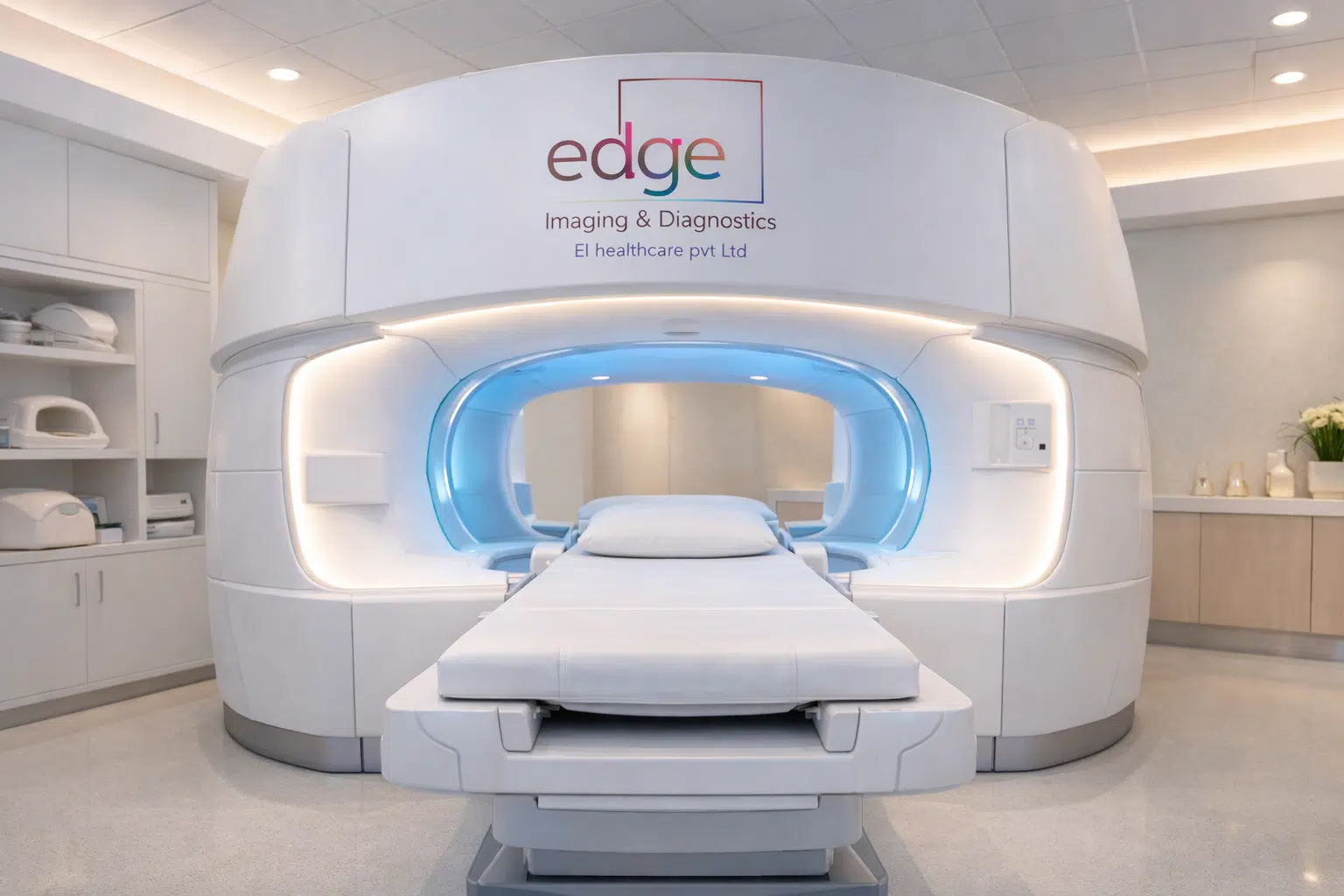
Edge Imaging & Diagnostics is a NABH-accredited centre offering both CT and MRI — including a spacious, radiation-free Open MRI for anyone anxious about the tunnel — under one roof, with experienced radiologists and fast same-day reporting. If you have a prescription and are unsure what it involves or what it will cost, just message us a photo and we will explain the scan and share an all-inclusive quote before you come in.
📩 Ask us on WhatsApp which scan you need | Call 9555999960
One practical reason people end up choosing CT over MRI is space rather than medicine: a CT gantry opening is usually wider than an MRI bore and CT table ratings are often higher. Before you accept that swap, read how MRI bore size and table weight limits actually work — a 70cm wide-bore scanner solves the clearance problem for most people, and CT is not equivalent to MRI for the spinal cord, bone marrow, cartilage or ligaments.
Frequently asked questions
Is an MRI better than a CT scan?
Neither is universally better — they show different things. MRI is superior for soft tissue like the brain, spine and joints; CT is superior for bone, lungs, bleeding and emergencies. The right scan depends entirely on what your doctor needs to see.
What is the main difference between MRI and CT?
A CT uses X-rays and is fast, making it excellent for bone, chest and acute problems. An MRI uses a magnetic field and radio waves with no radiation, giving unmatched soft-tissue detail but taking longer.
Which has radiation — MRI or CT?
Only the CT scan uses radiation (X-rays). An MRI uses no radiation at all, which is why it is often preferred for younger patients or when repeated scans are likely.
Why is MRI more expensive than CT?
An MRI takes longer and uses more complex magnetic technology, so it usually costs more than a CT of the same region. What matters most, though, is choosing the scan that actually answers your doctor’s question.
Can I choose to have an MRI instead of a CT?
It is best not to self-select. The two scans are not interchangeable — each is better for certain problems, and MRI is unsafe for some people with implants. Follow your doctor’s prescription, and ask them if you would like to understand the choice.
Is an Open MRI as good as a regular MRI?
Yes. An Open MRI provides high-resolution images comparable to a closed machine, with a spacious design that is far more comfortable for claustrophobic patients, children, the elderly and larger body types.
The bottom line
MRI versus CT is not a contest — it is a matter of matching the right tool to the right question. CT is your fast, bone-and-emergency scan; MRI is your detailed, radiation-free soft-tissue scan. Trust your doctor’s choice, go to a centre that does both well, and you will get exactly the answer your treatment depends on.
MRI and CT studies at Edge Imaging & Diagnostics, West Delhi — a NABH-accredited diagnostic centre — are reported by experienced radiologists. This article is for general information only and does not replace your doctor’s advice. Last updated: 2026.