
 PV
 TG
 MN
 EM
 EI
 ND

 CT Scan
 PET CT
 Digital X-ray
 Ultrasound
 Amniocentesis

 Fetal Reduction
 Thermalytix Breast Screening
 Cardiology
 Lab Tests
 GAMCA Pre-Medical
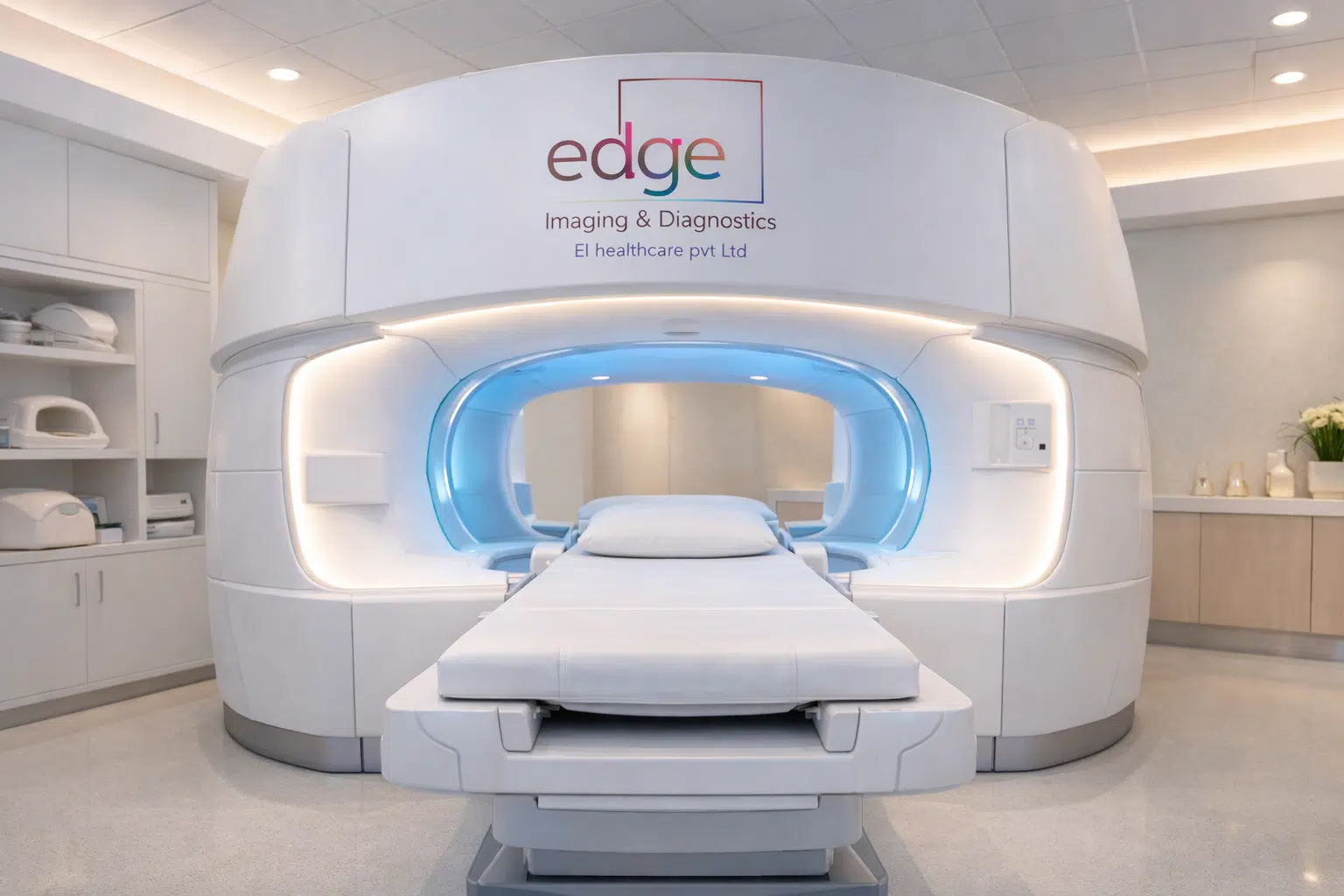
Your prescription says “MRI Whole Spine Screening”, and it looks like it should cost three times a normal spine MRI — or perhaps someone has told you it is the thorough version and you should just get it done.
Neither assumption is quite right, and the difference matters both clinically and financially. A whole spine screening is a specific kind of study with a specific job: it surveys the entire spine to find where the problem is. It is not the same as a detailed MRI of one region, it does not replace one, and understanding that distinction is what stops people paying twice.
This guide explains exactly what the study is, what it finds that a regional scan would miss, why it is ordered so often in India in particular, when a combined study is the right answer, the warning signs that mean you should not be booking an outpatient scan at all, and what it costs in Delhi in 2026.
The quick answer
An MRI whole spine screening covers the cervical, dorsal and lumbosacral spine in one sitting, using a limited set of sequences — typically sagittal images through the whole column — to survey the spinal cord, the vertebrae and the bone marrow from top to bottom. It takes about 25–40 minutes, uses no radiation, and in Delhi generally costs in the region of ₹8,000–₹15,000, with screening protocols usually towards the lower end of that band.
Its purpose is to find the level, not to detail it. Once a screening study identifies where the abnormality is, a dedicated regional MRI of that area is often done for the fine detail a surgeon needs. That is why you will sometimes see a prescription asking for both.
Screening versus a dedicated regional MRI — the distinction that saves money
| Whole spine screening | Dedicated regional MRI | |
|---|---|---|
| Covers | Neck to sacrum, entire column | One region — cervical, dorsal or lumbar |
| Sequences | Limited, mostly sagittal | Full set, including axial images through each level |
| Answers | “Is there something anywhere, and where?” | “Exactly what is happening at this level?” |
| Good for | Metastases, marrow disease, TB, cord compression at unknown level, multi-level disease | Disc herniation detail, nerve root compression, canal measurement, surgical planning |
| Not good for | Fine surgical detail at one level | Anything outside the region scanned |
This is the crux of it. A screening study that reports a lesion at D8 has done its job perfectly — but a surgeon planning an operation at D8 will usually still want dedicated sequences through that level. Conversely, a beautifully detailed lumbar MRI tells you nothing whatsoever about a deposit in the cervical spine. For everyday back pain and sciatica, a regional study is the right test — our MRI spine guide covers that, and our guide on back pain and sciatica — when an MRI is needed covers whether you need a scan at all.
Why would a doctor want the whole spine?
Because certain diseases do not stay in one place, and because the spine has a habit of causing pain a long way from where the problem is.
1. Tuberculosis of the spine — and skip lesions
This is the single most important reason whole spine screening is ordered so frequently in India, and it deserves proper explanation.
Spinal tuberculosis, also called Pott’s spine, does not always involve adjacent vertebrae. In a notable minority of patients it produces skip lesions — separate areas of disease at another level entirely, with normal vertebrae in between. A patient with obvious disease in the dorsal spine can have a second, clinically silent focus in the cervical or lumbar region.
If only the symptomatic region is scanned, that second site is simply not seen — and it can declare itself months later, sometimes as a neurological emergency. This is why physicians managing suspected spinal TB routinely ask for the whole spine rather than one region, and it is a genuinely sound clinical reason rather than over-investigation. Contrast is often added in this setting to define abscesses and the extent of soft-tissue involvement.
2. Metastases and bone marrow disease
The spine is one of the commonest sites for cancer to spread to bone, and deposits are frequently at multiple levels. MRI shows bone marrow directly, so a whole spine survey can identify deposits well before they cause vertebral collapse or become visible on X-ray. The same applies to multiple myeloma and related marrow disorders, where the pattern across the whole column is part of the diagnosis. For a survey extending beyond the spine, a whole body MRI may be preferred.
3. Cord compression when the level is not obvious
When someone develops weakness, altered sensation or difficulty walking, the spinal cord may be compressed — but the neurological signs do not always point precisely to the level, and sometimes the compression sits well above where the pain is felt. Screening the whole spine finds it. This is time-critical: the sooner compression is relieved, the better the neurological recovery tends to be.
4. Demyelinating disease
In suspected multiple sclerosis and related conditions, lesions can occur anywhere along the cord as well as in the brain. Assessment usually involves the whole spine together with an MRI brain, because the distribution of lesions in space is part of how the diagnosis is made.
5. Symptoms that do not localise
Pain in several areas at once, symptoms in both arms and both legs, or a picture that does not fit any single region — these are good reasons to look at the whole column rather than guess which third to scan.
6. Other established reasons
- Syringomyelia and Chiari malformation — a fluid cavity in the cord can extend over many segments, so the whole cord is assessed.
- Spinal dysraphism and tethered cord in children, where the whole spine is imaged as standard.
- Ankylosing spondylitis and inflammatory back pain, assessing activity across the column and the sacroiliac joints.
- Scoliosis before surgery, to map the deformity and exclude an underlying cord abnormality.
- Significant trauma, where injuries at more than one level are common and easily missed.
- Suspected spinal infection other than TB, including discitis and epidural abscess.
Stop and read this: when it is an emergency, not an appointment
Some spinal symptoms should not be managed by booking an outpatient scan for next week. Go to a hospital emergency department the same day if you have:
- New difficulty controlling the bladder or bowels, or being unable to pass urine
- Numbness in the saddle area — the inner thighs, buttocks or genital region
- Weakness in both legs, or legs that are rapidly becoming weaker
- Difficulty walking that is worsening over hours or days, or a sudden loss of balance and coordination
- Back pain with fever, especially with a known infection, recent surgery or reduced immunity
- Severe back pain after a fall in someone elderly or with osteoporosis
These can indicate cauda equina syndrome, cord compression or spinal infection, where the interval between symptoms and treatment strongly influences recovery. An emergency department can arrange an urgent scan and the treatment that may need to follow within the same hours — which an outpatient appointment cannot. This is not a reason to panic; it is a reason not to wait.
“MRI lumbar spine with whole spine screening” — why both are prescribed together
This combination appears on prescriptions frequently and confuses almost everyone who receives one. It is not duplication, and it is not padding.
The logic is straightforward: your doctor wants full detail at the level causing your symptoms — usually the lumbar spine, with axial images through each disc level for surgical planning — plus a survey of the rest of the column to make sure nothing else is hiding. It is ordered when there is a reason to look beyond the symptomatic region: suspected TB, known or suspected malignancy, symptoms in the arms as well as the legs, or a neurological picture that does not fit the lumbar spine alone.
It is billed as more than a single regional study because it is more scanning and more reporting. If you have received this prescription and the cost concerns you, the right conversation is with the prescribing doctor about whether the screening component is necessary in your case — not a silent decision at reception to have only half of it.
With contrast or without?
Many whole spine screening studies are done without contrast, and that is entirely appropriate for surveying marrow, discs and the cord. Contrast is added when the question involves infection, tumour, inflammation, or assessment after spine surgery — because enhancement is what distinguishes an abscess from a collection, active disease from old scar, and recurrent disc from post-operative fibrosis.
Your prescription specifies it. If it says “without contrast”, that is a deliberate choice, not an omission. Our contrast MRI (CEMRI) guide covers the safety checks, kidney function requirements and cost implications in detail.
MRI whole spine screening cost in Delhi
Indicatively for Delhi in 2026:
- One spinal region (cervical, dorsal or lumbar) — generally about ₹4,000–₹8,000
- Whole spine study — generally about ₹8,000–₹15,000, with a screening protocol usually towards the lower end because it uses limited sequences
- With contrast — adds meaningfully to either figure
- Regional study plus whole spine screening — priced above a single region, as it is genuinely more work
What moves the price: how many sequences are run, whether contrast is included, whether a dedicated regional study is combined with the survey, and the scanner used. If you are covered under CGHS or another empanelled scheme, the applicable scheme rate may apply — ask at booking and carry your card and referral. Broader pricing is in our MRI scan cost in Delhi guide.
These are indicative market ranges, not a quotation. One caution worth repeating: a very low quote for a “whole spine” sometimes means a screening survey being sold as a full study. Ask specifically whether axial sequences through the symptomatic level are included — because if surgery is being considered, that is the part your surgeon will need.
Whole spine MRI or whole spine CT?
They are not interchangeable. MRI shows the spinal cord, nerve roots, discs and bone marrow, and uses no radiation — which is why it is the test for compression, marrow disease, TB and demyelination. CT shows bone architecture and fractures superbly and is far quicker, which is why it is used in acute trauma and for certain surgical planning, but it delivers a significant radiation dose across a long segment of the body and does not show the cord well. Our CT scan whole spine guide covers that side, and MRI vs CT scan compares the two more generally. Your doctor chooses based on the question, and sometimes both are needed.
How to prepare, and what the scan is like
- No fasting for a plain whole spine study. Fasting may be advised if contrast is planned — confirm at booking.
- Kidney function report (serum creatinine / eGFR) if contrast is prescribed.
- Carry the prescription and all previous imaging — X-rays, CT, earlier MRIs, and reports. On a spine study, comparison with a previous scan is often the single most valuable input the radiologist has, particularly for deciding whether something is new.
- Declare all implants and metal — pacemaker or cardiac device, cochlear implant, aneurysm clip, neurostimulator, metal fragments in the eye, and especially spinal hardware from previous surgery. Most modern spinal implants can be scanned safely, but the team needs the details, and metal causes local image distortion the radiologist must account for.
- Declare pregnancy or possible pregnancy.
- Wear metal-free clothing; leave jewellery, watch, cards and phone outside.
You lie on your back on the table, which moves through the scanner as each part of the column is imaged. It is noisy, so earplugs or headphones are given, and it takes roughly 25–40 minutes for a screening protocol, longer with contrast or with combined regional sequences. The one thing that matters is staying still — on a long spine study, movement in one segment means repeating that segment.
If back pain makes lying flat difficult, say so before you get on the table; a bolster under the knees is a small adjustment that makes a real difference. And if you are claustrophobic, mention it at booking — a whole spine study is a longer time inside the scanner than a knee or wrist scan. An open MRI is considerably more comfortable for many people; our guide on open MRI vs closed MRI sets out the trade-offs honestly.
Reading your report sensibly
Spine reports are, for most people, the most alarming documents in medicine. They are full of phrases like disc bulge, desiccation, osteophyte, facet arthropathy and modic change — and every one of those is found routinely in people who have never had a day of back pain.
Two principles help. Degenerative findings are extremely common and increase with age; their presence on a report does not establish that they are causing your symptoms. And a screening study is deliberately limited — if the report recommends dedicated sequences through a particular level, that is the protocol working as designed, not the scan having failed.
Take the report and the images to the doctor who examined you. The findings only mean something when read together with your symptoms and your neurological examination.
Get your MRI whole spine screening at Edge Imaging & Diagnostics, West Delhi
Edge Imaging & Diagnostics is a NABH-accredited diagnostic centre in West Delhi offering MRI, CT, ultrasound, digital X-ray, NCV and EMG, pathology and image-guided procedures under one roof, with all studies reported by experienced radiologists. Whole spine studies are performed on a protocol matched to the clinical question — screening survey, dedicated regional detail, or the combination your doctor has asked for — and an open MRI option is available, which matters on a study of this length.
Send us the prescription before you travel and we will confirm exactly which protocol is intended, whether contrast is required, what to bring, and the current cost — so there is no confusion at the counter about what a “whole spine” includes. We also perform regional MRI spine, MRI brain and whole body MRI studies, and serve patients across Paschim Vihar, Punjabi Bagh, Rajouri Garden, Moti Nagar, Janakpuri, Tilak Nagar and nearby areas.
📩 Send your prescription on WhatsApp | Call 9555999960
A whole spine screen is the right study when the pattern suggests the cord or multiple levels — for example both legs numb with a clear level on the body, or bladder changes alongside. For numbness that is symmetrical in both feet and worse at night, a different test is usually needed first: see what the pattern of numbness means and which test finds the cause.
Frequently asked questions
What is MRI whole spine screening?
It is an MRI that covers the cervical, dorsal and lumbosacral spine in one sitting using a limited set of sequences, mostly sagittal, to survey the spinal cord, vertebrae and bone marrow from top to bottom. Its purpose is to find where an abnormality is; a dedicated regional MRI is then done if fine detail is needed at that level.
How much does an MRI whole spine screening cost in Delhi?
Indicatively, a whole spine study in Delhi generally costs about ₹8,000–₹15,000, with screening protocols usually towards the lower end because they use limited sequences. A single region is about ₹4,000–₹8,000, and contrast adds to either. These are indicative market ranges, not a quotation — send your prescription on WhatsApp or call 9555999960 for our current price.
What is the difference between whole spine screening and a full MRI spine?
Screening surveys the entire column with limited sequences to locate a problem. A dedicated regional study uses a full set of sequences, including axial images, through one region to characterise it in detail for treatment or surgical planning. Screening finds the level; the regional study explains it.
Why has my doctor asked for a lumbar spine MRI and whole spine screening together?
Because they want full detail where your symptoms are, plus a survey of the rest of the spine to ensure nothing else is present. This combination is typically ordered when there is a reason to look beyond the symptomatic region — suspected tuberculosis, known or suspected malignancy, or neurological symptoms that do not fit the lumbar spine alone.
Why is whole spine screening used for spinal TB?
Because spinal tuberculosis can produce skip lesions — separate areas of disease at another level with normal vertebrae in between. Scanning only the symptomatic region can miss a second focus entirely. Contrast is often added to define abscesses and the extent of soft-tissue involvement.
How long does an MRI whole spine screening take?
Usually about 25–40 minutes for a screening protocol, longer if contrast is given or if dedicated regional sequences are combined with the survey. Add time for registration, changing and the safety check.
Does whole spine screening need contrast?
Often not. Many screening studies are done without contrast and that is entirely appropriate for surveying marrow, discs and the cord. Contrast is added when infection, tumour, inflammation or post-surgical assessment is the question. Your prescription decides.
Is whole spine MRI safe? Does it use radiation?
It uses no radiation at all — only a magnetic field and radio waves — which is one reason it is preferred over CT for surveying the spine. The safety considerations are about implants and metal, so declare any pacemaker, cochlear implant, aneurysm clip, neurostimulator or spinal hardware before the scan.
Can I have a whole spine MRI if I have had spine surgery with implants?
Usually yes. Most modern spinal implants are MRI-safe or MRI-conditional, but bring your operation details or implant card so it can be verified. Metal causes local image distortion around the hardware, which the radiologist accounts for when reporting.
My report mentions disc bulges at several levels. Is that serious?
Not necessarily. Disc bulges, degeneration and facet changes are extremely common in people with no back pain at all, and they become more frequent with age. Whether a finding explains your symptoms depends on your examination and where your pain and numbness actually are — which is why the report belongs with the doctor who examined you.
Should I get a whole spine MRI just to check everything is fine?
It is not recommended as a screening test for people without symptoms or a clinical reason. It commonly finds age-related degenerative changes that were never going to cause trouble, which can lead to further tests and unnecessary worry. If you have symptoms, see a doctor and let the examination decide which scan you need.
The bottom line
MRI whole spine screening exists because some spinal diseases refuse to stay in one region — tuberculosis with its skip lesions, metastases at multiple levels, cord compression above where the pain is felt. For those questions it is exactly the right test, and scanning only the painful region would be the false economy.
What it is not is a more thorough version of a regional MRI. It surveys; it does not detail. So the two things worth clarifying before you pay are simple: ask your doctor why the whole spine is needed, and ask the centre what exactly their whole spine protocol includes. And if you have new bladder or bowel symptoms, saddle numbness, or legs that are getting weaker, do not book a scan for next week — go to a hospital today.
MRI, CT, ultrasound, digital X-ray, NCV and EMG, pathology and image-guided procedures at Edge Imaging & Diagnostics, West Delhi — a NABH-accredited diagnostic centre — are performed and reported by experienced radiologists. This article is general patient information only. It is not a diagnosis, not medical advice for your individual situation, and not a substitute for consultation with a qualified doctor. Whether you need a whole spine screening, a regional study, or both, and whether contrast is appropriate, is decided by your treating doctor together with the reporting radiologist. The emergency symptoms listed above require assessment at a hospital, not an outpatient appointment. Costs mentioned are indicative market ranges for Delhi and are not a quotation — please contact us for current pricing. Last updated: 2026.