
 PV
 TG
 MN
 EM
 EI
 ND

 CT Scan
 PET CT
 Digital X-ray
 Ultrasound
 Amniocentesis

 Fetal Reduction
 Thermalytix Breast Screening
 Cardiology
 Lab Tests
 GAMCA Pre-Medical
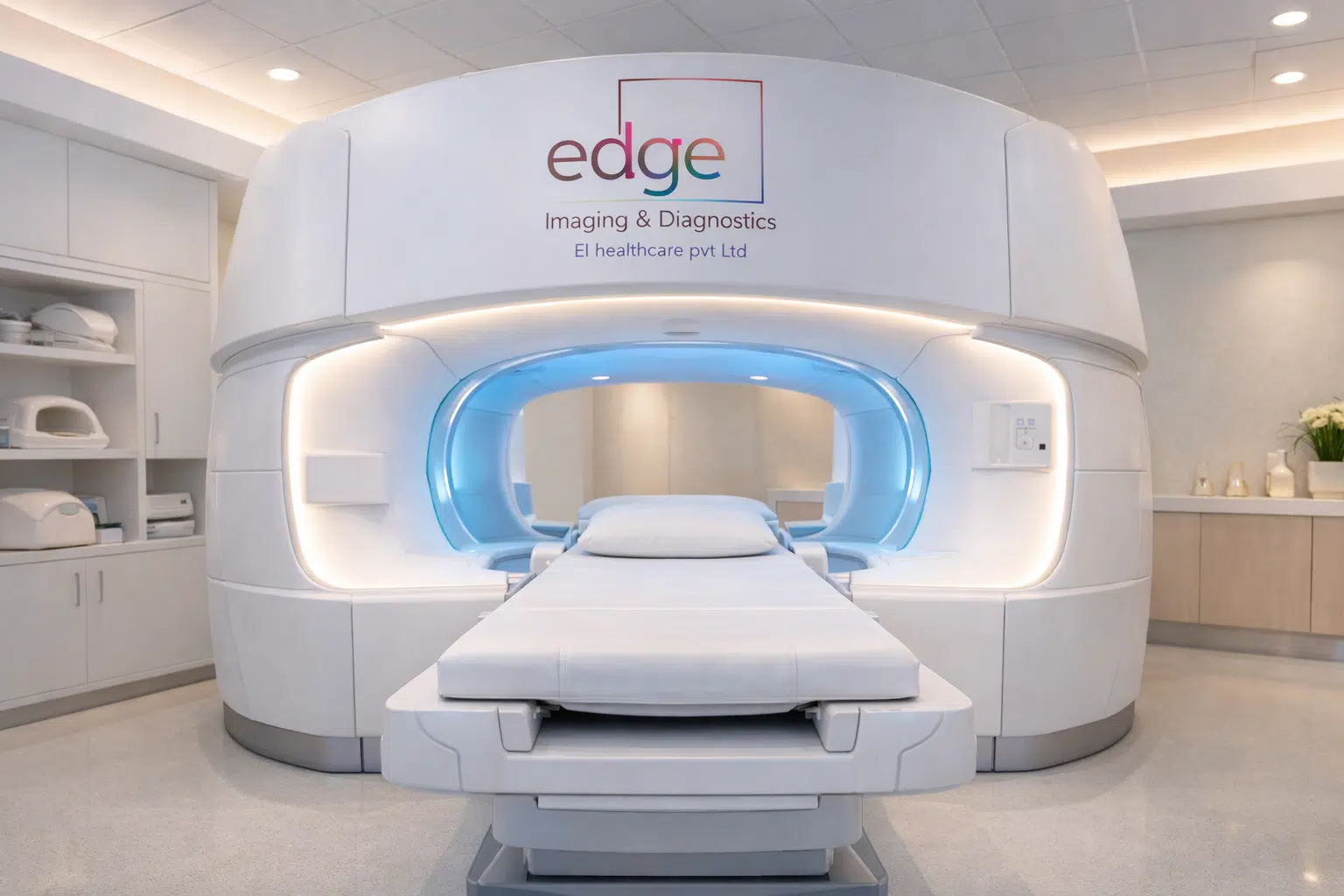
Your doctor has written “MRI Pelvis” on the prescription, and now you have two questions running in parallel — what exactly are they looking for, and what is this going to cost? Both are fair questions, and both have clear answers.
This guide is written for patients in Delhi who have an MRI pelvis advised and want to walk in prepared. It covers what the scan actually shows, why your doctor may have chosen MRI over an ultrasound or CT, the real difference between a plain and a contrast (CEMRI) study and why the price changes, how to prepare, and what an MRI pelvis costs in Delhi in 2026.
The quick answer
An MRI pelvis is a radiation-free scan that produces very high-detail images of the organs and structures inside the bony pelvis — the uterus, ovaries and cervix in women; the prostate, seminal vesicles and bladder in men; the rectum and anal canal; the hip and sacroiliac joints; and the surrounding muscles, nerves and lymph nodes. It usually takes 25–45 minutes, needs no radiation, and may be done plain or with contrast (CEMRI) depending on what your doctor needs to see. In Delhi, a plain MRI pelvis generally costs in the region of ₹5,000–₹9,000, and a contrast study more, because the contrast injection is added. At Edge Imaging, a plain MRI pelvis is ₹3,999, with contrast charged extra. Prices vary by centre and by the exact protocol requested — always confirm against your prescription rather than a general figure.
What an MRI pelvis actually shows
MRI’s real strength is soft tissue. Where an X-ray shows bone and a CT shows structure quickly, MRI distinguishes between different kinds of soft tissue with a clarity nothing else matches — which is exactly what the pelvis is full of.
In women
- Uterus: fibroids — their exact number, size, position and type (submucosal, intramural, subserosal), which is often what decides the treatment; adenomyosis, which MRI shows far better than ultrasound; and congenital variations in the shape of the uterus.
- Ovaries and adnexa: characterising a cyst or mass that ultrasound has found but not fully resolved — whether it looks simple, haemorrhagic, endometriotic or complex.
- Endometriosis: deep infiltrating disease, which is notoriously difficult to see on ultrasound and is one of the strongest reasons a pelvic MRI is requested.
- Cervix and pelvic floor: local assessment of a known cervical problem, and evaluation of prolapse or pelvic floor dysfunction on dedicated protocols.
In men
- Prostate: a multiparametric MRI (mpMRI) of the prostate assesses the gland in detail when PSA is raised or a nodule is felt, and it is what guides a targeted MRI-fusion prostate biopsy rather than a blind sampling.
- Bladder, seminal vesicles and surrounding tissue planes when a local assessment is required.
In everyone
- Anal fistula: an MR fistulogram maps the exact track of a fistula-in-ano, its branches and any collection — a study surgeons rely on before operating, because a missed track is the usual reason a fistula recurs.
- Sacroiliac joints: MRI of the SI joints can show active inflammation (bone marrow oedema) in suspected inflammatory back pain long before changes appear on X-ray, which is why rheumatologists ask for it specifically.
- Hip joints: avascular necrosis (AVN) of the femoral head at an early stage, labral tears, stress fractures and unexplained hip pain with normal X-rays.
- Rectum: local staging and assessment of rectal disease on a dedicated rectal protocol.
- Soft tissue masses, nerves and lymph nodes within the pelvis.
Why MRI and not ultrasound or CT?
They are not competitors — they answer different questions, and your doctor picks the one that answers yours.
| Test | Best at | Radiation |
|---|---|---|
| Ultrasound (pelvic/TVS) | First look at uterus, ovaries, bladder; cyst vs solid; follow-up; quick and inexpensive | None |
| CT pelvis | Emergencies, trauma, stones, bowel; very fast | Yes (X-rays) |
| MRI pelvis | Highest soft-tissue detail — fibroid mapping, adenomyosis, endometriosis, prostate, fistula, SI joints, AVN | None |
In practice, a pelvic ultrasound is usually done first because it is quick, safe and often sufficient. MRI is added when the ultrasound has found something that needs to be characterised precisely, when the clinical suspicion (endometriosis, adenomyosis, fistula, sacroiliitis, AVN) is one that ultrasound cannot settle, or when surgery is being planned and the surgeon needs an exact map. Our guide to MRI vs CT scan explains the choice in more general terms, and if MRI is new to you, start with what an MRI scan is and how it works.
Plain MRI or contrast (CEMRI) — and why the price differs
This is the single most common source of confusion, and the reason two quotes for “MRI pelvis” can look very different.
A plain MRI pelvis uses the magnet and radio waves alone. A contrast-enhanced MRI (CEMRI) adds an injection of a gadolinium-based contrast agent into a vein partway through the scan. Contrast highlights how tissue takes up blood supply, which helps to characterise a mass, define the extent of inflammation or infection, distinguish scar from active disease, and assess a fistula track more completely.
The contrast study costs more because of the agent itself, the cannula and the additional imaging time — typically adding several thousand rupees over the plain scan. You do not choose this. Your prescription specifies it, and if it is ambiguous, the radiologist will decide on protocol based on the clinical question. If your prescription says CEMRI or “with contrast”, budget for the contrast study.
Is the contrast injection safe?
Gadolinium contrast is generally well tolerated and is not the same as the iodinated contrast used in CT. Before a contrast MRI, the centre will normally ask about kidney function — often a recent serum creatinine / eGFR report — because reduced kidney function changes how the agent is handled, and about any previous reaction to contrast. Tell the team if you are pregnant or breastfeeding, or if you have kidney disease, so the right decision is made for you. These are routine checks, not a cause for alarm.
How the scan is done, step by step
- Registration and safety check. You will be asked about metal in or on the body — pacemaker or implanted cardiac device, cochlear implant, aneurysm clips, orthopaedic implants, an IUD (copper T), metal fragments in the eye from previous injury, or any recent surgery with metal hardware. This is the most important part of the visit; answer it completely.
- Changing and removing metal. Jewellery, watch, belt, coins, phone, hairpins, hearing aid and cards are left outside. Most centres provide a gown.
- Positioning. You lie on your back on the MRI table, with a coil placed over the pelvis. The table moves into the scanner.
- The scan. The machine is loud — knocking and buzzing — so earplugs or headphones are given. You will be asked to lie as still as possible; movement blurs the images and can mean repeating a sequence. Some sequences require brief breath-holds.
- Contrast, if prescribed. An injection is given through a cannula partway through, and a few more sequences are taken afterwards.
- Finish. Total table time is usually 25–45 minutes, longer for a contrast or a specialised protocol such as mpMRI prostate or an MR fistulogram.
How to prepare
- Carry the prescription. The protocol depends on the clinical question — “MRI pelvis” for a fibroid, a fistula and a prostate are three different studies.
- Bring previous reports and films — prior ultrasound, CT or MRI, and relevant blood tests. Comparison with an earlier scan is genuinely valuable to the reporting radiologist.
- Fasting: not usually needed for a plain pelvic MRI. Some protocols (rectal, fistula, or contrast studies) ask for 4–6 hours of fasting — confirm with the centre when you book, since it varies by protocol.
- Bladder: instructions differ by protocol. Some studies want a moderately full bladder, others an empty one. Ask when booking rather than guessing.
- Kidney function report if a contrast study is prescribed.
- Wear simple clothing without zips, hooks or metal buttons.
- If you are claustrophobic, say so before the appointment rather than on the table. An open MRI is far more comfortable for many people, and knowing in advance lets the team plan the scan properly. Our guide on open MRI vs closed MRI explains the difference.
Who should not have an MRI, or needs extra care
MRI uses a very strong magnet, so certain implants and devices matter a great deal. Tell the radiographer and radiologist if you have a pacemaker or implantable defibrillator, a cochlear implant, an aneurysm clip or coil, a neurostimulator or implanted pump, any metallic foreign body in the eye, or recent surgery with implanted hardware. Many modern implants are MRI-conditional and can be scanned under specific conditions — but that decision needs the implant card or details, so bring them. Also mention pregnancy: MRI is not known to harm the fetus and uses no radiation, but the decision to scan and whether to use contrast is taken case by case.
MRI pelvis cost in Delhi — what actually changes the price
Indicatively, an MRI pelvis in Delhi in 2026 generally falls in the range of ₹5,000–₹9,000 for a plain study, with contrast studies costing more. At Edge Imaging, a plain MRI pelvis is ₹3,999, with contrast charged extra; every MRI price we charge is listed on our MRI scan page. Rather than a single number, it is more useful to understand what moves it:
- Plain vs contrast (CEMRI) — the largest single factor.
- The protocol. A routine pelvis, an mpMRI prostate, an MR fistulogram and a dedicated SI joint study are different studies with different scan times.
- Combined regions. “MRI whole abdomen and pelvis” is a larger study than pelvis alone and is priced accordingly.
- Magnet strength and machine type (1.5T, 3T, open MRI).
- Scheme rates. If you are covered under CGHS or another empanelled scheme, the applicable scheme rate may apply — ask when booking and carry your card.
A word of caution worth more than the money saved: an unusually cheap quote sometimes means a shorter, limited protocol, or a report without the detail your surgeon needs. What you are actually paying for is the sequences acquired and the radiologist reading them. Compare like with like — and confirm whether the quoted figure includes contrast and the report. Broader indicative pricing is in our MRI scan cost in Delhi guide.
When will the report be ready?
An MRI pelvis report is typically available within about 24 hours, and often the same day. Studies that need comparison with older films, or complex protocols, may take a little longer — because the reporting, not the scanning, is where the value is. Ask at the time of the scan when to expect it and how it will be shared, and carry the report and images to your follow-up consultation.
Get your MRI pelvis done at Edge Imaging & Diagnostics, West Delhi
Edge Imaging & Diagnostics is a NABH-accredited diagnostic centre in West Delhi offering MRI, CT, ultrasound, digital X-ray and image-guided procedures under one roof, with scans reported by experienced radiologists. For patients who find a conventional scanner difficult, an open MRI option is available. We also perform MRI spine, MRI knee and other joint studies, and image-guided procedures including MRI-fusion prostate biopsy and uterine fibroid embolization. Patients across Paschim Vihar, Punjabi Bagh, Rajouri Garden, Moti Nagar, Janakpuri, Tilak Nagar and nearby areas come to us for accurate, doctor-led reporting and transparent pricing.
The simplest way to get an exact price for your scan is to send us the prescription — we can then tell you the correct protocol, whether contrast is required, the preparation needed, and the current cost.
📩 Send your prescription on WhatsApp | Call 9555999960
If the pain is in the groin rather than the pelvis, the focused study your doctor may want is an MRI hip scan — a higher-resolution look at the hip joint itself, used for avascular necrosis, labral tears and impingement.
Frequently asked questions
How much does an MRI pelvis cost in Delhi?
A plain MRI pelvis in Delhi generally costs in the region of ₹5,000–₹9,000, and a contrast-enhanced (CEMRI) pelvis costs more because of the contrast agent and the extra imaging. The exact figure depends on the protocol, whether contrast is prescribed, and the machine used. At Edge Imaging, a plain MRI pelvis is ₹3,999, with contrast charged extra. Send your prescription on WhatsApp or call 9555999960 to confirm the protocol.
What is the difference between MRI pelvis and CEMRI pelvis?
CEMRI pelvis is the same scan with a gadolinium contrast injection given into a vein partway through. Contrast shows how tissue takes up blood supply, which helps characterise a mass, define inflammation or infection, and assess a fistula track. Your doctor decides which is needed; a contrast study costs more.
Is an MRI pelvis painful, and does it use radiation?
It is painless and uses no radiation at all — it works with a magnetic field and radio waves. The only discomfort most people report is the noise and having to lie still. If contrast is prescribed, you will feel the small prick of a cannula.
How long does an MRI pelvis take?
Usually 25–45 minutes of table time, longer for contrast studies or specialised protocols such as mpMRI prostate or an MR fistulogram. Allow extra time for registration, changing and the safety check.
Do I need to fast before an MRI pelvis?
Not usually for a plain pelvic MRI. Some protocols — rectal, fistula or contrast studies — do ask for 4–6 hours of fasting, and bladder instructions vary by protocol. Confirm with the centre when you book so you prepare correctly.
Can an MRI pelvis detect fibroids and endometriosis?
Yes. MRI maps fibroids precisely — number, size, position and type — which often decides the treatment, and it is the best imaging test for adenomyosis and for deep infiltrating endometriosis, which ultrasound frequently cannot demonstrate.
Is MRI pelvis better than an ultrasound?
Neither is simply “better” — they answer different questions. Ultrasound is usually the right first test: quick, safe and often enough. MRI is added when something needs to be characterised in far greater detail, when the suspected condition is one ultrasound cannot resolve, or when a surgeon needs an exact map before operating.
Can I have an MRI if I have an implant or a copper T?
Many implants are MRI-safe or MRI-conditional, but each one must be checked before the scan. Bring the implant card or details for a pacemaker, defibrillator, cochlear implant, aneurysm clip, neurostimulator or orthopaedic hardware. Most modern IUDs, including copper devices, are MRI-safe — but always declare it so it is verified.
Can an MRI pelvis be done during pregnancy?
MRI uses no ionising radiation and is not known to harm the fetus, but the decision to scan during pregnancy — and particularly whether to use contrast — is taken case by case by your doctor and the radiologist. Always declare a known or possible pregnancy before the scan.
What is an MRI whole abdomen and pelvis?
It covers the abdomen and the pelvis in one sitting, rather than the pelvis alone. It takes longer, is priced higher, and is requested when the clinical question spans both regions. Your prescription will specify which one you need.
The bottom line
An MRI pelvis is the most detailed, radiation-free look available at what lies inside the pelvis — and for fibroids, adenomyosis, endometriosis, prostate assessment, anal fistula, sacroiliac inflammation and early hip AVN, it frequently answers a question that no other test can. The two things worth getting right are simple: take your prescription with you so the correct protocol is done, and confirm before you arrive whether contrast, fasting or bladder preparation is required. Do that, and the scan itself is nothing more than half an hour of lying still in a noisy machine — and you leave with a real answer.
MRI, CT, ultrasound and image-guided procedures at Edge Imaging & Diagnostics, West Delhi — a NABH-accredited diagnostic centre — are performed and reported by experienced radiologists. This article is general patient information only. It is not a diagnosis and does not replace consultation with a qualified doctor; whether you need an MRI pelvis, and whether it should be plain or with contrast, is decided by your treating doctor. Delhi cost ranges mentioned are indicative market figures, not a quotation; Edge Imaging’s own MRI prices are published on our MRI scan page. Last updated: 2026.