
 PV
 TG
 MN
 EM
 EI
 ND
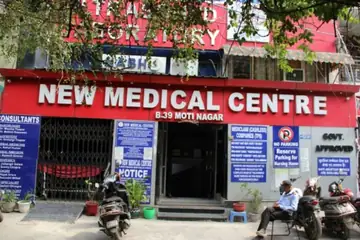 NM
 SR

 CT Scan
 PET CT
 Digital X-ray
 Ultrasound
 Amniocentesis

 Fetal Reduction
 Thermalytix Breast Screening
 Cardiology
 Lab Tests
 GAMCA Pre-Medical
The merchant navy medical test for freshers (the pre-sea medical) checks that a candidate is fit to train for and work at sea. It must be done by a DG Shipping-approved doctor. It covers eyesight and colour vision, hearing, heart, lungs, blood and urine tests and a full physical examination. Deck courses need sharper eyesight without glasses than engine courses, and colour blindness is not accepted for these courses.
You have finished Class 12, or you are about to. You have decided on the merchant navy, and everyone has an opinion: “Your eyes must be perfect,” “You need a certain height,” “Glasses are not allowed.” Some of this is true, some is half-true, and some is old information.
This guide explains the merchant navy medical test for freshers in simple language — what is checked, which standards matter most, when to get tested, and how to avoid the most painful mistake of all: paying a large course fee and then failing the medical at admission.
People search for this as “merchant navy medical test”, “pre-sea medical”, “merchant navy medical requirements”, “IMU CET medical” or, in Hinglish, “merchant navy medical test kaise hota hai”. All are answered here, with a short Hinglish section near the end.
Merchant navy medical test for freshers: at a glance
- Who does it: a doctor approved by the Directorate General of Shipping (DG Shipping)
- When it is needed: at admission to a pre-sea course, and before you can work at sea
- Biggest deal-breakers: eyesight without glasses, and colour vision
- Deck vs engine: deck (nautical) courses need sharper unaided eyesight than engine courses
- Colour blindness: not accepted for these courses
- Other checks: hearing, blood pressure, heart (ECG), chest X-ray, blood and urine tests, and a physical examination
- Under 18: a seafarer medical certificate is valid for at most one year
- Smart move: get your eyes and colour vision checked before you pay any course fee
- Rules updated: new Merchant Shipping (Medical Examination) Rules were notified in September 2026
What this guide covers
- What the merchant navy medical test is
- Which courses need a pre-sea medical
- Your first ILO medical vs later medicals
- The 2026 rules: what you should know
- When to get tested: the golden rule
- The IMU admission medical
- Fresher eyesight: deck vs engine
- GP Rating, ETO and catering candidates
- Colour vision: the most common deal-breaker for freshers
- Glasses, contact lenses and LASIK before a pre-sea course
- Hearing
- Height, weight and build
- Blood pressure and sugar at the pre-sea medical
- Heart and chest checks for freshers: ECG and X-ray
- Urine and blood tests in the pre-sea medical
- Hernia, fractures and past surgery
- Fits, bed-wetting and other history
- Drug and HIV tests for cadets
- Mental fitness
- Pre-sea tests proposed in DG Shipping’s draft list
- Merchant navy medical requirements: a checklist
- Choosing the right centre for your pre-sea medical
- What happens on the day
- How to prepare
- What to bring
- If you are under 18
- After the medical: keep your certificate safe
- Your pre-sea result: fit, temporarily unfit, permanently unfit
- If a fresher is declared unfit
- Mistakes freshers make
- A note for parents
- A simple timeline
- Myths and facts
- Questions to ask before you apply
- Seedhi baat: merchant navy medical test kaise hota hai
- Pre-sea medical at Edge Marine Medicals, Delhi
- References
- Frequently asked questions
What the merchant navy medical test is
Life at sea is demanding. Ships are far from hospitals, watches run day and night, and a seafarer must be able to see lights and signals clearly, hear alarms, and work safely in heat, cold and rough weather. The merchant navy medical test checks that you can do this safely — for your own sake and for everyone on board.
For freshers, this examination is often called the pre-sea medical. It is a detailed check-up done by a doctor approved by DG Shipping, the Indian maritime authority. The doctor examines you, reviews your test results, and records whether you meet the required standards.
In everyday language, people also call it the DG medical or ILO medical. For a fresher, these words all point to the same thing: your first seafarer medical examination.
Which courses need a pre-sea medical
DG Shipping lists a number of pre-sea courses that lead to a seagoing career. These include:
- B.Sc. Nautical Science (deck side)
- Diploma in Nautical Science (DNS)
- BE/B.Tech Marine Engineering (engine side)
- Graduate Marine Engineering (GME)
- Electro-Technical Officer (ETO)
- General Purpose (GP) Rating
- Certificate Course in Maritime Catering (CCMC)
For marine courses, institutes ask for a medical fitness certificate from a DG Shipping-approved doctor at the time of admission. The exact standards depend on the course and the institute, so always read the prospectus of the course you are applying for.
Your first ILO medical vs later medicals
Your pre-sea medical is your first seafarer medical, but it will not be your last. Throughout your career, you will need a valid medical certificate to work on ships, renewed regularly.
The first medical matters most, because it decides whether you can enter the profession and which side (deck or engine) suits your eyesight. Later medicals check that you remain fit as you work. If you want to understand the regular medical that working seafarers take, read our guide to the DG Shipping ILO medical in Delhi.
The 2026 rules: what you should know
In September 2026, the Government notified the Merchant Shipping (Medical Examination) Rules, 2026 (G.S.R. 816(E)), replacing the earlier rules of 2000. These rules cover both pre-sea and periodic medical examinations, and they set out who can examine seafarers and how certificates are issued.
Some points that matter to freshers:
- Only a medical examiner approved under the rules can examine you and issue the certificate.
- A seafarer under 18 years of age gets a medical certificate valid for a maximum of one year.
- The doctor can declare a candidate fit, temporarily unfit or permanently unfit.
- There is an appeal route for a seafarer who disagrees with an unfitness decision, within 60 days.
Rules and standards are updated from time to time. Your DG-approved doctor applies the standards in force on the day of your examination, and your institute may have its own requirements on top.
When to get tested: the golden rule
Here is the single most useful piece of advice in this guide: get your eyesight and colour vision checked before you pay any course fee.
Many families find out about a colour vision problem or weak unaided eyesight only at the admission medical — after paying for coaching, entrance forms or a seat. A simple early check can save a great deal of money and heartbreak. If your eyes do not meet the deck standard but do meet the engine standard, you can choose the right course from the start.
A full pre-sea medical can be done when your institute asks for it. But an early check of the main deal-breakers (unaided vision and colour vision) can be done as soon as you start thinking seriously about the merchant navy, even in Class 11 or 12.
The IMU admission medical
Indian Maritime University (IMU) is one of the main routes into the merchant navy, through the IMU CET entrance test. IMU’s citizen charter states that candidates for its nautical science and marine engineering programmes must be medically fit, including eyesight and hearing, and must produce a certificate of medical fitness issued by a doctor approved by DG Shipping at the time of admission.
So the IMU CET medical is not a separate type of test — it is a pre-sea medical by a DG-approved doctor, checked against IMU’s standards for your chosen programme. Read the latest IMU brochure for your year, because details can change.
Fresher eyesight: deck vs engine
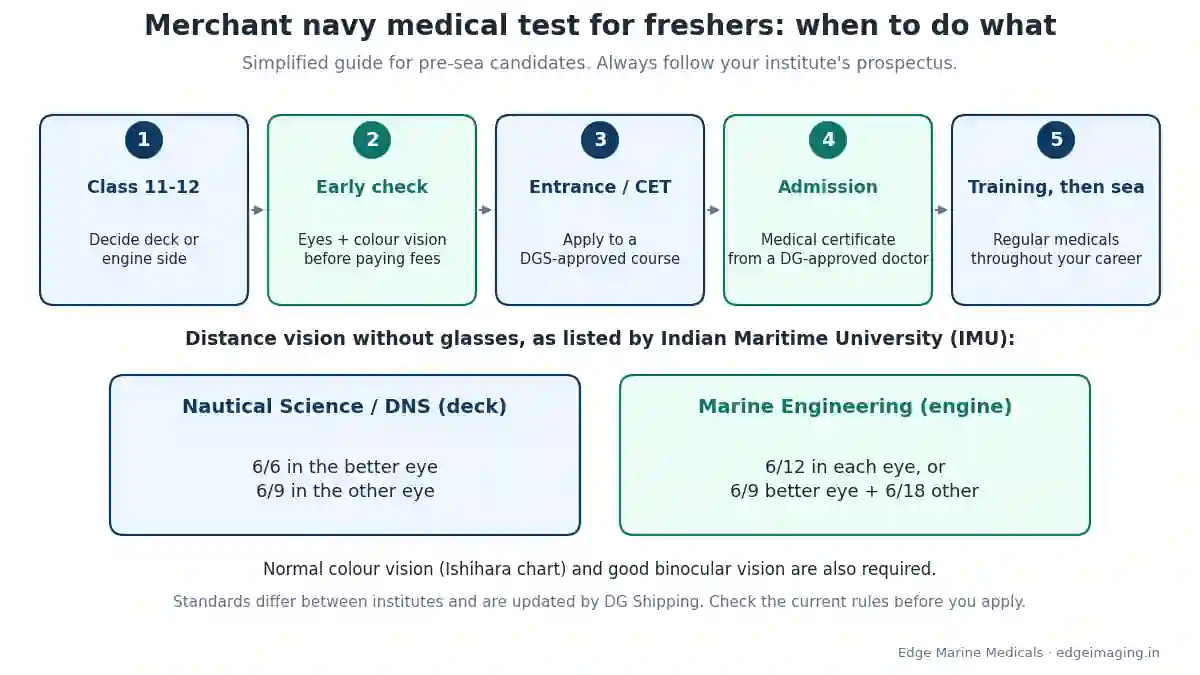
Eyesight is where most fresher questions begin. IMU lists these distance vision standards without glasses (unaided):
- Nautical Science and DNS (deck): 6/6 in the better eye and 6/9 in the other eye
- Marine Engineering (engine): 6/12 in each eye, or 6/9 in the better eye and 6/18 in the other eye
IMU also requires good binocular vision — both eyes working together, with a full field of vision. In simple terms, deck officers keep a lookout and must spot distant lights and objects, so their unaided standard is stricter. Engine-side standards are a little more relaxed.
Other institutes may state their own standards. For a detailed look at eyesight rules for working seafarers, see our DG Shipping eyesight requirements guide.
GP Rating, ETO and catering candidates
Not every seafarer is a deck officer or marine engineer. GP Rating candidates, Electro-Technical Officers and catering candidates also need a pre-sea medical by a DG-approved doctor before they can go to sea.
The basic examination is similar, but the eyesight and other standards that apply can depend on your duties — for example, whether you will keep a lookout. Read your course prospectus carefully and ask the institute which standard applies to you. If in doubt, an early eye and colour vision check is still the safest first step.
Colour vision: the most common deal-breaker for freshers
At sea, colour matters. Navigation lights, buoys, signal flags, electrical wiring and alarm panels all depend on telling red, green and other colours apart. That is why normal colour vision is required for these courses. IMU tests it with the Ishihara chart — the book of coloured dot patterns with numbers hidden inside.
Colour vision problems are usually inherited and often go unnoticed for years. Many young people discover them only at the medical. One institute, Tolani Maritime Institute, states plainly that colour blindness is not permitted for its marine engineering programme.
This is exactly why an early colour vision check is so valuable. It takes a few minutes and can redirect your plans before money is spent.
Glasses, contact lenses and LASIK before a pre-sea course
The IMU standards above are for vision without glasses. So if you wear glasses, the key question is: what is your eyesight when you take them off? Your doctor checks this.
If you have had LASIK or other eye surgery, or you use contact lenses, ask the institute in writing before you apply whether your situation is accepted for the course. Policies can differ, and it is far better to know before you commit. Bring your eye surgery records and prescriptions to the medical.
Please do not try to “train” for the eye test or memorise charts. The doctor uses different charts and methods, and an honest result protects you from a much bigger problem later in your career.
Hearing
Seafarers must hear alarms, radio messages and orders over engine noise. Hearing is checked by the doctor and, increasingly, by audiometry — a test where you listen to tones through headphones and press a button when you hear them.
As an example of an institute standard, Tolani Maritime Institute states that a candidate should be able to hear a whisper at 5 metres on each side without hearing aids. If you have had ear infections, ear surgery or hearing problems, mention them and bring any reports.
Height, weight and build
Many students ask about height. Under Annexure 4 of the 2026 medical rules, the minimum height for new entrants is 157 cm for men and 145 cm for women, with a 5 cm relaxation for candidates from listed island and hill areas. Institutes may add their own requirements, so check your prospectus. For example, Tolani Maritime Institute lists a minimum height of 157 cm, with weight in proportion to height and a chest expansion of at least 5 cm, for its marine engineering admissions.
Weight that is very low or very high for your height can also raise questions about fitness for physical work at sea. If you are working on your weight, start early and do it in a healthy way. Our guide to blood pressure, diabetes and BMI limits for the seafarer medical explains how these are assessed.
Blood pressure and sugar at the pre-sea medical
Your blood pressure is measured at the medical. Some institutes publish their own limits — for example, Tolani Maritime Institute states that blood pressure should not exceed 140/90 mm Hg for admission. The limit applied to you depends on the current standards and your institute’s requirements.
Young people sometimes have a high reading simply because they are nervous. Sleep well the night before, avoid tea, coffee and energy drinks that morning, and sit quietly for a few minutes before the reading. Urine is also checked for sugar. Our BP and diabetes guide covers this in detail.
Heart and chest checks for freshers: ECG and X-ray
An ECG (electrocardiogram) records your heart’s electrical activity. It takes a few minutes and is painless. A chest X-ray checks your lungs and heart shadow. Tolani Maritime Institute, for example, asks that the ECG be within normal limits and the chest X-ray be normal.
If you have ever been told about a heart murmur, asthma, tuberculosis or any lung problem, mention it and bring your reports. Many conditions that were treated in childhood cause no problem today, but the doctor needs the full picture.
Urine and blood tests in the pre-sea medical
A urine test checks for sugar, protein (albumin) and blood, which can point to problems such as diabetes or kidney disease. Tolani Maritime Institute states that candidates with albumin, sugar or red blood cells in the urine are not accepted for its programme, so an abnormal result is usually looked into further.
Blood tests commonly include a blood count and other tests decided by the doctor and the standards in force. Simple things help: drink normal amounts of water, and tell the doctor about any recent fever or illness.
Hernia, fractures and past surgery
The physical examination checks for problems that could be risky during heavy work at sea. A hernia (a bulge in the groin or abdomen) is one example — Tolani Maritime Institute states there should be no hernia or tendency to it.
Past fractures and operations also matter. The same institute states that a healed fracture with a pin still inside is a disqualification for its programme. If you have had any surgery or fracture, bring the discharge summary and X-rays, and ask your institute about your situation before you apply.
Fits, bed-wetting and other history
Some conditions are a concern at sea because help is far away. For example, Tolani Maritime Institute states that candidates with a history of fits (seizures), incontinence of urine or bed-wetting are not accepted.
Always answer the doctor’s questions honestly, including about medicines you take. Hiding a condition is never worth it: it can lead to the certificate being cancelled later and, more importantly, to real danger at sea.
Drug and HIV tests for cadets
Institutes and employers may require drug and HIV tests. Tolani Maritime Institute, for example, states that these may be done at the time of the medical examination or at any time during the programme.
Drug testing is a normal part of maritime life, and shipping has a strict approach to drugs and alcohol. Tell the doctor about any prescribed medicines you take, so that results can be read correctly.
Mental fitness
Life at sea means long months away from home, small crews, irregular sleep and limited contact with family. Mental well-being matters as much as physical fitness. DG Shipping’s draft list of investigations even includes a psychometric evaluation for pre-sea candidates.
Be honest with the doctor about any past or present mental health treatment, and bring your records. Many conditions are well managed and need only a careful assessment. Talking openly also helps you decide whether a seafaring life truly suits you.
Pre-sea tests proposed in DG Shipping’s draft list
DG Shipping has circulated a draft notice to standardise the minimum medical investigations for Indian seafarers. For the pre-sea examination, the draft lists tests such as vision (distance, near and colour), audiometry, spirometry (a breathing test), chest X-ray, ECG, abdominal ultrasound and a psychometric evaluation.
Because this is a draft, the final list may change. Your DG-approved doctor will tell you exactly which tests apply on the date of your medical.
Merchant navy medical requirements: a checklist
Here is a quick checklist of the merchant navy medical requirements most freshers should think about before applying. Tick each one with your doctor and your institute’s prospectus:
- Unaided distance vision meets the standard for your course (deck or engine)
- Normal colour vision on the Ishihara test
- Good binocular vision and full field of vision
- Hearing within the required standard
- Height and weight as required by your institute
- Blood pressure within the applicable limit
- Normal ECG and chest X-ray
- Urine free of sugar, protein and blood
- No hernia, and past fractures or surgery reviewed
- Honest declaration of past illnesses and medicines
Choosing the right centre for your pre-sea medical
The most important point is simple: the doctor must be approved by DG Shipping. Under the 2026 rules, an approved medical examiner conducts examinations at a designated clinic, and approvals are recorded by the authorities. You can check a doctor’s approval online — our guide on verifying a DG-approved doctor on eSamudra explains how.
Also look for a centre that can do the tests your medical needs — eye tests, audiometry, blood and urine tests, ECG and chest X-ray — so you are not sent from place to place. And choose a centre that explains your results clearly, especially if anything needs follow-up.
What happens on the day
A pre-sea medical usually follows these steps:
- Registration: your ID and details are checked, and you fill a health questionnaire.
- Basic measurements: height, weight and blood pressure.
- Eye tests: distance and near vision, colour vision and other checks.
- Hearing: audiometry and the doctor’s hearing check.
- Tests: blood and urine samples, ECG and chest X-ray.
- Doctor’s examination: a full physical examination and review of your history and results.
- Decision: the doctor records the result and issues the certificate as per the rules.
Plan to spend a few hours at the centre. Bring something to read and a snack for after the blood test, if your doctor allows.
How to prepare
- Sleep well the night before. Tiredness affects eyesight and blood pressure.
- Avoid tea, coffee and energy drinks on the morning of the test.
- Eat normally unless the centre asks you to fast for a specific test.
- Wear comfortable clothes that make the physical examination and ECG easy.
- Do not use eye drops or anything else to “improve” your result.
- Arrive on time and relaxed. Rushing raises your blood pressure.
What to bring
- Photo ID (such as Aadhaar card or passport)
- Passport-size photographs
- Any medical form or format given by your institute
- Your glasses, if you wear them, and any eye prescriptions
- Reports of past illnesses, surgeries, fractures or eye surgery
- A list of medicines you take regularly
- A parent or guardian, especially if you are under 18
For a complete document checklist used by working seafarers, see our guide to the same-day DG medical.
If you are under 18
Many students complete Class 12 at 17. Under the 2026 rules, a medical certificate for a seafarer under 18 is valid for a maximum of one year. So plan the timing of your medical sensibly, keeping your admission date in mind.
It is a good idea for a parent or guardian to come along. They can help with your medical history and ask questions on your behalf.
After the medical: keep your certificate safe
Once you have your certificate, treat it like an important document. Keep the original safe, keep scanned copies on your phone and email, and note the date of issue and expiry.
Check the details for spelling mistakes before you leave the centre. If your institute needs it by a certain date, make sure the certificate will still be valid then — especially if you are under 18, when validity is a maximum of one year.
Your pre-sea result: fit, temporarily unfit, permanently unfit
After the examination, the doctor records one of three outcomes:
- Fit: you meet the standards.
- Temporarily unfit: something needs treatment or more tests first, such as a high blood pressure reading, an infection, or an abnormal test. The doctor gives the reason and when you can be re-examined.
- Permanently unfit: a condition that does not meet the standards and is not expected to change. The doctor records the grounds.
A temporarily unfit result is common and usually fixable. It is not the end of your plans.
If a fresher is declared unfit
First, understand the reason. Ask the doctor to explain it clearly and tell you what can be done. For a temporary problem, get it treated and return for re-examination as advised. Our guide on why candidates are declared unfit and how to pass explains common reasons.
If you disagree with an unfitness decision, the 2026 rules provide an appeal route within 60 days. Keep copies of every report and certificate. And if a condition such as colour blindness rules out deck or engine work, talk to your family and counsellors about the many other careers in shipping and logistics that do not require sea service.
Mistakes freshers make
- Paying fees before an eye and colour vision check. The most expensive mistake.
- Assuming glasses are fine. Many standards are for vision without glasses.
- Going to a doctor who is not DG-approved. The certificate will not be accepted.
- Hiding past illnesses or surgery. It can lead to cancellation later.
- Arriving stressed after no sleep. Blood pressure and eye tests suffer.
- Trusting old advice. Rules were updated in 2026; check current requirements.
A note for parents
Parents often carry the financial and emotional weight of a merchant navy decision. The kindest thing you can do is to get your child’s unaided eyesight and colour vision checked early, read the institute’s medical requirements together, and ask questions in writing before paying.
Check that the doctor is approved by DG Shipping — our guide on how to verify a DG Shipping-approved doctor shows how. And remember that the medical is not just a formality; it protects your child on board.
A simple timeline
- Class 11 or 12: get an early eye and colour vision check. Decide between deck and engine.
- Before paying fees: read the institute’s medical requirements; ask questions in writing.
- Entrance (such as IMU CET): prepare and appear.
- Admission: full pre-sea medical by a DG-approved doctor, on the institute’s format if they have one.
- During training and at sea: regular medicals as required throughout your career.
Myths and facts
- Myth: “Any MBBS doctor can do the merchant navy medical.” Fact: it must be a DG Shipping-approved doctor.
- Myth: “If I wear glasses, I cannot join.” Fact: what matters is whether your unaided vision meets the standard for your course.
- Myth: “Colour blindness can be passed with practice.” Fact: doctors use several methods; an honest result is what counts.
- Myth: “Deck and engine have the same eye standard.” Fact: deck courses need sharper unaided vision.
- Myth: “Temporarily unfit means my career is over.” Fact: most temporary findings can be treated and re-examined.
- Myth: “The medical is just paperwork.” Fact: it is a detailed examination that protects you at sea.
Questions to ask before you apply
- What are the exact eyesight standards for my course, with and without glasses?
- Is colour vision tested by Ishihara only, or other methods too?
- Do you accept candidates who have had LASIK or eye surgery?
- Is there a height, weight or BMI requirement?
- Which tests must the admission medical include, and is there a set format?
- How recent must the medical certificate be at admission?
- Will there be another medical after joining, or a drug test?
Seedhi baat: merchant navy medical test kaise hota hai
Merchant navy join karne se pehle pre-sea medical hota hai, jo sirf DG Shipping approved doctor kar sakta hai. Isme aankhon ki jaanch (bina chashme), colour vision, sunne ki jaanch, BP, ECG, chest X-ray, blood aur urine test, aur doctor ka poora check-up hota hai.
Deck side (Nautical Science) me bina chashme ki eyesight engine side se zyada strict hoti hai. Colour blindness in courses me accept nahi hoti. Isliye sabse zaroori salah: course ki fees bharne se pehle apni aankhein aur colour vision check karwa lo. 18 saal se kam umar ho toh medical certificate maximum 1 saal valid hota hai.
Agar “temporarily unfit” aaye toh ghabrao mat — zyada tar cases me ilaaj ke baad dobara medical karke fit ho jaate hain.
Pre-sea medical at Edge Marine Medicals, Delhi
Edge Marine Medicals is the seafarer medical centre of Edge Imaging & Diagnostics, at B-568-569, Raghubir Nagar, Tagore Garden Extension, New Delhi 110027. Our DG Shipping-approved doctor in Delhi, Dr. Nishant Thapar (Approval No. DEL/WES/0005/2026), examines pre-sea candidates, cadets and working seafarers, with vision and colour vision testing, audiometry, pathology, chest X-ray, ECG and the doctor’s examination under one roof.
Tell us the course and institute you are applying for, and bring their medical format if they have one. For fees, see our DG Shipping medical cost guide, or simply send us a WhatsApp message with your course name, and we will share the earliest slot, what to bring, and today’s actual pricing.
💬 WhatsApp Edge Marine Medicals for your pre-sea medical | Call 9599941470
References
- Merchant Shipping (Medical Examination) Rules, 2026 — Notification G.S.R. 816(E) — text as reproduced by StaffNews
- Merchant Shipping (Medical Examination) Rules, 2026: summary — TeamLease RegTech
- IMU Citizen Charter (eligibility and medical requirements) — Indian Maritime University
- B.Tech Marine Engineering: medical requirements — Tolani Maritime Institute
- Draft MS Notice: Standardization of Mandatory Minimum Medical Investigations for Indian Seafarers — Directorate General of Shipping
- DGS Circular No. 20 of 2020 (pre-sea course certificates) — Directorate General of Shipping
Frequently asked questions
What is the merchant navy medical test for freshers?
It is the pre-sea medical examination done by a DG Shipping-approved doctor before you join a pre-sea course or go to sea. It checks eyesight, colour vision, hearing, heart, lungs, blood and urine, and your general fitness.
Who can do the pre-sea medical?
Only a medical examiner approved by DG Shipping. A certificate from any other doctor is not accepted for this purpose.
What eyesight do freshers need for the deck side?
IMU lists unaided distance vision of 6/6 in the better eye and 6/9 in the other eye for Nautical Science and DNS. Other institutes may state their own standards.
What eyesight do freshers need for marine engineering?
IMU lists unaided distance vision of 6/12 in each eye, or 6/9 in the better eye and 6/18 in the other, for Marine Engineering.
Can a colour blind person join the merchant navy?
Normal colour vision is required for deck and engine courses such as those at IMU, and colour blindness is not accepted for them. Get tested early, before paying any fees.
Can I join the merchant navy if I wear glasses?
It depends on your eyesight without glasses. The IMU standards are for unaided vision, so the doctor checks what you can see with your glasses off.
Is LASIK allowed for the merchant navy?
Policies can differ between institutes. Ask your institute in writing before you apply, and bring your eye surgery records to the medical.
Is there a height requirement for the merchant navy?
It depends on the institute and standards in force. For example, Tolani Maritime Institute lists a minimum height of 157 cm for its marine engineering admissions.
What is the IMU CET medical?
It is a pre-sea medical by a DG Shipping-approved doctor, which IMU asks you to produce at admission for its marine programmes, checked against IMU’s standards.
When should I get the merchant navy medical test done?
Get an eye and colour vision check before paying any course fee. Do the full pre-sea medical when your institute asks for it, usually at admission.
How long is the medical certificate valid if I am under 18?
Under the 2026 rules, a seafarer medical certificate for someone under 18 is valid for a maximum of one year.
What if I am declared temporarily unfit at the pre-sea medical?
The doctor explains the reason and when you can be re-examined. Most temporary findings, such as a high blood pressure reading or an infection, can be treated before you return.
Can a pre-sea candidate appeal an unfit decision?
The 2026 rules provide an appeal route within 60 days of an unfitness decision. Keep copies of all your reports.
Do I need to fast for the pre-sea medical?
Usually not, unless the centre asks you to fast for a specific test. Eat normally, sleep well and avoid tea, coffee and energy drinks that morning.
Merchant navy medical test kaise hota hai?
DG Shipping approved doctor aapki aankhein (bina chashme), colour vision, sunna, BP, ECG, chest X-ray, blood aur urine test, aur poora physical examination karte hain.
Merchant navy ke liye eyesight kitni chahiye?
IMU ke hisaab se deck side me bina chashme 6/6 aur 6/9, aur engine side me 6/12 dono aankhon me, ya 6/9 aur 6/18. Colour vision normal honi chahiye.
Where can I get a pre-sea medical in Delhi?
At Edge Marine Medicals, B-568-569, Raghubir Nagar, Tagore Garden Extension, New Delhi 110027. WhatsApp or call 9599941470 with your course name for the earliest slot and today’s actual pricing.
The bottom line
The merchant navy medical test for freshers is your first and most important seafarer medical. It must be done by a DG Shipping-approved doctor, and eyesight without glasses and colour vision are the checks that most often decide whether — and on which side — you can join.
Check your eyes and colour vision early, read your institute’s requirements before paying, prepare sensibly for the day, and answer every question honestly. Do that, and the medical becomes what it should be: a confident first step towards a career at sea.
Written by the team at Edge Marine Medicals, Edge Imaging & Diagnostics, New Delhi. Medically reviewed by Dr. Nishant Thapar. Last reviewed: October 2026.
Disclaimer: this article is general information for pre-sea candidates and their families. Medical standards are set by DG Shipping and by each institute and can change; always check the current requirements of your course. The final fitness decision is made by the DG Shipping-approved medical examiner.