
 PV
 TG
 MN
 EM
 EI
 ND
 NM
 SR

 CT Scan
 PET CT
 Digital X-ray
 Ultrasound
 Amniocentesis

 Fetal Reduction
 Thermalytix Breast Screening
 Cardiology
 Lab Tests
 GAMCA Pre-Medical

Foam sclerotherapy is a treatment for varicose veins without surgery. Under ultrasound guidance, a doctor injects a medicine mixed into a foam into the faulty vein. The foam makes the vein seal shut, and blood then flows through healthy veins instead. It is usually done as a short day-care visit under local anaesthetic, with no cuts, and most people walk out and return to normal activities quickly.
Bulging, twisted veins on the legs. Heaviness and aching by evening. Itching, swelling around the ankles, or dark skin near the ankle. Many people live with varicose veins for years because they are afraid the only answer is an operation. For many patients, it is not.
This guide explains ultrasound-guided foam sclerotherapy in simple language — who it suits, how it is done, what recovery looks like, the honest risks and results, and how it compares with laser and surgery. It is written for patients and families, not doctors.
People search for this as “foam sclerotherapy”, “foam sclerotherapy for varicose veins”, “varicose veins treatment”, “varicose veins treatment in Delhi”, “sclerotherapy treatment”, “varicose veins treatment without surgery”, “ultrasound guided foam sclerotherapy”, “varicose veins injection treatment” or, in Hinglish, “varicose veins ka ilaj bina operation”. All are answered here, with a short Hinglish section near the end.
Foam sclerotherapy: at a glance
- What it is: an injection treatment that closes faulty veins from inside
- Guidance: ultrasound shows the vein and the foam in real time
- Anaesthesia: local anaesthetic; you stay awake
- Cuts or stitches: none
- Time: usually a short day-care visit; you go home the same day
- After: compression stocking, commonly for about a week; walking is encouraged
- Sessions: sometimes more than one is needed
- Before treatment: a venous Doppler (duplex) ultrasound maps your veins
- Not usually done: during pregnancy, or with an active blood clot
What this guide covers
- What varicose veins are
- Symptoms that bring people to treatment
- Varicose veins vs DVT: know the difference before treatment
- When to see a doctor soon
- Before foam sclerotherapy, a Doppler scan comes first
- What foam sclerotherapy is
- Why foam, and why ultrasound?
- Who foam sclerotherapy suits
- When it is not suitable
- Before the procedure
- The procedure, step by step
- Does it hurt?
- Right after the procedure
- Compression stockings
- The first week at home
- How the leg looks over the coming weeks
- How many sessions?
- How well does it work?
- Common, minor side effects
- Rare but important risks
- Warning signs: call your doctor
- Foam sclerotherapy vs laser vs surgery for varicose veins
- What affects the cost of foam sclerotherapy
- Choosing where to get treated
- Can varicose veins come back?
- Is it varicose veins or just spider veins?
- Varicose veins in pregnancy
- Skin changes and leg ulcers
- Everyday habits that help
- Work, travel and exercise after treatment
- Myths and facts
- Questions to ask your doctor
- Seedhi baat: varicose veins ka ilaj bina operation
- Foam sclerotherapy at Edge Imaging, West Delhi
- References
- Frequently asked questions
What varicose veins are
Veins carry blood from the legs back up to the heart. To do this against gravity, they have small one-way valves. When these valves become weak, blood leaks backwards and pools in the leg. The veins stretch, bulge and twist. These are varicose veins.
The problem usually starts in the superficial veins, just under the skin, especially the long vein running up the inner leg (the great saphenous vein) and the vein at the back of the calf (the small saphenous vein). The visible lumps are often just the “tip of the iceberg” of a leaking vein deeper down.
Varicose veins are common. They run in families and become more likely with age, pregnancy, excess weight, and jobs with long hours of standing — teachers, shopkeepers, security staff, nurses, cooks and many others.
Symptoms that bring people to treatment
- Bulging, blue or purple, twisted veins on the legs
- Heaviness, aching or tiredness in the legs, worse by evening
- Swelling around the ankles
- Itching over the veins
- Night cramps or restless legs
- Brown or dark skin around the ankle, dry or eczema-like skin
- Embarrassment about the look of the legs
Some people have large veins with few symptoms; others have smaller veins with a lot of discomfort. Treatment is guided by your symptoms, your skin and your Doppler scan — not just by how the veins look.
Varicose veins vs DVT: know the difference before treatment
People often confuse varicose veins with deep vein thrombosis (DVT). They are different. Varicose veins are swollen, leaky veins just under the skin, usually developing slowly over years. DVT is a blood clot in a deep vein, often coming on suddenly with pain, swelling and warmth of the calf or whole leg.
DVT is an urgent condition, because a clot can travel to the lungs. If your leg suddenly becomes swollen, painful and tight, do not wait for a routine appointment — get a Doppler scan and medical review the same day. Varicose veins themselves are not an emergency, except when a vein bleeds.
When to see a doctor soon
UK guidance from NICE advises referral to a vein specialist for people with varicose veins and any of the following:
- Bleeding from a varicose vein (this needs urgent attention)
- Symptoms such as aching, heaviness or swelling
- Skin changes such as dark pigmentation or eczema, thought to come from vein problems
- Hard, painful, inflamed veins (superficial vein thrombosis)
- A leg ulcer that has not healed within 2 weeks, or a healed leg ulcer
If a varicose vein bleeds, lie down, raise the leg above heart level and press firmly on the spot with a clean cloth, and seek medical help. Sudden swelling and pain of the whole leg, or breathlessness, needs emergency care, as it can be a sign of a clot.
Before foam sclerotherapy, a Doppler scan comes first
Before any treatment, your veins must be mapped with a venous Doppler (duplex) ultrasound. NICE recommends duplex ultrasound to confirm varicose veins and the extent of leakage (reflux) in the main veins.
The scan shows which veins are leaking, where the leak starts, how big the veins are, and whether the deep veins are healthy and free of clots. It is painless and uses no radiation. Read our guide to the venous Doppler test in Delhi to know what to expect.
The Doppler result decides whether foam sclerotherapy suits you, which veins to treat, and how many sessions may be needed. Treating veins without a proper map is one of the main reasons varicose veins come back.
What foam sclerotherapy is
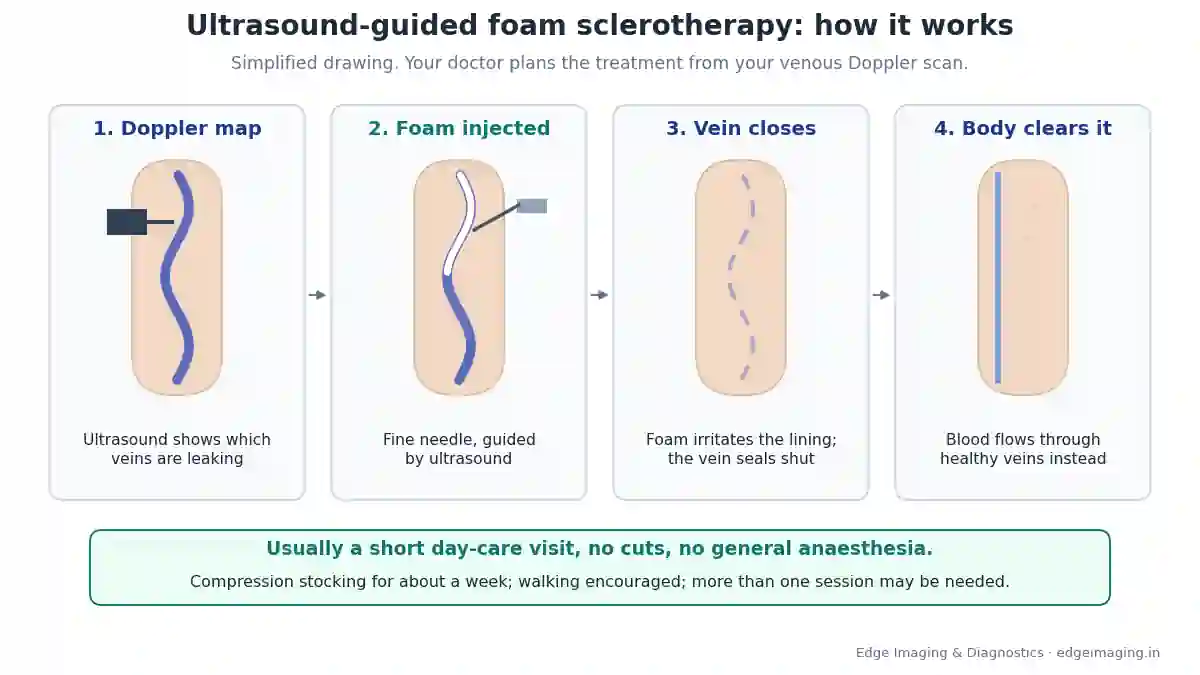
Sclerotherapy treatment means treating a vein by injecting a medicine (a sclerosant) that irritates its inner lining. The lining swells and sticks together, the vein seals shut, and over time the body absorbs it. Blood then returns to the heart through other, healthy veins.
In foam sclerotherapy, the sclerosant is mixed with air or another gas to make a fine foam, a bit like shaving foam. NICE describes it in exactly these terms: a chemical mixed with gas to produce a foam, injected into the vein under ultrasound guidance.
Because it is an injection, there are no cuts, no stitches, and no general anaesthetic. Several veins can often be treated in one session.
Why foam, and why ultrasound?
A liquid sclerosant mixes quickly with blood and gets diluted. Foam pushes the blood aside and stays in contact with the vein wall, which lets it work on larger veins. It also shows up clearly on ultrasound.
Ultrasound guidance lets the doctor see the vein, place the needle accurately, watch the foam fill the right vein segment, and keep it away from places it should not go. That is why it is called ultrasound-guided foam sclerotherapy (UGFS). It is the difference between treating the hidden source of the problem and only the visible lumps.
Who foam sclerotherapy suits
The decision is made by your doctor after examining you and reviewing your Doppler scan. In general, foam sclerotherapy may suit people who:
- Have symptomatic varicose veins confirmed on Doppler
- Have veins that come back after earlier surgery or treatment
- Have twisted veins that are hard to treat with a straight catheter
- Prefer to avoid cuts and general anaesthesia
- Want a treatment that lets them return to normal activities quickly
In the UK, the NHS usually offers heat treatment of the vein (endothermal ablation) first and foam sclerotherapy when that is not suitable. Different countries and doctors use these options differently. What matters is that the option chosen fits your veins, your health and your preferences, after an honest discussion.
When it is not suitable
Foam sclerotherapy is generally not done, or needs extra care, if you:
- Have an active blood clot in a vein (deep vein thrombosis)
- Are pregnant or breastfeeding
- Cannot walk or are confined to bed
- Have a known allergy to the sclerosant
- Have poor arterial circulation in the legs, which can make compression unsafe
- Have a known heart defect such as a hole in the heart (patent foramen ovale) with past stroke-like symptoms — your doctor will assess this carefully
A past clot does not always rule out treatment; it depends on the cause and your doctor’s assessment. If your pulses are weak, your doctor may advise an arterial Doppler test first.
Before the procedure
- Doppler scan: recent, and ideally reviewed by the doctor who will treat you.
- Medical history: tell the doctor about past clots, migraines with visual symptoms, heart problems, allergies and all medicines, including blood thinners.
- Stocking: you may be asked to buy a properly sized compression stocking in advance.
- Clothing: wear loose trousers or a skirt that will fit over the stocking.
- Food: you can usually eat normally; ask if you are unsure.
- Skin: avoid applying creams or oil to the legs on the day.
- Travel: it is wise not to plan a long flight or long bus journey for a few days after.
The procedure, step by step
- Consent: the doctor explains the plan, benefits and risks, and answers your questions.
- Marking: with ultrasound, the veins to be treated are checked and marked.
- Positioning: you lie on the couch; the leg may be raised.
- Needle placement: a fine needle or small cannula is placed into the vein under ultrasound.
- Foam: the foam is prepared fresh and injected while the doctor watches it fill the vein on the screen.
- Compression: pads and the compression stocking or bandage are applied.
- Short rest and walk: you rest briefly and are encouraged to walk before you go home.
The whole visit is usually short, and you go home the same day. Many people walk out of the clinic by themselves.
Does it hurt?
Most people feel only a needle prick and some tightness or a mild burning or cramping sensation as the foam goes in. Local anaesthetic is used where needed, so you should not feel significant pain. You stay awake and can talk to the doctor throughout.
Afterwards, the treated area may feel tender or bruised for some days, and the vein may feel like a firm cord under the skin. This is part of the healing process.
Right after the procedure
You will usually be asked to walk for a short while before leaving. Walking keeps blood moving in the deep veins, which reduces the risk of clots. You can go home the same day, and most people can return to most normal activities straight away, according to NHS information.
Some centres advise that someone accompanies you home, especially if both legs are treated. Follow the specific instructions your doctor gives you.
Compression stockings
A compression stocking presses the treated vein closed and helps it seal. NHS information says you may need to wear compression stockings for about a week after treatment. NICE advises that when compression is used after treatment, it should not be for more than 7 days.
Wear it exactly as your doctor instructs. If the stocking feels too tight, your toes go numb or blue, or the pain increases, loosen it and contact your doctor.
The first week at home
- Walk: walk regularly through the day; avoid sitting or standing still for long periods.
- Avoid heat: skip hot baths, saunas and direct heat on the legs for a few days; showers are usually fine.
- Avoid strenuous exercise: heavy gym work and high-impact sport can wait a few days, or as advised.
- Pain relief: ask your doctor which painkiller is suitable for you.
- Sun: protect treated skin from strong sun to reduce the chance of dark marks.
- Follow-up: keep your review appointment, which may include a Doppler check.
How the leg looks over the coming weeks
Treated veins do not disappear overnight. In the first weeks, they often feel firm and lumpy, and there may be bruising. Over the following weeks and months, the body gradually absorbs the closed vein. Cleveland Clinic notes that larger veins can take around three to four months to improve, while small spider veins respond in three to six weeks.
Brown lines or spots along the treated vein are common and usually fade over months. Patience is part of the treatment — judge the result at your follow-up, not in the first week.
How many sessions?
Many patients need one session for each leg; some need more. NICE notes that further injections may be given if treatment is incomplete. If a second session is needed, it is often planned some weeks or months after the first, once the treated veins have settled.
Your Doppler map helps your doctor estimate how many sessions you are likely to need. Ask about this before you start, so you can plan your time.
How well does it work?
A systematic review in the British Journal of Surgery (2007) found that foam sclerotherapy achieved complete closure of treated veins in a median of 87% of cases, with recurrence or new veins in a median of 8.1% in the studies reviewed. Serious complications were rare.
In a trial summarised by NICE, closure of the main vein above the knee at 5 years was 58% with foam plus a small groin operation and 54% with surgery alone, a difference that was not significant. Symptom and quality-of-life scores improved in both groups.
Results vary with the size and pattern of the veins, the technique, and how well aftercare is followed. Some veins need a top-up session, and new varicose veins can develop over the years, whatever treatment is used.
Common, minor side effects
The same 2007 review reported these side effects across studies (median rates):
- Pain at the injection site: 25.6%, usually short-lived
- Skin staining, pigmentation or tiny new red veins (matting): 17.8%
- Thrombophlebitis (a tender, inflamed, hard vein): 4.7%
- Headache: 4.2%
- Visual disturbance: 1.4%, usually brief
Bruising and lumpiness along the vein are expected and settle with time. Dark marks often fade over months, though they can occasionally last longer. If a vein becomes tender and hard, tell your doctor, who will advise you on how to ease it.
Rare but important risks
The 2007 review found serious adverse events, such as deep vein thrombosis and pulmonary embolism, in a median of less than 1% of patients. NICE’s review also mentions very rare reports of stroke-like events, mostly in people with a hole in the heart (patent foramen ovale); in the case report NICE describes, all the patients recovered fully.
This is why your doctor asks about migraines, heart problems, past clots and previous reactions before treatment, and why walking afterwards is encouraged. Choosing an experienced team that uses ultrasound guidance and careful technique keeps these risks as low as possible.
Warning signs: call your doctor
- Sudden swelling, pain or tightness of the whole calf or leg
- Breathlessness or chest pain (seek emergency care)
- Weakness, numbness of the face or limbs, difficulty speaking, or loss of vision that does not pass quickly (seek emergency care)
- A painful sore or ulcer at an injection site
- Fever or spreading redness
- Toes that are numb, cold or blue under the stocking
Foam sclerotherapy vs laser vs surgery for varicose veins
Patients often ask which treatment is “best”. The honest answer is: the one that suits your veins, health and preferences. Here is a simple comparison of the main options:
- Foam sclerotherapy: injection under ultrasound; no cuts; local anaesthetic; quick return to activity; may need more than one session; side effects listed above.
- Endovenous laser or radiofrequency ablation (heat treatment): a thin catheter heats and closes the main vein from inside, under local anaesthetic; in the UK, NICE and the NHS usually offer this first when suitable.
- Surgery (ligation and stripping): the vein is tied and removed through small cuts, usually under general or spinal anaesthesia; longer recovery; generally used when other options are unsuitable.
Sometimes these are combined — for example, heat treatment of the main vein with foam for the twisted branches. At Edge Imaging & Diagnostics, we offer ultrasound-guided foam sclerotherapy. If your Doppler suggests another option may suit you better, you will be told honestly, so you can discuss it with a vascular specialist.
What affects the cost of foam sclerotherapy
The cost of varicose veins treatment without surgery varies from patient to patient, so a single price for everyone would not be honest. The main things that affect it are:
- Whether one leg or both legs need treatment
- How many veins, and which veins, are leaking on the Doppler scan
- How many sessions are likely to be needed
- Whether a fresh Doppler scan is needed before treatment
- The compression stocking and any follow-up scans
The best way to know your cost is to share your Doppler report or prescription. That way, the estimate is based on your actual veins rather than a guess.
Choosing where to get treated
When you are looking for varicose veins treatment without surgery, a few questions help you choose well:
- Is a proper venous Doppler map done or reviewed before treatment?
- Is the foam injected under ultrasound guidance, not just into visible veins?
- Will the doctor explain which veins are being treated and why?
- Is there a clear plan for aftercare, follow-up and a repeat scan if needed?
- Will you be told honestly if another treatment suits you better?
A centre that is comfortable with ultrasound — both for diagnosis and for guiding treatment — is well placed to plan foam sclerotherapy carefully.
Can varicose veins come back?
Yes, with any treatment. The treated vein may partly reopen, or new varicose veins can form because the tendency to weak valves remains. The 2007 review reported recurrence or new veins in a median of 8.1% across foam studies, and longer-term figures vary.
The good news is that recurrent veins can often be treated again with foam. Keeping active, managing weight and following up with a Doppler scan if symptoms return all help.
Is it varicose veins or just spider veins?
Spider veins are tiny red, blue or purple threads in the skin, often on the thighs or ankles. They are mostly a cosmetic concern. Varicose veins are larger, bulging veins that often cause symptoms and may involve a leaking main vein.
Small spider veins are often treated with liquid sclerotherapy rather than foam. If you have spider veins along with aching or swelling, a Doppler scan helps find out whether a deeper vein problem lies underneath. For a full guide, read our article on spider veins treatment.
Varicose veins in pregnancy
Pregnancy commonly brings on or worsens varicose veins, because of hormones, increased blood volume and the pressure of the growing womb. Many improve after the baby is born.
NICE advises that interventional treatment for varicose veins should not be carried out during pregnancy, except in exceptional circumstances, and that compression stockings can be considered for relief of leg swelling. If your veins persist a few months after delivery and breastfeeding, a Doppler scan and a treatment discussion can follow.
Skin changes and leg ulcers
Long-standing vein leakage raises pressure in the lower leg. Over time this can cause dark skin, thickened skin, eczema, and eventually a venous leg ulcer — a wound near the ankle that is slow to heal.
These are signs that the vein problem needs attention, not just cream. NICE advises referral for people with skin changes thought to be caused by vein problems, and for a leg ulcer that has not healed within 2 weeks. Treating the leaking vein can help ulcers heal and reduce the chance of them returning; your doctor will plan this alongside wound care.
Everyday habits that help
- Keep moving: walk daily; calf muscles act as a pump for the veins.
- Break long standing or sitting: shift your weight, rise on your toes, and take short walks regularly.
- Raise your legs: rest with your legs raised above heart level for a while in the evening.
- Healthy weight: less weight means less pressure on leg veins.
- Comfortable clothing: avoid very tight waistbands for long hours.
- Skin care: moisturise dry skin and protect it from injury, especially near the ankles.
These habits ease symptoms and support your treatment, but they do not repair faulty valves.
Work, travel and exercise after treatment
Most people can return to desk work and everyday activities quickly, often the same or next day, according to their doctor’s advice. Jobs with heavy lifting or long standing may need a few more days or a plan to walk and move regularly.
Long flights and long road journeys are best avoided for a short period after treatment; ask your doctor how long in your case. Light walking starts on day one; return to running, gym or sports is usually gradual over the following days to weeks.
Myths and facts
- Myth: “Varicose veins can only be treated by operation.” Fact: many patients can be treated with foam sclerotherapy, without cuts.
- Myth: “If the vein is closed, my blood will have nowhere to go.” Fact: the faulty vein was not working well; blood returns through healthy veins.
- Myth: “Creams and oils will cure varicose veins.” Fact: they may soothe skin but cannot fix leaking valves.
- Myth: “Varicose veins are only cosmetic.” Fact: they can cause pain, swelling, skin damage and ulcers.
- Myth: “Treatment is a one-time fix forever.” Fact: veins can recur, and follow-up matters.
- Myth: “Any injection at any clinic is the same.” Fact: a proper Doppler map and ultrasound guidance make a real difference.
Questions to ask your doctor
- What did my Doppler scan show, and which veins are leaking?
- Is foam sclerotherapy suitable for me, or is another option better?
- How many sessions am I likely to need?
- How long should I wear the compression stocking, and how?
- When can I return to work, exercise and travel?
- Which side effects should I expect, and which should worry me?
- When is my follow-up, and will I need a repeat Doppler?
Seedhi baat: varicose veins ka ilaj bina operation
Varicose veins me pair ki nason ke valve kamzor ho jaate hain, khoon neeche jama hota hai aur nasein phool kar tedhi-medhi dikhti hain. Pair me bhaaripan, dard, sujan, khujli ya ankle ke paas kaali skin iske aam lakshan hain.
Foam sclerotherapy me pehle Doppler scan se kharab nas ka map banta hai. Phir ultrasound dekhte hue patli sui se dawai ka foam nas me daala jaata hai. Nas band ho jaati hai aur khoon healthy nason se wapas jaata hai. Koi cut nahi, koi stitch nahi, aur aksar usi din ghar. Lagbhag ek hafte compression stocking pehenna hota hai aur chalna-phirna zaroori hai. Kabhi-kabhi ek se zyada session lagte hain.
Pregnancy me yeh treatment aam taur par nahi kiya jaata. Achanak poore pair me sujan aur dard ho, ya saans phoole, toh turant doctor ko dikhayein.
Foam sclerotherapy at Edge Imaging, West Delhi
At Edge Imaging & Diagnostics, West Delhi, we offer ultrasound-guided foam sclerotherapy for varicose veins, planned on a detailed venous Doppler scan. Bring your previous Doppler reports and a list of your medicines to your visit.
Send your Doppler report or doctor’s prescription on WhatsApp, and we will share the earliest slot, what to bring, and today’s actual pricing.
💬 WhatsApp your Doppler report for today’s pricing | Call 9555999960
References
- Varicose veins: diagnosis and management (CG168), recommendations — NICE
- Ultrasound-guided foam sclerotherapy for varicose veins: the procedure, efficacy and safety — NICE
- Systematic review of the safety and efficacy of foam sclerotherapy for venous disease of the lower limbs — British Journal of Surgery, 2007
- Varicose veins: treatment — NHS
- Sclerotherapy — Cleveland Clinic
Frequently asked questions
What is foam sclerotherapy?
It is a non-surgical treatment for varicose veins in which a medicine mixed into a foam is injected into the faulty vein under ultrasound guidance. The vein seals shut and blood flows through healthy veins instead.
Is foam sclerotherapy a treatment for varicose veins without surgery?
Yes. It uses a fine needle and local anaesthetic, with no cuts or stitches, and you usually go home the same day.
Is foam sclerotherapy painful?
Most people feel a needle prick and mild tightness or cramping. Afterwards, there may be tenderness and bruising for some days.
Do I need a Doppler scan before foam sclerotherapy?
Yes. A venous Doppler (duplex) ultrasound maps which veins are leaking and checks the deep veins, so the right veins are treated.
How long does the procedure take?
It is usually a short day-care visit. You rest briefly, walk, and go home the same day.
How long do I wear compression stockings after foam sclerotherapy?
Commonly about a week, as advised by your doctor. NICE advises not more than 7 days of compression after treatment.
When can I go back to work?
Most people return to normal activities quickly, often the same or next day. Heavy work or long standing may need a few more days, as your doctor advises.
How many sessions of foam sclerotherapy are needed?
Some people need one session per leg; others need more. Your doctor estimates this from your Doppler scan.
How successful is foam sclerotherapy?
A 2007 systematic review found complete closure of treated veins in a median of 87% of cases, with recurrence or new veins in a median of 8.1%.
What are the side effects of foam sclerotherapy?
Common ones are injection-site pain, bruising, skin staining, a tender hard vein, and occasionally headache or brief visual disturbance. Serious problems such as clots are rare.
Will the brown marks go away?
Brown lines or spots along the treated vein are common and usually fade over months, though occasionally they last longer. Protecting the skin from strong sun helps.
Can varicose veins come back after foam sclerotherapy?
They can, as with any treatment. Recurrent veins can often be treated again, and follow-up with a Doppler scan helps.
Is foam sclerotherapy better than laser?
Neither is best for everyone. Laser or radiofrequency heat treatment suits some main veins; foam suits many veins and avoids heat and cuts. Your doctor advises based on your Doppler scan.
Can foam sclerotherapy be done in pregnancy?
Usually not. NICE advises against interventional varicose vein treatment during pregnancy except in exceptional circumstances.
Varicose veins ka ilaj bina operation ho sakta hai?
Haan, kai patients me foam sclerotherapy se bina cut aur bina stitch ilaj ho jaata hai. Pehle Doppler scan se tay hota hai ki yeh aapke liye sahi hai ya nahi.
Foam sclerotherapy ke baad kitne din aaram karna padta hai?
Aksar usi din ghar aur jaldi normal kaam shuru. Lagbhag ek hafte compression stocking pehenna hota hai aur roz chalna zaroori hai.
Where can I get foam sclerotherapy in West Delhi?
At Edge Imaging & Diagnostics, West Delhi. WhatsApp or call 9555999960 with your Doppler report or prescription for the earliest slot and today’s actual pricing.
The bottom line
Varicose veins are more than a cosmetic problem, and for many people they can be treated without an operation. Ultrasound-guided foam sclerotherapy closes faulty veins from inside with a few injections, under local anaesthetic, with no cuts and a quick return to normal life.
It starts with a proper venous Doppler map, continues with careful ultrasound-guided treatment, and depends on simple aftercare: a compression stocking for about a week, regular walking, and follow-up. Know the common side effects and the rare warning signs, ask your questions, and choose the option that truly fits your veins.
Written by the medical team at Edge Imaging & Diagnostics, West Delhi. Medically reviewed by Dr. Nishant Thapar. Last reviewed: October 2026.
Disclaimer: this article is general information about foam sclerotherapy for varicose veins. It is not a diagnosis. Whether a treatment suits you depends on your examination and Doppler scan; always follow your treating doctor’s advice.