
 PV
 TG
 MN
 EM
 EI
 ND
 NM
 SR

 CT Scan
 PET CT
 Digital X-ray
 Ultrasound
 Amniocentesis

 Fetal Reduction
 Thermalytix Breast Screening
 Cardiology
 Lab Tests
 GAMCA Pre-Medical
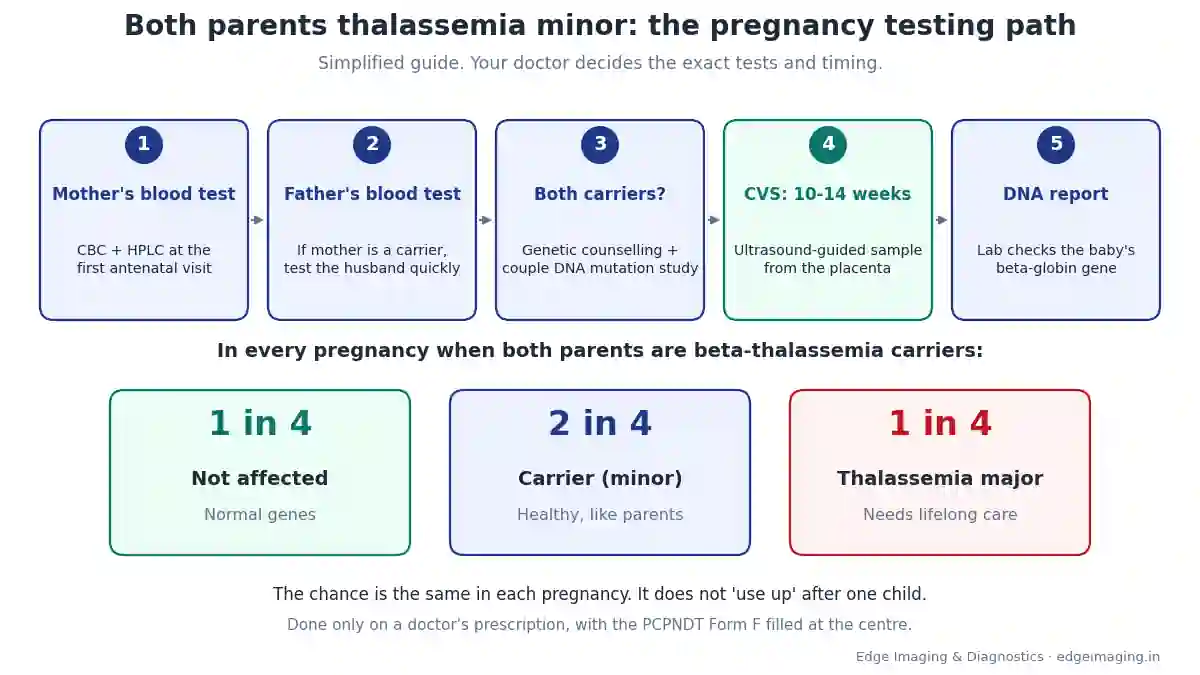
If both husband and wife are thalassemia minor (beta-thalassemia carriers), there is a 1 in 4 chance in every pregnancy that the baby has thalassemia major. The baby can be tested early in pregnancy: after a couple DNA mutation study, a CVS test at about 10 to 14 weeks checks the baby’s own gene, so parents get a clear answer in the first trimester.
Many couples first hear the words “thalassemia minor” on a routine pregnancy blood report. Then the doctor asks the husband to get tested too — and suddenly both reports say the same thing. It is natural to feel scared. The good news is that this situation is very well understood, testing is clear, and you have time to act if you start early.
This guide explains, step by step and in simple language, what it means when both parents are carriers, which blood tests are done, why the timing matters so much, how the baby is tested, and what each result means. It is written for couples, not doctors.
People search for this as “thalassemia minor husband wife”, “both parents thalassemia minor”, “thalassemia test in pregnancy”, “prenatal diagnosis of thalassemia”, “thalassemia minor pregnancy” or, in Hinglish, “pati patni dono thalassemia minor”. All of these are answered here, with a short Hinglish section near the end.
Both parents thalassemia minor: at a glance
- Your own health: thalassemia minor (trait) usually causes no illness, at most mild anaemia
- The risk: when both parents carry beta-thalassemia, each pregnancy has a 1 in 4 chance of thalassemia major
- Same chance every time: the 1 in 4 applies afresh to every pregnancy
- Blood tests: CBC (look at MCV and MCH) and HPLC (look at HbA2) for both partners
- Key step: genetic counselling and a couple DNA mutation study, as early as possible
- Testing the baby: CVS, usually at about 10 to 14 weeks of pregnancy
- Found out late? Amniocentesis is possible after about 16 weeks
- Three possible results: not affected, carrier (minor), or thalassemia major
- Best timing: test before marriage or before pregnancy, or at the very first antenatal visit
What this guide covers
- Thalassemia minor and major: what they mean
- Minor vs major: the key differences
- Why both parents matter: the 1 in 4 chance
- The chance is the same in every pregnancy
- How common thalassemia is in India
- When should a couple get tested?
- The blood tests: CBC and HPLC
- Reading your HPLC report
- Borderline HbA2 and iron deficiency
- Why a screening strip test alone is not enough
- Wife is a carrier: test the husband quickly
- HbE, sickle cell and other partner traits
- Genetic counselling: what happens
- The couple DNA mutation study
- How the baby is tested: CVS
- Why 10 to 14 weeks matters for thalassemia
- Found out late? Amniocentesis
- CVS day for a thalassemia carrier couple
- Is the small risk worth it for a carrier couple?
- The DNA report: three possible results
- How long the thalassemia DNA result takes
- If the baby is affected
- Your own pregnancy as a thalassemia minor mother
- Iron tablets: a common confusion
- Planning future pregnancies
- Tell your brothers and sisters
- Week-by-week checklist
- What to bring
- The law in India
- Myths and facts
- Questions to ask your doctor
- Coping with the worry
- Seedhi baat: pati patni dono thalassemia minor
- CVS at Edge Imaging, West Delhi
- References
- Frequently asked questions
Thalassemia minor and major: what they mean
Thalassemia is an inherited blood condition. It affects how the body makes haemoglobin, the protein in red blood cells that carries oxygen. In India, the type that matters most for couples is beta-thalassemia, which involves the beta-globin gene.
Every person has two copies of the beta-globin gene — one from the mother and one from the father. If one copy is changed (has a mutation), the person has thalassemia minor, also called thalassemia trait or carrier state. If both copies are changed, the person has thalassemia major, a serious condition.
Thalassemia minor is not a disease you “catch” and it does not turn into thalassemia major later in life. You are born a carrier and you stay a carrier. Most carriers never know unless a blood test shows it.
Minor vs major: the key differences
- Thalassemia minor (carrier): usually healthy, with no symptoms. Red blood cells are smaller than usual and haemoglobin may be slightly low. It does not need treatment and is not the same as iron-deficiency anaemia.
- Thalassemia major: babies look normal at birth, but severe anaemia usually develops within the first year of life. Children need regular blood transfusions, usually every few weeks, plus medicines to remove the extra iron that builds up from transfusions.
Some children with a well-matched donor can be cured with a bone marrow (stem cell) transplant, but it is a major treatment and not available or suitable for every child. This is why so many families, once they understand the risk, choose to test the baby early in pregnancy.
There is also a middle form, thalassemia intermedia, where the condition is milder than major. The DNA result helps doctors predict which form a baby is likely to have, depending on the exact mutations involved.
Why both parents matter: the 1 in 4 chance
A baby gets one beta-globin gene from each parent. If only one parent is a carrier and the other is not, the baby can at most be a carrier — never thalassemia major. That is why one carrier parent alone is not a cause for alarm.
When both parents are carriers, each parent can pass on either the normal copy or the changed copy. This gives four equal possibilities in every pregnancy:
- 1 in 4 (25%): the baby gets two normal copies — not affected and not a carrier
- 2 in 4 (50%): the baby gets one normal and one changed copy — a carrier (minor), healthy like the parents
- 1 in 4 (25%): the baby gets two changed copies — thalassemia major
Put simply, three out of four times the baby will not have thalassemia major. But one in four is a real risk, and it is the reason doctors recommend testing the baby whenever both parents are carriers.
The chance is the same in every pregnancy
A very common misunderstanding is: “Our first child is healthy, so the next one will be too,” or the reverse, “Our first child has thalassemia major, so the next three will be fine.” Neither is true.
Genes are passed on fresh in every pregnancy, like a new toss of two coins. The 1 in 4 chance does not “get used up”. A couple can have two healthy children and then an affected third child, or two affected children in a row. This is why every pregnancy of a carrier couple should be tested, not just the first.
How common thalassemia is in India
Beta-thalassemia is one of the most common inherited conditions in India. Indian guidance from FOGSI (the Federation of Obstetric and Gynaecological Societies of India) estimates about 42 million carriers of the beta-thalassemia trait in the country.
A large national multicentre study found an overall carrier rate of about 2.78%, varying between states, and FOGSI notes that rates can be much higher in some communities and regions. In real life, this means a carrier marrying another carrier is not rare at all — and most carriers have no idea until they are tested.
This is why FOGSI recommends that pregnant women who have not been tested before should be screened regardless of risk factors — not only those with a family history.
When should a couple get tested?
The earlier, the better. In order of preference:
- Before marriage: a simple blood test for both partners gives the most choices.
- Before planning a pregnancy: lets you complete the couple DNA study in advance, so the baby can be tested without delay once you conceive.
- At the very first antenatal visit: FOGSI advises screening preferably at the first visit and before 8 weeks of pregnancy, with both partners screened together where possible.
If your pregnancy is already further along, do not panic and do not wait — get tested straight away. Your doctor will plan the next steps around the weeks you have.
The blood tests: CBC and HPLC
The thalassemia test in pregnancy usually starts with two simple blood tests, done in a pathology laboratory:
- CBC (complete blood count): shows haemoglobin and red cell indices. Two numbers matter most: MCV (size of red cells) and MCH (haemoglobin per red cell). FOGSI uses MCV below 80 fL and MCH below 27 pg as a signal to do the next test.
- HPLC (haemoglobin variant analysis): measures the different types of haemoglobin. In beta-thalassemia trait, a type called HbA2 is raised. FOGSI considers HbA2 above 3.5% diagnostic of beta-thalassemia trait.
No fasting is usually needed. Both tests need a small blood sample. Your doctor may also check your iron level (serum ferritin), because iron deficiency can confuse the results.
Reading your HPLC report
An HPLC report lists several haemoglobin types with percentages. Here is what the common ones mean, in simple terms:
- HbA: normal adult haemoglobin — most of your haemoglobin
- HbA2: a small normal fraction; raised above 3.5% suggests beta-thalassemia trait
- HbF: fetal haemoglobin; a raised value can point to beta-thalassemia or another condition, and is interpreted by the doctor
- Other peaks (such as HbE or HbS): suggest a different haemoglobin trait that also matters when planning a pregnancy
Your doctor will read the HPLC together with your CBC and iron studies. Please do not interpret a single number on your own — a value can look worrying or reassuring when the full picture says otherwise.
Borderline HbA2 and iron deficiency
Sometimes HbA2 comes in the “grey zone”, just above or below the usual cut-off. FOGSI advises that values of about 3.3 to 3.9% must not be dismissed and may need DNA testing. A study from India found that some genuine carriers have borderline HbA2 levels and can be missed if only strict cut-offs are used.
Iron deficiency, which is very common in pregnancy, can lower HbA2 and hide a carrier state. Recent blood transfusion can also change HPLC results. That is why doctors check iron levels and, when the partner is a known carrier, may advise DNA testing even when HPLC is borderline.
The practical lesson: if one partner is a confirmed carrier and the other’s report is borderline, ask your doctor specifically whether a DNA test is needed for the borderline partner.
Why a screening strip test alone is not enough
Some places use a quick screening test called NESTROFT. It is cheap and simple, but FOGSI notes that it can give false negative results in a small proportion of beta-thalassemia carriers and does not recommend relying on it.
For a couple planning a pregnancy, the safer approach is CBC plus HPLC, with DNA testing whenever results are unclear. A missed carrier is the one situation everyone wants to avoid.
Wife is a carrier: test the husband quickly
If the wife’s report shows thalassemia minor, the most important next step is simple: test the husband as soon as possible — ideally the same week. Many couples lose precious weeks here because the husband is busy, travelling or feels it is unnecessary.
- If the husband is not a carrier: the baby cannot have thalassemia major. The baby may be a carrier, which is harmless to health.
- If the husband is a carrier (or has HbE or sickle trait): the couple is “at risk”, and the baby should be offered testing.
- If the husband cannot be tested: the doctor treats the pregnancy as potentially at risk and will discuss baby testing.
The same applies the other way round. If the husband already knows he is a carrier, the wife should be tested at the very start of pregnancy, or better, before it.
HbE, sickle cell and other partner traits
Beta-thalassemia is not the only trait that matters. If one partner has beta-thalassemia trait and the other has HbE trait or sickle cell trait (HbS), the baby can inherit a combination such as HbE-beta-thalassemia or sickle-beta-thalassemia, which can also be serious.
FOGSI notes that HbE and HbS carrier rates can be high in certain regions. So when the HPLC report shows any unusual haemoglobin, the couple should be counselled in the same way as a beta-thalassemia carrier couple. Your doctor will explain what your specific combination means.
Genetic counselling: what happens
When both partners are found to be carriers, FOGSI recommends genetic counselling. This is a calm, private conversation with a trained doctor or counsellor. It is not a test and it does not commit you to anything.
In counselling, you can expect to discuss:
- What your reports mean and what the 1 in 4 chance means for you
- What thalassemia major involves for a child and family
- The couple DNA mutation study and why it comes first
- The options for testing the baby (CVS or amniocentesis), with their timing and risks
- What happens after each possible result
For a thalassemia minor husband wife couple, this one conversation often brings the most relief. Bring your HPLC and CBC reports, your dating scan, and any family history (for example, a relative with thalassemia major). Ask every question you have — there are no silly questions here.
The couple DNA mutation study
This is the step that many couples do not know about, and it is one of the most important. Before the baby is tested, the laboratory usually needs to know exactly which mutation each parent carries. FOGSI lists “couple gene mutation analysis” as the next step once both partners are found to be carriers.
Why does this matter? The lab then looks for those specific mutations in the baby’s sample. Knowing them in advance makes the baby’s test faster and more reliable. If the parents’ mutations are not yet known, the lab may have to study the parents and the baby sample together, which can take longer.
The couple study is done on blood samples from both parents. Ask your doctor or the lab when to give these samples — usually as early as possible, so the result is ready before the baby’s sample is taken.
How the baby is tested: CVS
Chorionic villus sampling (CVS) is the usual way to test the baby for thalassemia in early pregnancy. A tiny sample of tissue is taken from the developing placenta. The placenta comes from the same fertilised egg as the baby, so it carries the baby’s genes.
The procedure is done under continuous ultrasound guidance, usually with a thin needle through the abdomen. The sample is sent to a genetics laboratory, which checks the baby’s beta-globin genes for the parents’ mutations.
For the full details of the procedure itself — who it is advised for, how it is done, and how it compares with amniocentesis — read our complete guide to the CVS test in pregnancy.
Why 10 to 14 weeks matters for thalassemia
FOGSI advises that confirmatory testing of the baby through CVS should be offered between 10 and 14 weeks of pregnancy. An Indian thalassemia clinic in New Delhi reported doing all its CVS procedures for thalassemia at 10 to 12 weeks, and described early CVS as offering less physical and emotional stress than waiting for the second trimester.
Early testing gives parents an answer while the pregnancy is still in the first trimester. That gives the family more time to think, talk to their doctors, and decide calmly. It also means any decision is taken earlier in pregnancy, when it is medically simpler.
Because the window is short, the whole chain — wife’s test, husband’s test, counselling, couple DNA study, booking the CVS — needs to move quickly. A few days’ delay at each step can add up to missing the window.
Found out late? Amniocentesis
If you are already past the CVS window when you learn both of you are carriers, the baby can still be tested. Amniocentesis takes a small amount of the fluid around the baby, and FOGSI places it after 16 weeks of pregnancy. The DNA in that fluid can be tested for the parents’ mutations.
The answer comes later than with CVS, so do not delay further. Read more in our amniocentesis guide and speak to your doctor straight away.
CVS day for a thalassemia carrier couple
Knowing what to expect makes the day much easier. A typical CVS visit goes like this:
- Paperwork: your doctor’s prescription, consent and the legally required Form F under the PCPNDT Act are completed.
- Ultrasound check: the radiologist confirms the baby’s heartbeat, the exact weeks of pregnancy, and where the placenta lies.
- Sampling: the skin is cleaned and a thin needle is guided into the placenta under continuous ultrasound. It usually takes a few minutes.
- Heartbeat check: the baby’s heartbeat is checked again after the procedure.
- Short rest: you rest briefly and go home the same day with simple aftercare advice.
Bring your husband or a family member along for support, and plan a quiet rest of the day. If you have not yet given blood samples for the couple mutation study, ask whether they can be taken on the same visit.
Is the small risk worth it for a carrier couple?
CVS is an invasive test, so it carries a small risk of miscarriage. In experienced hands this risk is low — about 0.2% is commonly quoted in recent data, which our CVS guide explains in more detail. Other problems, such as infection or leaking fluid, are uncommon.
For a carrier couple, this small procedure risk is weighed against the 1 in 4 chance of thalassemia major. Most couples, after counselling, feel the answer is worth it — but it is your decision, and a good counsellor will respect whichever choice you make.
After CVS, contact your doctor urgently if you have heavy bleeding, fever, leaking fluid, or strong, worsening pain.
The DNA report: three possible results
The genetics laboratory reports on the baby’s beta-globin genes. In simple words, there are three possible results:
- Not affected (normal): the baby has inherited neither parent’s mutation.
- Carrier (thalassemia minor, heterozygous): the baby has one mutation, like the parents. The baby is expected to be healthy. This is worth telling the child when they grow up, for their own family planning.
- Affected (thalassemia major, homozygous or compound heterozygous): the baby has inherited both parents’ mutations and is expected to have thalassemia major or a related serious form.
The lab also checks that the sample truly reflects the baby and has not been mixed with the mother’s cells. Your doctor will explain your report and the next steps. If anything on the report is unclear, ask for a counselling appointment — do not try to decode it alone.
How long the thalassemia DNA result takes
The waiting time depends on the laboratory and on whether the parents’ mutations are already known. Single-gene tests such as thalassemia are often reported in about 2 to 4 weeks, and sometimes sooner when the couple study has already been done. The lab will give you the expected date when the sample is sent.
Waiting is often the hardest part. Keep busy, lean on your partner and family, and remember that three out of four times the news is reassuring. If you feel overwhelmed, tell your doctor — support is part of good care.
If the baby is affected
This is the result every couple fears. If it happens, you will not be left alone with it. Your doctor and genetic counsellor will explain what thalassemia major means for the child, what treatment involves, and all the options available to you.
In India, options include those permitted under the Medical Termination of Pregnancy (MTP) Act. FOGSI notes that when an abnormality is detected beyond 24 weeks, termination needs approval from a Medical Board. This is one more reason why early testing at 10 to 14 weeks matters — it keeps every option open and allows a calm, unhurried decision.
Some families choose to continue the pregnancy and prepare for treatment. Whatever you decide, it is your family’s decision, and it deserves respect and support.
Your own pregnancy as a thalassemia minor mother
Thalassemia minor pregnancy is usually healthy. Being a carrier does not, by itself, harm the baby or make the pregnancy high-risk in most women. What it can do is cause a mild anaemia, because red blood cells are smaller than usual.
Your doctor will keep an eye on your haemoglobin through pregnancy. Folic acid is routinely advised in pregnancy, and your doctor will tell you the right dose for you. Regular check-ups and your scans — dating scan, NT scan and later scans — continue as normal. See our pregnancy scan schedule for which scan happens when.
Iron tablets: a common confusion
Many thalassemia minor women are given iron tablets again and again because their haemoglobin looks low — but the low reading is from the trait, not from lack of iron. Equally, some carriers really do have iron deficiency as well, which needs treatment.
The answer is simple: your doctor checks your iron level (ferritin) and decides. Please do not start, stop or double iron tablets on your own based on haemoglobin alone. Tell every doctor you see that you are a thalassemia carrier.
Planning future pregnancies
Once you know you are a carrier couple, you can plan every future pregnancy in advance:
- Keep your reports safe: your HPLC reports and, most importantly, the couple mutation report. With it, the baby’s test in the next pregnancy can be planned straight away.
- Book early: see your doctor as soon as the pregnancy test is positive, and plan CVS for 10 to 14 weeks.
- Ask about IVF with embryo testing: some couples choose IVF with preimplantation genetic testing, where embryos are tested before transfer. This is offered at some fertility centres; ask a fertility specialist whether it suits you.
Tell your brothers and sisters
If you are a carrier, there is a good chance that some of your brothers, sisters and cousins are carriers too. They may have no idea. A simple CBC and HPLC test can tell them, ideally before they marry or plan a family.
Sharing this information is one of the kindest things you can do for your family. It can save another couple from finding out only after a child is born with thalassemia major.
Week-by-week checklist
Here is a simple checklist that carrier couples can follow. Your doctor may adjust it for you.
- Positive pregnancy test: book your first antenatal visit at once. Mention that one or both of you are carriers.
- First visit (ideally before 8 weeks): CBC and HPLC for the wife, if not already done; same for the husband.
- Both carriers: genetic counselling within days. Give blood samples for the couple mutation study.
- Around 7 to 9 weeks: dating scan to confirm the exact weeks of pregnancy.
- 10 to 14 weeks: CVS as planned by your doctor.
- Around 11 to 14 weeks: NT scan, which is a routine scan for every pregnancy (see our NT scan guide).
- Result: review with your doctor and counsellor.
What to bring
- Your doctor’s prescription or referral for CVS
- Both partners’ CBC and HPLC reports
- The couple DNA mutation report, if already done
- Your dating scan and any other pregnancy scan reports
- A photo ID
- Your husband or a family member for support
The law in India
Prenatal procedures such as CVS are regulated under the PCPNDT Act. They are done only on a doctor’s advice for a medical reason, such as thalassemia risk, and the legally required Form F is completed at the centre. By law, no test in India may be used to tell the baby’s sex, and it is never disclosed.
The laboratory tests only for the condition your doctor has asked for. These rules protect families and ensure the test is used for its real purpose: the baby’s health.
Myths and facts
- Myth: “Thalassemia minor is a disease and we need treatment.” Fact: it is a carrier state and usually needs no treatment.
- Myth: “Our first child is healthy, so we are safe.” Fact: the 1 in 4 chance applies to every pregnancy.
- Myth: “If only the wife is a carrier, the baby can get thalassemia major.” Fact: thalassemia major needs a changed gene from both parents.
- Myth: “A normal haemoglobin means I am not a carrier.” Fact: many carriers have near-normal haemoglobin; MCV, MCH and HPLC are needed.
- Myth: “Iron tablets will cure thalassemia minor.” Fact: iron does not change the trait; it helps only if you are also iron deficient.
- Myth: “An ordinary ultrasound can tell if the baby has thalassemia.” Fact: only a DNA test on CVS or amniocentesis can diagnose it before birth.
Questions to ask your doctor
- Are both our reports clearly carrier, or is either one borderline?
- Do we need a DNA test because of a borderline HbA2 or low iron?
- When and where should we give samples for the couple mutation study?
- What is the latest week we can do CVS, given our dates?
- Which laboratory will test the sample, and when should we expect the result?
- Who will explain the result to us?
- Do I need iron tablets, or only folic acid?
- What should we do differently in our next pregnancy?
Coping with the worry
It is normal to feel shocked, guilty or anxious when both reports say “carrier”. Please remember: nobody chooses their genes, and being a carrier is nobody’s fault. Millions of healthy Indians are carriers.
What you can control is the next step. Move quickly through the tests, ask questions, and lean on each other. Many couples say the anxiety eased once they had a clear plan and a date for the CVS.
Seedhi baat: pati patni dono thalassemia minor
Agar pati aur patni dono thalassemia minor hain, toh har pregnancy me 4 me se 1 chance hai ki baby ko thalassemia major ho. 4 me se 2 baar baby carrier (minor) hoga, jo healthy rehta hai, aur 4 me se 1 baar baby bilkul normal hoga. Yeh chance har pregnancy me naya hota hai.
Kya karna hai? Pregnancy pata chalte hi doctor se milein. Dono ka CBC aur HPLC test karwayein. Dono carrier nikle toh genetic counselling aur couple DNA mutation study jaldi karwayein. Phir lagbhag 10 se 14 hafte me CVS test hota hai, jisme placenta ka chhota sample leke baby ka gene check hota hai. Late pata chale toh 16 hafte ke baad amniocentesis ho sakta hai.
Sabse zaroori baat: der mat kijiye. Patni carrier nikle toh pati ka test usi hafte karwa lijiye.
CVS at Edge Imaging, West Delhi
At Edge Imaging & Diagnostics, West Delhi, CVS is performed under continuous ultrasound guidance by experienced radiologists, in sterile conditions, at our PCPNDT-registered, NABH-accredited centre. The sample goes to the genetics laboratory of your doctor’s choice, or our partner lab. Form F is completed at the centre, and your dating scan, NT scan and later pregnancy scans can be done with us too.
To plan your visit, see our CVS test page for West Delhi. Send your doctor’s prescription and both partners’ HPLC reports on WhatsApp, and we will share the earliest slot, what to bring, and today’s actual pricing.
💬 WhatsApp your prescription for today’s pricing | Call 9555999960
References
- FOGSI Good Clinical Practice Recommendations on Thalassemia (2025) — Federation of Obstetric and Gynaecological Societies of India
- Significance of borderline HbA2 levels in β thalassemia carrier screening — Scientific Reports, 2022
- Prenatal diagnosis of thalassemia by chorionic villus sampling — Indian Pediatrics, 2005
- Thalassaemia — NHS
- Screening for sickle cell and thalassaemia in pregnancy — NHS
- Thalassemia — MedlinePlus
Frequently asked questions
What happens if husband and wife are both thalassemia minor?
In every pregnancy there is a 1 in 4 chance the baby has thalassemia major, a 2 in 4 chance the baby is a healthy carrier, and a 1 in 4 chance the baby is not affected. The baby can be tested early in pregnancy.
Can two thalassemia minor parents have a healthy baby?
Yes. Three out of four times the baby will not have thalassemia major. Testing the baby with CVS tells you which applies in your pregnancy.
Which test is done for thalassemia in pregnancy?
The mother and father have a CBC and HPLC blood test. If both are carriers, the baby is tested through CVS at about 10 to 14 weeks, or amniocentesis after about 16 weeks.
When should the thalassemia test be done in pregnancy?
As early as possible, ideally at the first antenatal visit and before 8 weeks, with both partners tested together. Testing before marriage or before pregnancy is even better.
What HbA2 level means thalassemia minor?
FOGSI considers HbA2 above 3.5% on HPLC diagnostic of beta-thalassemia trait. Values of about 3.3 to 3.9% are borderline and may need DNA testing.
Can iron deficiency hide thalassemia minor?
Yes. Iron deficiency can lower HbA2 and make a carrier look borderline or normal. Your doctor reads HPLC together with iron studies.
Why is a couple DNA mutation study needed before CVS?
The lab needs to know each parent’s exact mutation so it can look for those in the baby’s sample. It makes the baby’s test faster and more reliable.
At how many weeks is CVS done for thalassemia?
Usually between 10 and 14 weeks of pregnancy, as advised by your doctor.
What if we find out after 14 weeks?
The baby can still be tested by amniocentesis, usually after about 16 weeks. Speak to your doctor without delay.
How long does the thalassemia result on CVS take?
It depends on the lab and on whether the parents’ mutations are known. Single-gene tests are often reported in about 2 to 4 weeks. The lab will give you the expected date.
Is the small CVS risk worth it for a carrier couple?
CVS carries a small risk of miscarriage, about 0.2% in recent data, in experienced hands, against a 1 in 4 chance of thalassemia major. After counselling, it is the couple’s own decision.
If our first child is healthy, do we still need to test the next pregnancy?
Yes. The 1 in 4 chance applies afresh to every pregnancy, so every pregnancy of a carrier couple should be tested.
If only the wife is thalassemia minor, can the baby have thalassemia major?
No, not from beta-thalassemia alone, because thalassemia major needs a changed gene from both parents. The husband should still be tested to confirm he is not a carrier and has no other haemoglobin trait.
Does thalassemia minor affect my own pregnancy?
Usually not seriously. It may cause mild anaemia. Your doctor monitors your haemoglobin and checks iron levels before deciding on iron tablets.
Pati patni dono thalassemia minor hain toh kya karein?
Turant doctor se milein, genetic counselling aur couple DNA study karwayein, aur 10 se 14 hafte me CVS test plan karein. Har pregnancy me 4 me se 1 chance thalassemia major ka hota hai.
Thalassemia test pregnancy me kab karwana chahiye?
Pehli antenatal visit par hi, behtar ho ki 8 hafte se pehle. Pati aur patni dono ka test saath me karwana sabse achha hai.
Where can a carrier couple get CVS in West Delhi?
At Edge Imaging & Diagnostics, West Delhi. WhatsApp or call 9555999960 with your prescription and HPLC reports for the earliest slot and today’s actual pricing.
The bottom line
When husband and wife are both thalassemia minor, each pregnancy carries a 1 in 4 chance of thalassemia major — but three out of four times the baby will not have it, and you do not have to guess. With CBC and HPLC for both partners, genetic counselling, a couple DNA mutation study and CVS at about 10 to 14 weeks, you can know clearly, early in pregnancy.
The single most important thing is speed: test early, test both partners, and keep every step moving. Keep your reports safe for future pregnancies, and share your carrier status with your family. Clear information, at the right time, protects your child and your peace of mind.
Written by the medical team at Edge Imaging & Diagnostics, West Delhi. Medically reviewed by Dr. Nishant Thapar. Last reviewed: October 2026.
Disclaimer: this article is general information to help couples understand thalassemia testing in pregnancy. It is not a diagnosis or a substitute for genetic counselling. Decisions about prenatal testing should always be made with your treating doctor and, where offered, a genetic counsellor.