
 PV
 TG
 MN
 EM
 EI
 ND

 CT Scan
 PET CT
 Digital X-ray
 Ultrasound
 Amniocentesis

 Fetal Reduction
 Thermalytix Breast Screening
 Cardiology
 Lab Tests
 GAMCA Pre-Medical

Spider veins are tiny red, blue or purple thread-like veins that show through the skin, most often on the thighs, calves and around the ankles. The most widely used treatment for spider veins on the legs is sclerotherapy: a doctor injects a medicine into the tiny veins through a very fine needle, the veins close, and over the following weeks they fade. There are no cuts, you stay awake, and most people go back to normal activities the same day.
Many people first notice them in the mirror or while wearing shorts: a web of fine lines on the thigh, a little “starburst” near the knee, or a cluster of thin blue threads around the ankle. Some feel embarrassed and stop wearing skirts or shorts. Others worry that the lines are a sign of a serious blood problem. A few also feel aching, burning or heaviness in the legs and wonder whether the two are linked.
This guide explains spider veins in simple language: what they are, why they appear, when they need a scan, how sclerotherapy works, what it feels like, how many sessions are usually needed, the honest side effects, and how it compares with laser treatment and home remedies. It is written for patients and families, not doctors.
People search for this as “spider veins treatment”, “spider veins on legs”, “sclerotherapy for spider veins”, “foam sclerotherapy for spider veins”, “spider veins removal”, “thread veins treatment”, “spider veins treatment in Delhi” or, in Hinglish, “pairon me nason ka jaal kaise hataye”. All of these are answered here, with a short Hinglish section near the end.
Spider veins treatment: at a glance
- What spider veins are: very small widened veins in the skin, less than 1 mm wide
- Main treatment: sclerotherapy injections through a very fine needle
- Anaesthesia: usually none needed; you stay awake
- Cuts or stitches: none
- Time: a short clinic visit; you go home the same day
- Results: small spider veins usually fade over about 3 to 6 weeks
- Sessions: often more than one, spaced several weeks apart
- Scan first? A venous Doppler is advised if you also have aching, swelling or bulging veins
- Usually postponed: during pregnancy or breastfeeding; not done with an active blood clot
What this guide covers
- What spider veins are
- What they look like and where they appear
- Spider veins vs reticular veins vs varicose veins
- Why spider veins appear
- Who is more likely to get them
- Are spider veins dangerous?
- Do spider veins cause symptoms?
- When a Doppler scan is needed first
- Spider veins treatment options at a glance
- Sclerotherapy for spider veins: how it works
- Liquid or foam sclerotherapy for spider veins?
- Who is a good candidate
- When sclerotherapy should wait or is not suitable
- How to prepare
- The procedure, step by step
- Does sclerotherapy for spider veins hurt?
- Aftercare: the first two weeks
- When will I see results?
- How many sessions are needed?
- Common side effects
- Rare risks and warning signs
- Laser vs sclerotherapy for spider veins
- Spider veins on the face
- Home remedies and creams: what helps and what does not
- Can new spider veins be prevented?
- Spider veins in pregnancy
- Do spider veins come back after treatment?
- What affects the cost of spider veins treatment
- Questions to ask before treatment
- Myths and facts
- Seedhi baat: pairon me nason ka jaal (spider veins) ka ilaj
- Spider veins treatment at Edge Imaging, West Delhi
- References
- Frequently asked questions
What spider veins are
Your skin has a fine network of very small blood vessels. When some of the tiny veins in the top layers of the skin widen and become permanently visible, they are called spider veins. Doctors call them telangiectasias. In the UK they are often called thread veins, and some people call them “broken veins”, although nothing is actually broken.
Spider veins are very common, especially in women and with increasing age. They are usually harmless. For most people they are mainly a cosmetic concern, but they can sometimes be a surface sign of a deeper vein problem, which is why a short check is sensible before any treatment.
Mayo Clinic describes spider veins as a mild form of varicose veins: smaller and closer to the surface of the skin. They appear as thin red lines or web-like clusters, and they can look red, purple or blue depending on the vessel and your skin tone.
What they look like and where they appear
Spider veins can take a few typical shapes:
- Spider or starburst pattern: lines spreading out from a central point, like the legs of a spider
- Branching pattern: lines that split like the branches of a tree
- Simple lines: short, straight or wavy thin lines
- Mat or patch: a dense red or purple blush made of many tiny vessels close together
On the legs they most often appear on the outer thighs, the inner thighs, behind the knees, on the calves and around the ankles. They can also appear on the face, especially around the nose and on the cheeks, but facial spider veins are usually managed differently, as explained later.
Spider veins are flat or only very slightly raised. If you can see thick, rope-like veins that bulge above the skin, especially when you stand, those are varicose veins, not spider veins. The two often occur together.
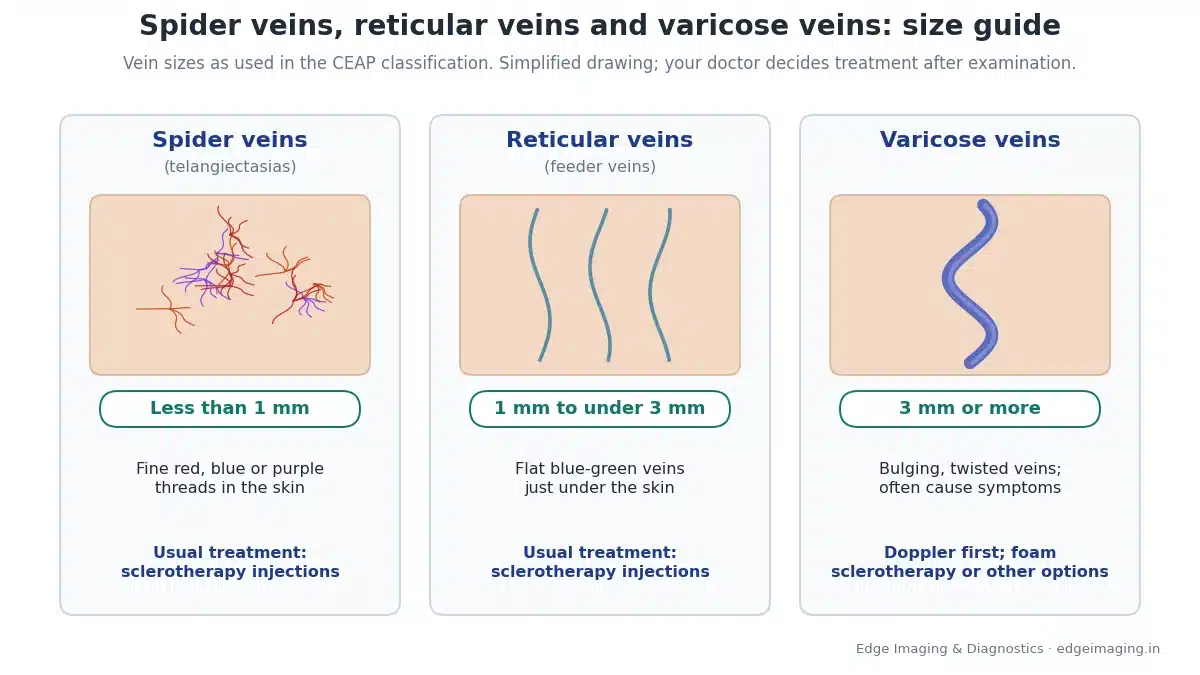
Spider veins vs reticular veins vs varicose veins
Doctors around the world describe leg veins using a system called CEAP. In its 2020 update, vein size is the simplest way to tell the three types apart:
- Spider veins (telangiectasias): less than 1 mm wide, lying within the skin
- Reticular veins: from 1 mm to under 3 mm wide, blue or green, lying just under the skin
- Varicose veins: 3 mm or more wide, often bulging and twisted
Reticular veins matter for spider vein treatment. They often act as “feeder veins” for a patch of spider veins. If a feeder vein is left untreated, the spider veins around it are more likely to persist or return. A good treatment plan looks for these feeders and treats them too.
Varicose veins matter even more. If a leaking main vein in the leg is feeding the surface veins, treating only the spider veins on top is like painting over a damp wall without fixing the leak. That is why spider veins with aching, swelling or bulging veins need a Doppler scan first.
Why spider veins appear
Veins in the legs work against gravity to return blood to the heart. Small one-way valves stop blood from falling back. When pressure in the small veins stays high for long periods, or when the vein walls are naturally weaker, the tiny vessels in the skin stretch and stay widened.
Common reasons include:
- Family history: spider veins and varicose veins often run in families
- Hormones: puberty, pregnancy, hormonal contraception and menopause can all play a part
- Age: vein walls and valves weaken with time
- Long hours of standing or sitting: blood pools in the lower legs
- Extra body weight: adds pressure on the leg veins
- Underlying vein leakage: a leaking deeper vein can raise pressure in the surface veins
- Sun exposure: mainly for spider veins on the face
- Injury: a bruise or knock can sometimes leave spider veins behind
In many people, there is no single cause. A family tendency plus daily habits plus hormones is the usual mix.
Who is more likely to get them
Spider veins can affect anyone, but they are seen more often in:
- Women, especially after pregnancy
- People whose parents or siblings have spider or varicose veins
- Older adults, as the chance rises with age
- People whose work keeps them on their feet: teachers, nurses, shop staff, security guards, cooks, hairdressers, factory workers
- People who sit for long hours at a desk or while driving
- People who are overweight
Having spider veins does not mean you did something wrong. Many people with healthy habits still get them because of their genes.
Are spider veins dangerous?
Spider veins on their own are usually not dangerous. They do not burst internally, they do not travel to the heart, and they do not turn into cancer. For most people, treatment is a personal choice made for comfort or appearance.
However, spider veins deserve a proper check when they come with any of the following, because these may point to a deeper vein problem:
- Aching, heaviness or tiredness in the legs, worse by evening
- Swelling around the ankles
- Bulging, twisted veins on the same leg
- Dark brown skin, itching or eczema near the ankle
- A cluster of fine veins around the inner ankle or foot (sometimes a sign of vein leakage higher up)
- A wound near the ankle that is slow to heal
Seek urgent medical care if one leg suddenly becomes swollen, painful, warm or red, or if you become breathless or have chest pain. These can be signs of a blood clot, which is different from spider veins and needs immediate attention.
Do spider veins cause symptoms?
Most spider veins cause no symptoms at all. Some people notice mild burning, itching or a dull ache over a patch, particularly in warm weather, after long standing, or around periods.
If you have strong symptoms such as heaviness, cramps at night, restless legs or swelling, do not assume the spider veins are the whole story. These symptoms are more often linked to vein leakage deeper in the leg, and a Doppler scan helps find it.
When a Doppler scan is needed first
A venous Doppler (duplex) ultrasound is a painless scan that shows the veins under the skin and the direction of blood flow. It can show whether a main vein in the leg is leaking backwards and whether the deep veins are healthy.
A Doppler is usually advised before spider vein treatment if you have:
- Leg aching, heaviness or swelling
- Visible bulging or varicose veins on the same leg
- Spider veins clustered around the ankle or on the foot
- Skin changes near the ankle
- Spider veins that came back quickly after earlier treatment
- A past history of blood clots in the legs
If the scan finds a leaking main vein, that is usually treated first, for example with foam sclerotherapy, and the spider veins are treated afterwards. Treating in this order gives better and longer-lasting results.
If you have only a few fine spider veins with no symptoms, the doctor may decide that an examination is enough. Your doctor will guide you.
Spider veins treatment options at a glance
- Sclerotherapy: the most widely used treatment for spider veins and feeder veins on the legs. Injections close the veins, which then fade.
- Surface laser or light treatment: a beam of light heats and closes very fine vessels. It is used more for the face and for tiny vessels that are too small to inject.
- Compression stockings: help leg aching and swelling but do not remove spider veins that are already there.
- Treatment of an underlying leaking vein: when a Doppler finds one, it is treated first.
- Camouflage: leg make-up can hide spider veins for an event; it does not treat them.
Creams, oils and tablets sold online to “remove spider veins” do not have good evidence. They are discussed in the home remedies section below.
Sclerotherapy for spider veins: how it works
In sclerotherapy, a medicine called a sclerosant is injected directly into the tiny vein through a very fine needle. The medicine irritates the inner lining of the vein. The vein walls stick together, the vein closes, and blood is redirected through healthy vessels. Over the next few weeks, your body gradually clears the closed vein, and it fades from view.
The two sclerosants most widely used, and the ones covered by the European guidelines, are polidocanol and sodium tetradecyl sulphate. For spider veins, they are used in low strengths, and the doctor chooses the strength according to the size of the veins.
Sclerotherapy has been used for decades. It is done in a clinic, usually takes less than an hour, and does not need any cuts or stitches.
Liquid or foam sclerotherapy for spider veins?
Sclerotherapy can be given in two forms:
- Liquid sclerotherapy: the medicine is injected as a liquid.
- Foam sclerotherapy: the same medicine is mixed with air or gas to form a fine foam. Foam pushes the blood aside and stays in contact with the vein wall for longer, which makes it stronger for larger veins.
The European guidelines on sclerotherapy describe liquid sclerotherapy as the usual choice for the finest spider veins, while foam is used for larger veins, and can also be used for reticular (feeder) veins. In practice, a treatment plan for spider veins often uses a combination: the fine threads are treated with a low-strength solution, and the bluish feeder veins nearby may be treated with foam.
A 2021 Cochrane review, which looked at 35 studies with 3,632 participants, found no clear difference between foam and other sclerosant forms in how well spider and reticular veins improved, although matting (new tiny red vessels) may be more common with foam. The choice is a clinical one that depends on the size of each vein.
So if you have searched for “foam sclerotherapy for spider veins”, the honest answer is that the doctor decides between liquid and foam, vein by vein. The aim is always the lowest effective dose that closes the vein.
Who is a good candidate
Sclerotherapy for spider veins usually suits people who:
- Have visible spider veins or reticular veins on the legs that bother them
- Have mild symptoms such as burning or itching over the veins
- Have had a Doppler scan, if needed, with no untreated main-vein leak
- Are not pregnant or breastfeeding
- Can walk normally after the procedure
- Have realistic expectations: improvement over weeks, often over more than one session
Your skin type also matters. On darker Indian skin, brown staining after treatment can be more noticeable, so careful dosing and sun protection afterwards are especially important.
When sclerotherapy should wait or is not suitable
Based on the European guidelines and standard practice, sclerotherapy is not done if you have:
- A known allergy to the sclerosant
- An active deep vein thrombosis (DVT) or a recent clot in the lungs
- An infection on the skin of the area to be treated
- Long-term inability to walk or get out of bed
- A known hole in the heart (patent foramen ovale) that has caused symptoms, if foam is planned
Treatment is usually postponed or carefully considered if you:
- Are pregnant or breastfeeding
- Have had blood clots before or have a known clotting tendency
- Have migraine with aura, especially after an earlier foam treatment
- Have narrowing of the leg arteries
- Have recent superficial vein inflammation (thrombophlebitis)
- Have many allergies or a skin condition in the area
Always tell the doctor about all your medicines, including blood thinners, hormonal tablets, and herbal or Ayurvedic products.
How to prepare
- Bring reports: any earlier Doppler scans, previous treatment details and a list of medicines.
- Medicines: do not stop any prescribed medicine on your own. Mayo Clinic advises telling your team about aspirin, pain-killers like ibuprofen, blood thinners, iron and herbal supplements; your doctor will tell you if anything needs to change.
- Skin: do not shave the legs or apply lotion or oil on the day of treatment.
- Clothing: wear loose, comfortable clothes, such as a loose salwar or track pants.
- Stockings: if your doctor has advised compression stockings, bring them or ask about them in advance.
- Timing: avoid planning treatment just before a beach holiday or a long flight. Sun and long immobility are best avoided in the weeks after.
- Photos: taking “before” photos in good light helps you see your progress later.
The procedure, step by step
- Consultation and check: the doctor examines your legs while you stand, asks about symptoms, and reviews any Doppler report.
- Marking: the veins to be treated are identified, often with a bright light or a vein viewer to see the feeder veins.
- Positioning: you lie on the couch with your legs slightly raised.
- Cleaning: the skin is cleaned with an antiseptic.
- Injections: very small amounts of sclerosant are injected into the tiny veins through a very fine needle. You may see the vein “blanch” or disappear for a moment as the medicine flows in.
- Pressure: gentle pressure or cotton pads are placed over the injection sites.
- Compression: a compression stocking or bandage may be applied.
- Walking: you are asked to walk for a short while before going home.
The number of injections depends on how many veins are treated. Mayo Clinic notes that the procedure is usually done in an hour or less, and most people go back to normal activities the same day.
Does sclerotherapy for spider veins hurt?
Honest answer: it is not completely painless, but most people find it very tolerable. You feel a small needle prick with each injection, because a needle is used. Some medicines cause brief stinging, burning or a cramp-like feeling for a few seconds to a minute.
No general anaesthesia is needed, and usually no local anaesthetic either, because the needle is so fine. If you are anxious about needles, tell the doctor. Treating a smaller area per session, breathing slowly, and having someone with you can all help.
After treatment, the area may feel tender, itchy or bruised for a few days. Simple walking usually eases any tightness.
Aftercare: the first two weeks
- Walk: walk every day from the same day. Walking helps blood flow and lowers the chance of clots.
- Compression: wear stockings or bandages for as long as your doctor advises. Mayo Clinic mentions about two weeks; some doctors advise a shorter or longer period depending on the veins treated.
- Avoid heavy exercise: skip heavy gym work, running and squats for about two weeks, or as your doctor advises.
- Avoid heat: avoid hot water baths, saunas, steam and hot fomentation on the area for a few days.
- Protect from sun: keep treated areas covered or use a broad-spectrum sunscreen of SPF 30 or higher for at least two weeks. Sun on fresh treatment can increase brown staining, especially on brown skin.
- Travel: avoid long flights or long car or bus journeys for the first few days if possible. If you must travel, keep moving, flex your calves and drink water.
- Do not scratch or massage hard: let small bruises settle on their own.
Office work and normal household work can usually continue from the same or next day.
When will I see results?
Right after the injections, the treated area often looks worse, not better. Expect bruising, redness and small dark lines where the veins were. This is normal.
Mayo Clinic says that small spider veins usually show results in about 3 to 6 weeks, while larger veins may take 3 to 4 months. Some fading continues for longer. A follow-up check after about a month is common.
Most people see a clear improvement, but rarely 100% clearance after one session. The goal is a visible, satisfying reduction, not perfect skin.
How many sessions are needed?
More than one session is common, especially for a larger area, depending on how many veins there are and how they respond. Sessions are usually spaced at least six weeks apart, to let the earlier treatment settle before deciding what still needs treating.
The doctor usually estimates the likely number of sessions at the first visit, after seeing how extensive the veins are and whether feeder veins are involved.
Common side effects
Most side effects of sclerotherapy for spider veins are mild and temporary:
- Bruising and redness at injection sites, usually settling over days to weeks
- Itching or mild tenderness along the treated veins
- Raised red bumps at injection sites that settle within days
- Brown staining (hyperpigmentation): brown lines or spots along treated veins. Common, and most fade over months, though some take longer. Sun protection helps.
- Matting: a blush of new, very fine red vessels near the treated area. It often fades on its own, and persistent matting can be treated.
- Small trapped blood clots in treated veins, which can feel like tender lumps. The doctor can release them with a tiny needle prick, which helps them settle faster and reduces staining.
The Cochrane review confirmed that hyperpigmentation and matting are more common after sclerotherapy than after placebo injections, which is why careful technique, low doses and good aftercare matter.
Rare risks and warning signs
Serious problems after spider vein sclerotherapy are rare. They include:
- Small skin ulcer: a small sore can form at an injection site and usually heals with simple care.
- Allergic reaction: uncommon; clinics keep emergency medicines ready.
- Visual disturbance or headache: brief flashing lights or migraine-like symptoms, more often after foam, usually passing within minutes to hours.
- Deep vein thrombosis: a clot in a deep vein is very rare after spider vein treatment, but must be recognised.
Call your doctor or seek urgent care if you notice:
- Sudden swelling, pain or warmth in the calf or whole leg
- Breathlessness, chest pain or coughing blood
- Weakness, numbness or trouble speaking
- A painful, spreading red area, or an open sore
- Signs of allergy: rash all over, swelling of the face or lips, difficulty breathing
Laser vs sclerotherapy for spider veins
Surface laser treatment uses light to heat and close very small blood vessels through the skin, without needles.
What the evidence shows: the 2021 Cochrane review found no clear difference between laser and sclerosing agents in how much spider and reticular veins improved. Hyperpigmentation may be less common with laser. Combining laser with polidocanol sclerotherapy may improve results, but may be more painful.
In practice:
- Sclerotherapy is widely used for spider veins and feeder veins on the legs, because it can treat both the visible threads and the bluish feeders.
- Surface laser is more often used for the face, and for vessels too fine to inject. On darker skin, laser settings need extra care.
- Neither treatment fixes an underlying leaking main vein. If one exists, it is treated first.
Do not confuse surface laser for spider veins with endovenous laser, which is a different procedure for large varicose veins done from inside the vein.
Spider veins on the face
Spider veins on the face, especially around the nose and on the cheeks, are common with sun exposure, rosacea, ageing and sometimes hormones. They are usually treated by a dermatologist, most often with laser or light-based treatment, rather than with injections.
Sclerotherapy is mainly a treatment for veins on the legs. If you have facial spider veins, a dermatologist is the right first contact. Daily sunscreen and gentle skin care also help prevent new ones.
Home remedies and creams: what helps and what does not
The internet is full of claims that apple cider vinegar, horse chestnut, essential oils, vitamin K cream or special tablets will “remove spider veins naturally”. It is important to be honest: no cream, oil or tablet has been shown to make existing spider veins disappear. A spider vein is a widened vessel in the skin; rubbing something on top does not close it.
What can genuinely help your legs:
- Regular walking and calf exercises, which pump blood out of the legs
- Raising your legs above heart level for a while after a long day
- Compression stockings for aching or swelling, especially if you stand all day
- Healthy weight and a high-fibre, lower-salt diet
- Changing position often if you sit or stand for long hours
These steps make legs feel better and may slow the appearance of new spider veins. They do not remove the ones you already have. If a product promises guaranteed removal, be cautious.
Can new spider veins be prevented?
You cannot change your genes, so it is not always possible to prevent spider veins completely. But you can lower the pressure on your leg veins:
- Avoid standing or sitting still for hours; walk for a few minutes every hour
- Do simple ankle pumps at your desk or while travelling
- Keep a healthy weight
- Avoid very tight clothing around the waist and thighs
- Wear comfortable footwear; very high heels for long hours reduce calf pumping
- Use compression stockings if your job keeps you standing, as your doctor advises
- Protect your face from strong sun
Spider veins in pregnancy
Pregnancy commonly brings new spider veins on the legs, and sometimes on the face, neck and chest. Hormones, extra blood volume and pressure from the growing womb all contribute. Many of them fade within a few months after delivery.
Sclerotherapy is usually not done during pregnancy; it is postponed until after delivery, and usually also during breastfeeding. Comfortable compression stockings, leg raising and walking can ease symptoms. If spider veins remain several months after delivery and breastfeeding, treatment can then be planned.
If you develop sudden one-sided leg swelling or pain during pregnancy, seek medical care immediately, as pregnancy raises the risk of blood clots.
Do spider veins come back after treatment?
Treated spider veins that close properly generally do not come back. Mayo Clinic notes that treated veins generally do not return, but new spider veins can appear over the years, because the tendency that caused them is still there.
New veins are more likely if feeder veins or a deeper leak are left untreated, or with further pregnancies, weight gain and long hours of standing. If new veins appear later, a short top-up session can treat them. Good daily habits help keep results longer.
What affects the cost of spider veins treatment
There is no single fixed price for spider vein treatment, because every patient’s legs are different. The cost usually depends on:
- How many areas and how many veins are being treated
- Whether feeder (reticular) veins also need treatment
- The number of sessions needed
- Whether a venous Doppler scan is needed first
- Whether a deeper vein problem needs treatment before the spider veins
- Compression stockings and follow-up visits
Spider vein treatment for appearance alone is generally considered cosmetic, so health insurance may not cover it. If you have symptoms and a vein problem on Doppler, ask your insurer what is covered. The best way to know the actual cost for your legs is to share photos or reports and get a personalised estimate.
Questions to ask before treatment
- Are these spider veins only, or are there feeder or varicose veins too?
- Do I need a Doppler scan before treatment?
- Will you use liquid, foam or both, and why?
- How many sessions do you expect for my legs?
- How long should I wear compression stockings?
- What side effects should I expect on my skin type?
- What should I do if I notice a lump, a dark mark or a sore?
- When should I come for follow-up?
Myths and facts
- Myth: Spider veins mean my blood is “dirty” or weak. Fact: They are widened skin vessels, not a blood disease.
- Myth: Crossing your legs causes spider veins. Fact: There is no good evidence for this. Genes, hormones and long standing matter much more.
- Myth: A cream can remove them. Fact: No cream or oil has been shown to close existing spider veins.
- Myth: Treatment is completely painless. Fact: A needle is used, so you feel small pricks and brief stinging, but most people tolerate it well.
- Myth: Once treated, I will never get spider veins again. Fact: Treated veins usually stay closed, but new ones can form over time.
- Myth: Closing these veins harms circulation. Fact: Spider veins are not needed for circulation; blood flows through healthy veins instead.
Seedhi baat: pairon me nason ka jaal (spider veins) ka ilaj
Spider veins pairon par patli laal, neeli ya baingani nason ka jaal hota hai, jo skin ke andar dikhta hai. Yeh aam taur par khatarnak nahi hota, lekin kai logon ko dekhne me bura lagta hai, aur kabhi-kabhi jalan ya halka dard bhi hota hai.
Iska sabse aam ilaj sclerotherapy hai. Isme bahut patli sui se dawai nas me daali jaati hai, nas band ho jaati hai aur kuch hafton me halki ho kar mit jaati hai. Koi cut nahi, koi stitch nahi, aur usi din ghar. Sui lagti hai, isliye halka chubhna aur kuch second ki jalan mehsoos hoti hai; bilkul painless kehna sahi nahi hoga, par zyada tar log aaram se karwa lete hain.
Agar pair me bhaaripan, sujan ya phooli hui nasein bhi hain, toh pehle Doppler scan zaroori hai, taaki andar ki kharab nas ka pata chale. Aksar ek se zyada session lagte hain, har session ke beech lagbhag 6 hafte. Ilaj ke baad roz chalna, stocking pehenna aur dhoop se bachna zaroori hai. Pregnancy me yeh ilaj aam taur par nahi kiya jaata.
Spider veins treatment at Edge Imaging, West Delhi
At Edge Imaging & Diagnostics, West Delhi, we check spider veins, perform a detailed venous Doppler scan when it is needed, and treat spider veins on the legs with sclerotherapy. Treatment is planned after examination, so that feeder veins and any deeper vein problem are not missed.
If you are looking for spider veins treatment in Delhi, especially West Delhi, send clear photos of your legs, your Doppler report or your doctor’s prescription on WhatsApp. We will tell you the next step, the earliest slot, what to bring, and today’s actual pricing for your treatment.
💬 WhatsApp your leg photos or report for today’s pricing | Call 9555999960
References
- Sclerotherapy: about the procedure, results and risks — Mayo Clinic
- Varicose veins and spider veins: symptoms and causes — Mayo Clinic
- Treatment for telangiectasias and reticular veins — Cochrane Review, 2021
- European guidelines for sclerotherapy in chronic venous disorders — Rabe E et al., Phlebology, 2014
- The 2020 update of the CEAP classification system and reporting standards — Lurie F et al., Journal of Vascular Surgery: Venous and Lymphatic Disorders, 2020
- Varicose veins: treatment — NHS
Frequently asked questions
What is the best treatment for spider veins on the legs?
Sclerotherapy is the most widely used treatment for spider veins on the legs. A fine needle is used to inject a medicine that closes the tiny veins, which then fade over weeks. Laser is an alternative, used more for the face and very fine vessels.
Are spider veins dangerous?
Usually not. They are mostly a cosmetic concern. But if you also have aching, swelling, bulging veins or skin changes near the ankle, a Doppler scan should check for a deeper vein problem.
Is sclerotherapy for spider veins painful?
It is not completely painless, because a needle is used. Most people feel small pricks and brief stinging or cramping, and find it very tolerable. No general anaesthesia is needed.
How many sessions of sclerotherapy are needed for spider veins?
More than one session is common, spaced at least about six weeks apart. The doctor estimates this after seeing how many veins there are.
How long does it take for spider veins to disappear after sclerotherapy?
Small spider veins usually fade over about 3 to 6 weeks; larger veins may take 3 to 4 months. The area often looks bruised at first, which is normal.
Is foam sclerotherapy used for spider veins?
Liquid sclerotherapy is the usual choice for the finest spider veins, while foam is used for larger veins and can be used for bluish feeder (reticular) veins. The doctor chooses liquid or foam vein by vein.
Do I need a Doppler scan before spider vein treatment?
Yes, if you have leg aching, swelling, bulging veins, spider veins around the ankle, or spider veins that returned quickly. If you have only a few fine veins with no symptoms, an examination may be enough.
Can spider veins come back after treatment?
Treated veins usually stay closed, but new spider veins can form over the years because the tendency remains. Treating feeder veins and keeping active help results last.
What should I avoid after sclerotherapy?
Avoid heavy exercise, hot baths and saunas for a few days to two weeks, avoid strong sun on the treated area, and avoid long journeys without moving. Do walk every day and wear compression as advised.
Will there be marks after spider vein treatment?
Bruising and brown lines along treated veins are common. Most fade over weeks to months. Sun protection and early release of small trapped clots reduce staining.
Can creams or home remedies remove spider veins?
No cream, oil or tablet has been shown to remove existing spider veins. Walking, leg raising, compression and a healthy weight help your legs feel better and may slow new ones.
Is laser better than sclerotherapy for spider veins?
A 2021 Cochrane review found no clear difference in improvement between laser and sclerosing agents, though laser may cause less brown staining. Sclerotherapy is widely used on the legs; laser is used more on the face.
Can spider veins be treated during pregnancy?
Usually not. Sclerotherapy is postponed until after pregnancy, and usually also during breastfeeding. Many pregnancy spider veins fade within months after delivery.
Can I go to work after spider vein treatment?
Yes. Most people return to office and household work the same or next day. Avoid heavy exercise for about two weeks, or as your doctor advises.
Pairon me nason ka jaal kaise hataye?
Pairon ki patli nason ke jaal (spider veins) ka sabse aam ilaj sclerotherapy hai, jisme patli sui se dawai daal kar nas band ki jaati hai. Cream ya ghar ke nuskhe se purani nasein nahi mitti.
Spider veins ke ilaj me kitne din lagte hain?
Ek session me lagbhag ek ghanta ya kam lagta hai aur usi din ghar. Nasein 3 se 6 hafte me halki hoti hain, aur aksar ek se zyada session lagte hain.
Where can I get spider veins treatment in West Delhi?
At Edge Imaging & Diagnostics, West Delhi. WhatsApp or call 9555999960 with leg photos, your Doppler report or prescription for the earliest slot and today’s actual pricing.
The bottom line
Spider veins are common, usually harmless, and very treatable. For spider veins on the legs, sclerotherapy remains the most widely used treatment: a few fine-needle injections, no cuts, the same-day return to normal life, and gradual fading over weeks, often over more than one session.
The best results come from treating the whole picture: checking for feeder veins, using a Doppler scan when symptoms suggest a deeper leak, choosing the right strength and form of medicine for each vein, and following simple aftercare such as walking, compression and sun protection. Know what to expect, ask your questions, and choose treatment that fits your legs.
Written by the medical team at Edge Imaging & Diagnostics, West Delhi. Medically reviewed by Dr. Nishant Thapar. Last reviewed: October 2026.
Disclaimer: this article is general information about spider veins and their treatment. It is not a diagnosis. Whether a treatment suits you depends on your examination and, where needed, a Doppler scan; always follow your treating doctor’s advice.