
 PV
 TG
 MN
 EM
 EI
 ND
 NM
 SR

 CT Scan
 PET CT
 Digital X-ray
 Ultrasound
 Amniocentesis

 Fetal Reduction
 Thermalytix Breast Screening
 Cardiology
 Lab Tests
 GAMCA Pre-Medical

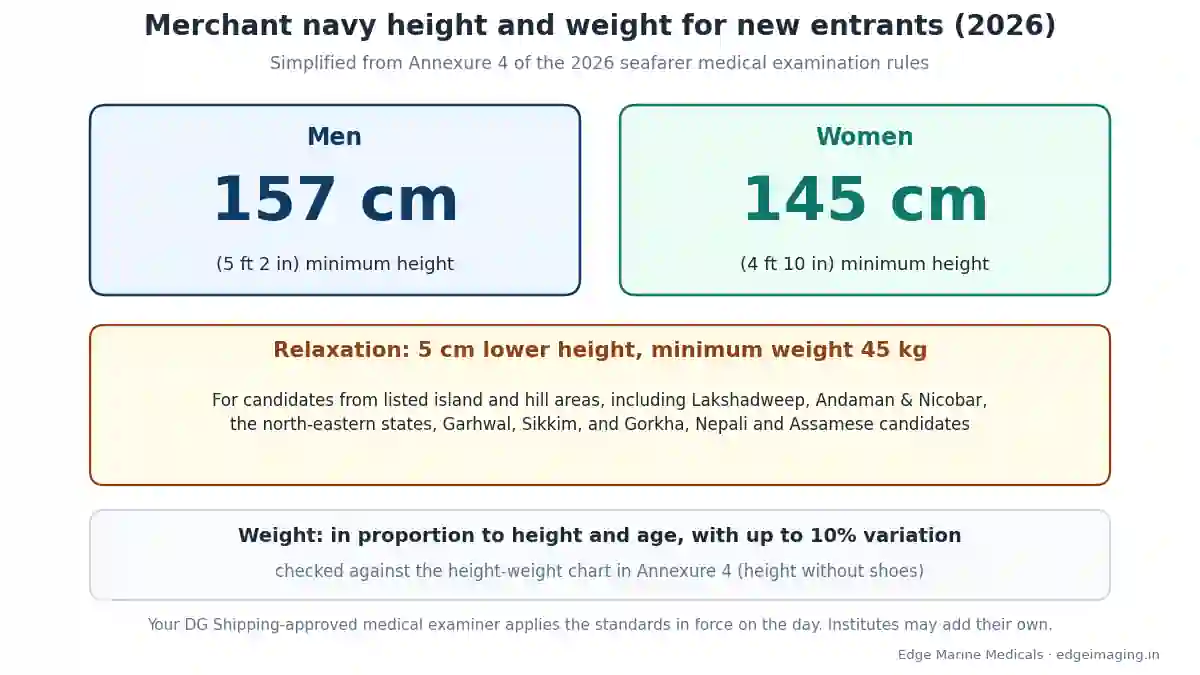
Under Annexure 4 of the Merchant Shipping (Medical Examination) Rules, 2026, the minimum height for new entrants to the merchant navy is 157 cm for men and 145 cm for women. Candidates from listed island and hill areas get a 5 cm height relaxation, with a minimum weight of 45 kg. Weight should be in proportion to height and age, with up to 10% variation from the chart in the Annexure.
“What height do I need for the merchant navy?” and “Is my weight okay?” are among the first questions every fresher asks. For years, the answers floating around the internet have been patchy and sometimes out of date. In September 2026, new rules were notified, and their Annexure 4 sets out height and weight for new entrants in one place.
This guide explains Annexure 4 in simple language — the minimum heights, who gets a relaxation, how the weight chart works, how you are measured, and what to do if you are close to the line. It also explains Annexure 5, which covers the medical assessment of transgender applicants.
People search for this as “merchant navy height requirement”, “merchant navy weight requirement”, “Annexure 4 medical”, “height and weight for new entrants” or, in Hinglish, “merchant navy height kitni chahiye”. All are answered here, with a short Hinglish section near the end.
Merchant navy height and weight (2026): at a glance
- Rules: Merchant Shipping (Medical Examination) Rules, 2026 — notified on 16 September 2026
- Annexure 4: “Height and weight for new entrants”
- Minimum height, men: 157 cm (5 ft 2 in)
- Minimum height, women: 145 cm (4 ft 10 in)
- Relaxation: 5 cm for candidates from listed island and hill areas, with a minimum weight of 45 kg
- Weight: in proportion to height and age, with up to 10% variation from the chart
- How measured: height without shoes; weight in light indoor clothing
- Annexure 5: medical assessment of applicants identified as transgender persons
- Who decides: your DG Shipping-approved medical examiner
What this guide covers
- The 2026 medical rules in brief
- What Annexure 4 is
- Who Annexure 4 applies to
- Minimum height for men
- Minimum height for women
- The 5 cm relaxation: who gets it
- The weight rule: proportion and 10%
- The height and weight chart
- How to read the chart for yourself
- Merchant navy height requirement: real-life examples
- How you are measured
- What about BMI?
- Why older guides say different things
- How Annexure 4 fits with other medical standards
- Why height and weight matter at sea
- If you are underweight
- If you are overweight
- If you are just under the minimum height
- A sensible 3-month weight plan
- Women entering the merchant navy
- Institute requirements
- Annexure 5: transgender applicants
- How the Annexure 5 assessment works
- Your height and weight checklist
- A note for parents
- What to bring
- What happens at the medical
- Mistakes to avoid
- Myths and facts
- Questions to ask
- Seedhi baat: merchant navy height kitni chahiye
- Height and weight check at Edge Marine Medicals, Delhi
- References
- Frequently asked questions
The 2026 medical rules in brief
On 16 September 2026, the Ministry of Ports, Shipping and Waterways notified the Merchant Shipping (Medical Examination) Rules, 2026 (G.S.R. 816(E)), made under the Merchant Shipping Act, 2025. They replace the Merchant Shipping (Medical Examination) Rules, 2000.
The rules cover pre-sea and periodic medical examinations of seafarers, the approval of medical examiners, and the format of medical certificates. Their “prescribed standards” of physical fitness are set out in an Annexure and a set of Appendices — including vision, hearing and physical ability standards. Annexure 4 is the one that deals with height and weight.
For students and parents, the practical meaning is simple: there is now one current set of rules that every DG Shipping-approved medical examiner works from. If a website, coaching centre or agent quotes a different number, the notified rules and your examiner’s reading of them are what count.
What Annexure 4 is
Annexure 4 is titled “Height and weight for new entrants”. It is part of the prescribed standards that a DG Shipping-approved medical examiner applies. In short, it sets:
- A minimum height for men and a minimum height for women
- A height relaxation, and a minimum weight, for candidates from listed regions
- A rule that weight should be in proportion to height and age, with up to 10% variation
- A chart of acceptable weight ranges for each height, for men and for women
The official gazette text is in Hindi. This guide summarises it in plain English; always rely on the official text and your examiner’s decision for your own case.
Who Annexure 4 applies to
As its title says, Annexure 4 is about new entrants — people entering seafaring for the first time. In practice, that means pre-sea candidates: students joining B.Sc. Nautical Science, DNS, marine engineering, GP Rating, ETO, catering and similar courses, and anyone taking their first seafarer medical.
If you are a fresher, height and weight are only one part of your first medical. For the full picture — eyesight, colour vision, hearing and other tests — read our guide to the merchant navy medical test for freshers.
Minimum height for men
Under Annexure 4, the minimum height for male new entrants is 157 cm, which is about 5 feet 2 inches.
If you are well above 157 cm, height is not a concern for you. If you are close to it, measure yourself carefully (barefoot, standing straight against a wall) before the medical, so there are no surprises. Remember that the 5 cm relaxation, explained below, applies only to candidates from listed regions.
Minimum height for women
Annexure 4 sets a separate minimum height for female new entrants: 145 cm, which the rules also express as 4 feet 10 inches.
More and more women are choosing careers at sea, as deck officers, engineers, ETOs and in hospitality roles on passenger ships. Having a clear, separate height standard for women in the rules is helpful for them and their families when planning. Women candidates should also check their chosen institute’s prospectus, as some institutes may list their own requirements.
The 5 cm relaxation: who gets it
Annexure 4 allows a height relaxation of 5 cm (2 inches) for candidates from listed island and hill areas, with a minimum weight of 45 kg (100 lb) in the same proportion. The areas named include:
- Lakshadweep and the Amindivi islands
- The Andaman and Nicobar Islands
- Nagaland, Mizoram, Meghalaya, Arunachal Pradesh, Manipur and Tripura
- Garhwal and Sikkim
- Gorkha, Nepali and Assamese candidates, and candidates from other hill areas as listed
So, for example, a male candidate who qualifies for the relaxation needs a minimum height of 152 cm instead of 157 cm. If you think you qualify, carry proof of your domicile or origin to the medical, and ask your institute how they apply it at admission.
The weight rule: proportion and 10%
Unlike height, there is no single minimum weight for everyone (apart from the 45 kg figure for relaxation candidates). Instead, Annexure 4 says weight should be in proportion to height and age, and that a variation of up to 10% is acceptable. The average values are given in a chart attached to the Annexure.
In simple terms: your examiner looks up your height in the chart, sees the acceptable weight range for men or women of that height, and allows some leeway around it. Being far outside the range — very underweight or very heavy — is what needs attention.
The height and weight chart
The chart in Annexure 4 is based on standard reference tables. It gives an acceptable weight range for each height, and an “obesity” figure above which weight is considered obese. Heights are measured without shoes, and weights in light indoor clothing. Here is an extract, as we read it from the published gazette text:
| Height (m) | Women: acceptable (kg) | Women: obesity (kg) | Men: acceptable (kg) | Men: obesity (kg) |
|---|---|---|---|---|
| 1.45 | 42–53 | 64 | 51–64 | 77 |
| 1.48 | 42–54 | 65 | 52–65 | 78 |
| 1.50 | 43–55 | 66 | 53–66 | 79 |
| 1.52 | 44–57 | 68 | 54–67 | 80 |
| 1.54 | 44–58 | 70 | 55–69 | 83 |
| 1.56 | 45–58 | 70 | 56–71 | 85 |
| 1.58 | 46–59 | 71 | 58–73 | 88 |
| 1.60 | 48–61 | 73 | 59–74 | 89 |
| 1.62 | 49–62 | 74 | 60–75 | 90 |
| 1.64 | 50–64 | 77 | 62–77 | 92 |
| 1.66 | 51–65 | 78 | 64–79 | 95 |
| 1.68 | 52–66 | 79 | 65–80 | 96 |
| 1.70 | 53–67 | 80 | 66–82 | 98 |
| 1.72 | 55–69 | 83 | 67–84 | 101 |
| 1.74 | 56–70 | 84 | 69–86 | 102 |
| 1.76 | 58–72 | 86 | 71–88 | 106 |
| 1.78 | 59–74 | 89 | 73–90 | 108 |
| 1.80 | — | — | 75–93 | 112 |
How to read the chart for yourself
- Measure your height without shoes, in metres (for example, 170 cm = 1.70 m).
- Find the nearest row in the chart.
- Look at the column for men or women.
- Compare your weight with the acceptable range. Remember that up to 10% variation is allowed.
- Check the obesity figure. If your weight is near or above it, start working on it early.
Example: a man who is 1.70 m tall sees an acceptable range of 66–82 kg and an obesity figure of 98 kg in the chart. A woman of 1.60 m sees 48–61 kg, with an obesity figure of 73 kg. These are guides only; the examiner applies the rule to you on the day.
Merchant navy height requirement: real-life examples
Here is how the merchant navy height requirement in Annexure 4 works out in a few common situations. These are illustrations; your examiner measures and decides on the day.
- Rahul, from Delhi, 158 cm: above the 157 cm minimum for men. Height is not a concern; he should next check eyesight, colour vision and weight.
- Aman, from Delhi, 155 cm: below 157 cm. Delhi is not among the listed relaxation areas, so he does not meet the minimum height for men.
- Tenzing, from Sikkim, 153 cm: Sikkim is a listed area. With the 5 cm relaxation, the minimum becomes 152 cm, so he meets it — provided his weight is at least 45 kg and proportionate, and he carries proof of origin.
- Priya, from Delhi, 147 cm: above the 145 cm minimum for women. She should check her weight against the women’s column of the chart.
If your situation is different — for example, you moved from a listed area as a child — ask your institute and your examiner how the relaxation applies to you.
How you are measured
Height is measured without shoes, standing straight, usually against a wall-mounted measure. Weight is taken on a calibrated scale in light indoor clothing. A few practical tips:
- Stand tall with your heels, back and head against the measure; look straight ahead.
- Remove heavy jackets, belts, wallets and phones before weighing.
- Do not try to “add height” with thick socks or hair styles; it will not help and can cause a re-measure.
- Height can vary slightly through the day; morning readings are often a little taller. Do not rely on this if you are right at the limit.
What about BMI?
Many people ask about BMI (body mass index). Annexure 4 itself is written as a height-weight chart with acceptable ranges and an obesity figure, rather than as a BMI cut-off. Your examiner may still calculate BMI as part of the overall assessment of your fitness.
For how weight, BMI, blood pressure and blood sugar are assessed together in the seafarer medical, read our guide to blood pressure, diabetes and BMI limits for the seafarer medical.
Why older guides say different things
If you have read different numbers online — for example, “157 cm and 48 kg”, or “152 cm and 45 kg” for relaxation candidates — you are not alone. Many guides were written before the 2026 rules, or quote draft versions.
As notified in 2026, Annexure 4 sets 157 cm for men, a separate 145 cm for women, a 5 cm relaxation with a 45 kg minimum weight for listed areas, and weight in proportion to height and age using the chart. When in doubt, follow the current rules and your institute’s prospectus — and ask your examiner.
How Annexure 4 fits with other medical standards
Height and weight are only one part of the prescribed standards. The 2026 rules also set out, in their Appendices, standards for vision (including colour vision and the STCW vision standards for deck, engine and radio duties), hearing, and physical ability — the ability to climb, lift, balance and carry out emergency duties.
Your examiner looks at all of these together. A candidate who comfortably meets the merchant navy weight requirement can still be held back by eyesight or colour vision, and the reverse is also true. That is why it is wise to check all the main standards early, not just height and weight.
Why height and weight matter at sea
Ships are working environments with steep ladders, narrow passageways, small hatches and heavy equipment. Seafarers must climb, lift, pull, and in emergencies, help evacuate and fight fires — sometimes in rough weather.
Height and weight standards help ensure that new entrants can do these tasks safely, fit safety equipment properly, and stay healthy through long voyages. Very low or very high body weight can also point to health problems that are better addressed before a career at sea begins.
None of this is about appearance. It is about whether your body can safely handle the demands of the job for months at a time, far from a hospital. Seen that way, getting your weight into a healthy range helps you long after the medical is over.
If you are underweight
If your weight is well below the chart range, do not panic — and do not try to “bulk up” with junk food or unknown supplements. Instead:
- See a doctor to rule out causes such as thyroid problems, infections or anaemia.
- Eat regular, balanced meals with enough protein, and add healthy snacks.
- Do strength training under guidance to build muscle.
- Give yourself time; healthy weight gain is gradual.
Ask your examiner whether your case can be reassessed after you have gained weight.
If you are overweight
If your weight is near or above the obesity figure, start early. Crash diets before the medical can backfire, affecting blood pressure, sugar and energy. Healthier steps include:
- Cutting sugary drinks, fried snacks and late-night eating
- Walking, swimming, cycling or sports most days of the week
- Checking blood pressure and blood sugar, which often rise with weight
- Getting advice from a doctor or dietitian for a realistic plan
Weight can change, unlike height. If you are found temporarily unfit for weight, your examiner will explain what is needed before you can be re-examined.
If you are just under the minimum height
Height is the one standard you cannot train for once growth has finished. If you are a few millimetres short:
- Get measured accurately by a doctor, not just at home.
- Check whether you qualify for the 5 cm relaxation, and carry proof.
- Check your institute’s own requirements before paying any fee.
- If you are 16 or 17, you may still grow; ask your doctor about timing.
Please avoid anyone who promises a way around the height rule. A certificate obtained incorrectly can be questioned later and put your whole career at risk.
A sensible 3-month weight plan
If you need to move your weight into the acceptable range, give yourself time. A simple, safe approach many young people find workable:
- Weeks 1–2: see a doctor; check thyroid, blood count, sugar and blood pressure if advised. Write down what you eat for a week.
- Weeks 3–6: fix meal timings; add protein and vegetables; cut sugary drinks and fried snacks; start daily activity you enjoy.
- Weeks 7–10: add strength exercises two or three times a week; keep sleep regular.
- Weeks 11–12: check your weight against the chart again, and book your medical when you are comfortably within range.
Avoid pills, powders or injections promising quick weight change. They can harm your health and affect your medical results.
Women entering the merchant navy
Annexure 4 gives women a clear height standard of 145 cm and a separate column in the weight chart. This makes planning simpler for young women and their families.
The rest of the medical — eyesight, colour vision, hearing, blood and urine tests, ECG and chest X-ray — applies to women as it does to men. Women candidates should check their institute’s prospectus for any specific requirements, and feel free to ask questions about the examination process in advance.
Institute requirements
Training institutes may publish their own requirements in addition to the rules. For example, Tolani Maritime Institute lists a minimum height of 157 cm, with weight in proportion to height and a chest expansion of at least 5 cm, for its marine engineering admissions.
Always read the prospectus of the course you are applying for, and ask the institute in writing if anything is unclear — especially about relaxations.
Annexure 5: transgender applicants
Annexure 5 of the 2026 rules covers the medical assessment of applicants identified as transgender persons, including gender dysphoria and gender incongruence. It sets out a structured, respectful way for medical examiners to assess fitness for sea service.
The Annexure groups applicants by how long ago gender-affirming surgery took place or how long hormone therapy has been taken — for example, five years or more, or less than five years. The assessment is individual, and in some situations the fitness decision and validity period are decided case by case.
It is worth noting what Annexure 5 is not. It is not a ban, and it does not mean a different standard of fitness for the job. It sets out how the examiner gathers the right information — from specialists and from a mental health evaluation — so that a fair, individual decision can be made about fitness for duties at sea.
How the Annexure 5 assessment works
- Mental health evaluation: a psychiatrist or psychologist carries out a detailed evaluation, following the WPATH Standards of Care.
- Specialist reports: an endocrinologist’s report if you are on hormone therapy and, where relevant, a report from your treating surgeon.
- Checklist: the evaluation covers medical and mental health history, current treatment, and current well-being.
- Re-assessment: later assessments follow the standards published by the Director General.
If this applies to you, bring all relevant reports to your medical and speak openly with your examiner. Your information is medical and should be handled with confidentiality and respect.
Your height and weight checklist
- Measure your height barefoot, against a wall, in the morning and evening
- Convert it to metres and find your row in the chart
- Check your weight against the acceptable range for men or women
- Note how far you are from the obesity figure
- Check whether you qualify for the 5 cm relaxation, and gather proof
- Read your institute’s height and weight requirements
- Book a pre-sea medical with a DG Shipping-approved doctor before paying any course fee
A note for parents
Parents often worry about the merchant navy weight requirement and height rule more than the students do. The best help you can give is calm, practical support: measure accurately together, compare with the chart, and read the institute’s requirements before any money is paid.
If your child needs to gain or lose weight, support healthy meals and regular activity at home, and avoid pressure or crash diets. And if your child falls short of a standard that cannot change, remember that the shipping and logistics industry also has many shore-based careers.
What to bring
- Photo ID (such as Aadhaar card or passport)
- Proof of domicile or origin, if you are claiming the 5 cm relaxation
- Your institute’s medical form, if they have given one
- Your glasses and any eye prescriptions
- Reports of any past illness, surgery or ongoing treatment
- For Annexure 5 assessments: relevant specialist reports
Arrive rested, wear light clothing, and remove heavy items before weighing. For the full list of what happens at a fresher’s medical, see our pre-sea medical guide.
What happens at the medical
Height and weight are among the first things measured at your seafarer medical, along with blood pressure. After that come the eye tests, hearing, blood and urine tests, ECG, chest X-ray and the doctor’s examination, as required.
Your examiner records your measurements, checks them against Annexure 4, and considers them alongside everything else. The final fitness decision — fit, temporarily unfit or permanently unfit — is made by the DG Shipping-approved medical examiner.
Mistakes to avoid
- Trusting old numbers from outdated websites or forwarded messages.
- Measuring at home with shoes on and assuming you are “just fine”.
- Crash dieting or bulking with unknown supplements just before the medical.
- Forgetting proof if you are claiming the regional relaxation.
- Paying course fees before checking height, weight and eyesight.
- Believing shortcuts offered by agents; they can put your career at risk.
Myths and facts
- Myth: “There is no height rule for the merchant navy.” Fact: Annexure 4 sets minimum heights for new entrants.
- Myth: “Women have the same minimum height as men.” Fact: Annexure 4 sets 145 cm for women and 157 cm for men.
- Myth: “Everyone gets the 5 cm relaxation.” Fact: it applies to candidates from listed areas only.
- Myth: “The merchant navy weight requirement is just a fixed number like 48 kg.” Fact: weight is judged in proportion to height and age, using the chart.
- Myth: “Being overweight means you can never join.” Fact: weight can change, and your examiner will explain the way forward.
Questions to ask
- Do I meet the minimum height for my sex, measured without shoes?
- Do I qualify for the 5 cm relaxation, and what proof do I need?
- Is my weight within the acceptable range for my height, allowing 10%?
- Does my institute have any extra height or weight requirement?
- If my weight is out of range, when can I be re-examined?
Seedhi baat: merchant navy height kitni chahiye
Naye 2026 rules ke Annexure 4 ke hisaab se merchant navy me pehli baar aane waalon (new entrants) ke liye minimum height ladkon ke liye 157 cm (5 feet 2 inch) aur ladkiyon ke liye 145 cm (4 feet 10 inch) hai.
Lakshadweep, Andaman-Nicobar, North-East ke listed rajya, Garhwal, Sikkim aur kuch hill areas ke candidates ko 5 cm ki chhoot milti hai, aur unka minimum weight 45 kg hai. Weight height aur umar ke hisaab se hona chahiye — chart se 10% tak upar-neeche chalega. Height bina joote ke naapi jaati hai.
Weight zyada ya kam hai toh ghabrao mat — dheere-dheere healthy tareeke se theek karo. Height ki shortcut ka vaada karne waalon se door raho.
Height and weight check at Edge Marine Medicals, Delhi
Edge Marine Medicals is the seafarer medical centre of Edge Imaging & Diagnostics, at B-568-569, Raghubir Nagar, Tagore Garden Extension, New Delhi 110027. Our DG Shipping-approved doctor in Delhi examines pre-sea candidates, cadets and working seafarers, with height and weight, vision and colour vision testing, audiometry, pathology, chest X-ray, ECG and the doctor’s examination under one roof.
Planning to join the merchant navy? Send us a WhatsApp message with your course and institute, and we will share the earliest slot, what to bring, and today’s actual pricing.
💬 WhatsApp Edge Marine Medicals for your pre-sea medical | Call 9599941470
References
- Gazette notification G.S.R. 816(E), 16 September 2026: Merchant Shipping (Medical Examination) Rules, 2026 (Hindi text) — as reproduced by StaffNews
- Merchant Shipping (Medical Examination) Rules, 2026: notification — StaffNews
- Merchant Shipping (Medical Examination) Rules, 2026: summary — TeamLease RegTech
- B.Tech Marine Engineering: medical requirements — Tolani Maritime Institute
Frequently asked questions
What is the minimum height for the merchant navy in 2026?
Under Annexure 4 of the 2026 medical rules, new entrants need a minimum height of 157 cm for men and 145 cm for women.
What is Annexure 4 in the DG medical rules?
Annexure 4 of the Merchant Shipping (Medical Examination) Rules, 2026 is titled “Height and weight for new entrants”. It sets minimum heights, a regional relaxation and a height-weight chart.
What is the minimum height for women in the merchant navy?
Annexure 4 sets 145 cm (4 ft 10 in) as the minimum height for female new entrants. Check your institute’s prospectus too.
Who gets the 5 cm height relaxation?
Candidates from listed island and hill areas, including Lakshadweep, the Andaman and Nicobar Islands, listed north-eastern states, Garhwal and Sikkim, and Gorkha, Nepali and Assamese candidates.
What is the minimum weight for the merchant navy?
Weight should be in proportion to height and age, with up to 10% variation from the chart. For candidates getting the regional height relaxation, the minimum weight is 45 kg.
Is there a maximum weight for the merchant navy?
The Annexure 4 chart lists an obesity figure for each height. Weight well above the acceptable range needs attention, and your examiner decides fitness for your case.
How is height measured in the seafarer medical?
Without shoes, standing straight against a measure. Weight is taken in light indoor clothing.
Does Annexure 4 use BMI?
Annexure 4 is a height-weight chart with acceptable ranges and obesity figures, not a BMI cut-off. Your examiner may still consider BMI in the overall assessment.
Does Annexure 4 apply to working seafarers?
Its title refers to new entrants, so it mainly concerns people entering seafaring for the first time, such as pre-sea candidates.
What if I am overweight for the merchant navy medical?
Start a healthy weight-loss plan early, avoid crash diets, and check your blood pressure and sugar. Your examiner will explain what is needed before re-examination.
What if I am underweight?
See a doctor to rule out medical causes, eat balanced meals with enough protein, and build muscle gradually. Ask your examiner about reassessment.
What is Annexure 5 in the 2026 medical rules?
Annexure 5 covers the medical assessment of applicants identified as transgender persons, including a mental health evaluation by a psychiatrist or psychologist and specialist reports where relevant.
Do institutes have their own height rules?
Some do. For example, Tolani Maritime Institute lists a minimum height of 157 cm for its marine engineering admissions. Always read your course prospectus.
Can height be increased before the medical?
Not once growth has finished. Measure accurately, check whether you qualify for the relaxation, and avoid anyone offering shortcuts.
Merchant navy ke liye height kitni chahiye?
2026 rules ke Annexure 4 ke hisaab se ladkon ke liye 157 cm aur ladkiyon ke liye 145 cm. Listed hill aur island areas ke candidates ko 5 cm ki chhoot milti hai.
Merchant navy ke liye weight kitna hona chahiye?
Weight height aur umar ke hisaab se chart ke andar hona chahiye, 10% tak ka farak chalta hai. Chhoot waale candidates ke liye minimum 45 kg.
Where can I get a pre-sea medical with height and weight check in Delhi?
At Edge Marine Medicals, B-568-569, Raghubir Nagar, Tagore Garden Extension, New Delhi 110027. WhatsApp or call 9599941470 for the earliest slot and today’s actual pricing.
The bottom line
The 2026 medical rules make merchant navy height and weight clearer than before. Annexure 4 sets a minimum height of 157 cm for men and 145 cm for women, a 5 cm relaxation with a 45 kg minimum weight for listed areas, and weight in proportion to height and age using a chart with up to 10% variation. Annexure 5 sets out a careful, individual assessment for transgender applicants.
Measure yourself accurately, compare with the chart, check your institute’s requirements before paying any fee, and work on your weight early if you need to. Your DG Shipping-approved examiner makes the final decision — and good preparation makes that decision easy.
Written by the team at Edge Marine Medicals, Edge Imaging & Diagnostics, New Delhi. Medically reviewed by Dr. Nishant Thapar. Last reviewed: October 2026.
Disclaimer: this article is a plain-English summary for general information. The official gazette text of the Merchant Shipping (Medical Examination) Rules, 2026 prevails, standards can be amended, and institutes may set their own requirements. The final fitness decision is made by the DG Shipping-approved medical examiner.