
 PV
 TG
 MN
 EM
 EI
 ND

 CT Scan
 PET CT
 Digital X-ray
 Ultrasound
 Amniocentesis

 Fetal Reduction
 Thermalytix Breast Screening
 Cardiology
 Lab Tests
 GAMCA Pre-Medical

Cordocentesis, also called fetal blood sampling or percutaneous umbilical blood sampling (PUBS), is a prenatal procedure in which a fine needle is guided through the mother’s abdomen, under continuous ultrasound, into the umbilical cord to take a small sample of the baby’s own blood. It is usually done from about 18 to 20 weeks of pregnancy, and today its main purpose is to confirm — and if needed treat — suspected fetal anemia.
If your obstetrician or a fetal medicine specialist has mentioned cordocentesis, you have probably already been through several scans and at least one worrying conversation. This is not a routine pregnancy test. It is a specialised procedure recommended in a small number of specific situations, and this guide explains every part of it in plain language: what it is, why it is done far less often than it used to be, when it is still the right test, how it is performed, the real cordocentesis risks, what the results mean, and what Indian law does and does not allow.
It does not tell you what to decide. That decision belongs to you and the doctors looking after you. Please read it alongside your doctor, not instead of them.
Cordocentesis at a glance
- What is sampled: the baby’s own blood, from the umbilical cord vein
- Usual timing: from about 18 to 20 weeks of pregnancy
- Main use today: measuring the baby’s blood count when a Doppler scan suggests fetal anemia, and giving a transfusion through the same needle if needed
- Guidance: continuous ultrasound, with the needle visible on screen throughout
- Anaesthesia: none, or local anaesthetic in the skin only
- Procedure risk: higher than amniocentesis — commonly quoted at about 1 to 2% in experienced hands, and higher when the baby is already unwell
- Law: regulated in India under the PCPNDT Act; determining or disclosing the sex of the baby is a criminal offence
What this guide covers
- What is cordocentesis?
- Is cordocentesis legal in India? The PCPNDT Act
- Why cordocentesis is done far less often today
- When cordocentesis is still the right test
- Rh disease, explained simply
- Parvovirus B19 and the baby
- How fetal anemia is found first: the MCA Doppler
- Cordocentesis vs amniocentesis vs CVS
- When is cordocentesis done?
- Preparing for cordocentesis: a checklist
- How cordocentesis is done, step by step
- Does cordocentesis hurt?
- Cordocentesis risks: the honest numbers
- Why the operator’s experience matters
- After the procedure: recovery and warning signs
- Cordocentesis results: what is tested and how long it takes
- Reading the numbers in your report
- If the baby is anemic: intrauterine transfusion
- Questions to ask before you agree
- Cordocentesis in Delhi: where it is done
- References and further reading
- Frequently asked questions
What is cordocentesis?
The umbilical cord carries blood between the placenta and the baby. Its vein is the largest vessel in the cord, and at the point where the cord joins the placenta it is held relatively still. That fixed point is the usual target for cordocentesis, because a still target is a safer target.
Using real-time ultrasound, the specialist watches the needle continuously from the moment it enters the skin until its tip is inside the cord vessel. A small volume of fetal blood — typically a millilitre or two — is withdrawn. The needle is then removed, and the baby’s heart rate and the puncture site are watched on the screen.
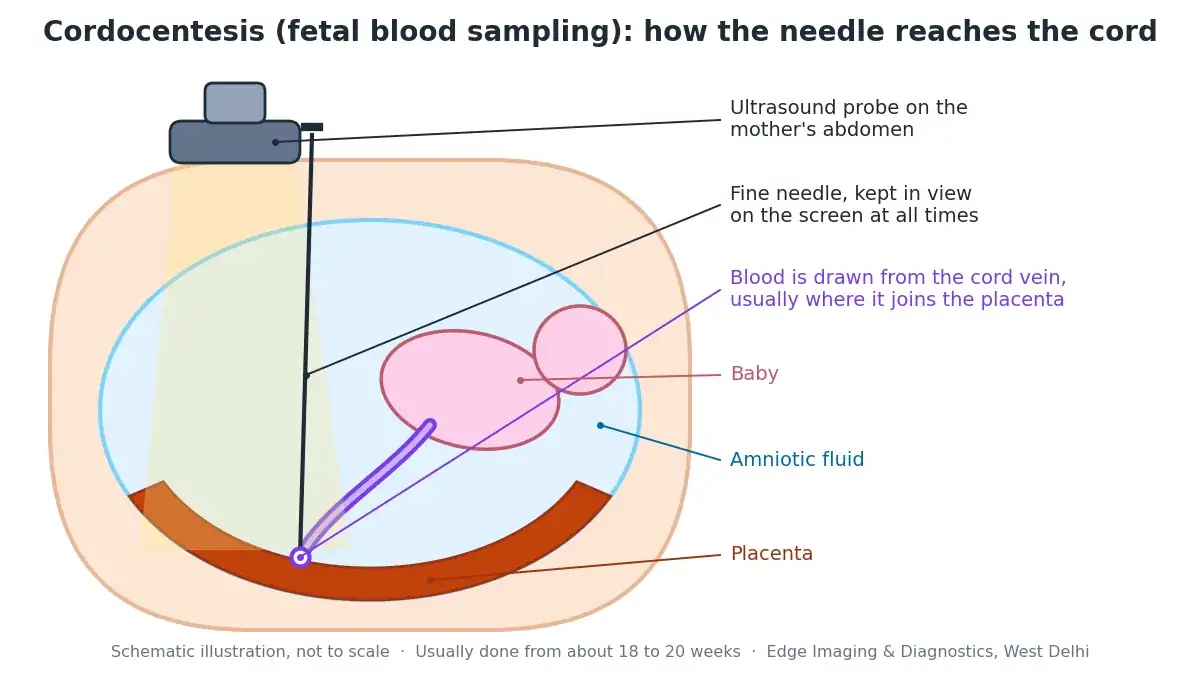
Where the placental insertion is difficult to reach, the vessel may be sampled from a free loop of cord, or from the umbilical vein where it runs inside the baby’s liver (the intrahepatic vein). The choice is made on the day, from the ultrasound picture, by the person doing the procedure.
The sample is checked straight away to confirm that it is the baby’s blood and not the mother’s. Fetal red cells are measurably larger than adult red cells, so a quick blood count confirms the origin before the sample is sent for testing.
You may see the procedure described under several names. Cordocentesis, fetal blood sampling (FBS) and percutaneous umbilical blood sampling (PUBS) all mean the same thing. Some reports also call it funipuncture.
Is cordocentesis legal in India? The PCPNDT Act
Yes, when it is done for the right reasons at a registered centre. All prenatal diagnostic procedures in India, including cordocentesis, are governed by the Pre-Conception and Pre-Natal Diagnostic Techniques (PCPNDT) Act. They may only be performed to detect genetic, chromosomal, metabolic, haematological or structural conditions, at a centre registered under the Act, with the documentation the Act requires. In Delhi, registration and oversight are handled by the state’s PCPNDT authority under the Department of Health and Family Welfare.
Determining or disclosing the sex of a fetus is a criminal offence. We do not determine it, we do not disclose it, and no reason or request will change that. If that is what someone is hoping for, this is the wrong page and the wrong centre.
Why cordocentesis is done far less often today
This is the most useful thing to understand, because it explains why you are being offered this particular test rather than a simpler one.
Twenty or thirty years ago, cordocentesis was the main way to get a rapid chromosome result late in pregnancy, to diagnose some fetal infections, and to assess fetal blood problems. Since then, three developments have taken most of that work away:
- Amniocentesis with rapid genetic tests. Rapid techniques such as FISH and QF-PCR on amniotic fluid now give chromosome answers within days, and chromosomal microarray adds further detail. Amniocentesis has a lower procedure risk, so it is preferred whenever it can answer the question. See our amniocentesis test guide.
- CVS earlier in pregnancy. For chromosomal and many genetic questions in the first trimester, chorionic villus sampling (CVS) gives an answer weeks earlier.
- Doppler ultrasound for anemia. The single biggest change. Blood flow in the middle cerebral artery of the baby’s brain speeds up when the baby is anemic, and that speed can be measured with no needle at all. So cordocentesis is no longer used to look for anemia — only to confirm and treat it once the Doppler says it is likely.
Fetal infections are now usually diagnosed from amniotic fluid as well. The net result: if you are being offered cordocentesis today, it is usually because a direct measurement of the baby’s blood is the only thing that will answer the question.
When cordocentesis is still the right test
Suspected fetal anemia
This is the main indication by a wide margin. A baby can become anemic in the womb for several reasons:
- Red cell alloimmunisation — most commonly Rh disease, where an Rh-negative mother has developed antibodies that cross the placenta and destroy the baby’s red cells. Other red cell antibodies, such as anti-Kell, can do the same.
- Parvovirus B19 infection in the mother, which can temporarily stop the baby’s bone marrow from making red cells.
- Inherited red cell conditions, in selected circumstances.
- Fetomaternal haemorrhage — bleeding from the baby into the mother’s circulation, which is uncommon but recognised.
- Complications of monochorionic twin pregnancy, in which blood is unevenly shared between twins who share one placenta.
When the middle cerebral artery Doppler reading rises above the threshold for the baby’s gestational age, or when there are signs such as fluid collecting in the baby’s body (hydrops), cordocentesis measures the haemoglobin directly. If the baby is significantly anemic, a transfusion through the same needle is the established treatment, and it can be life-saving.
Fetal platelet problems
In some rare conditions, such as fetal and neonatal alloimmune thrombocytopenia, the baby’s platelet count can be dangerously low. Measuring it directly was once routine. Today it is approached much more cautiously, because sampling a baby with very low platelets can itself cause bleeding from the cord. Many such pregnancies are now managed with treatment given to the mother instead. Your fetal medicine specialist will explain whether direct sampling is appropriate in your case.
Clarifying an unclear genetic result
Occasionally CVS or amniocentesis gives a result that is mixed or uncertain — for example, a mosaic finding that might be confined to the placenta rather than present in the baby. In selected cases, testing the baby’s own blood helps clarify what the baby actually carries.
Selected blood, metabolic or infection questions
A small number of conditions can only be assessed from fetal blood, and sometimes a very rapid answer is needed late in pregnancy to plan the delivery. These are decided case by case by the specialist team.
Rh disease, explained simply
Because Rh disease is the commonest reason families end up being offered cordocentesis, it is worth understanding how it happens.
Everyone’s red blood cells either carry a protein called the Rh(D) factor (Rh-positive) or do not (Rh-negative). If an Rh-negative mother carries an Rh-positive baby, a small amount of the baby’s blood can enter her circulation — most often at delivery, but also after a miscarriage, a termination, bleeding in pregnancy, an abdominal injury, or a procedure such as amniocentesis. Her immune system may then make antibodies against the Rh factor.
Those antibodies usually do not affect the pregnancy in which they first form. The danger is in a later pregnancy with an Rh-positive baby, when the antibodies cross the placenta and break down the baby’s red cells. Mild cases cause jaundice after birth. Severe cases cause anemia in the womb, heart strain and hydrops.
This is exactly what anti-D injections prevent. Given at the right times to Rh-negative mothers who are not yet sensitised, anti-D stops the antibodies from forming in the first place. It is one of the great successes of modern obstetrics, and it is why severe Rh disease is now far less common than it was. If you are Rh-negative, make sure you know your antibody status and that you receive anti-D whenever your doctor advises it.
In a mother who already has antibodies, the pregnancy is monitored with regular antibody levels and, once those reach a critical level, with regular MCA Doppler scans of the baby. Cordocentesis only comes in if the Doppler suggests the baby is becoming anemic.
Parvovirus B19 and the baby
Parvovirus B19 is the common childhood virus behind “slapped cheek” disease. Most adults have already had it and are immune. If a pregnant woman catches it for the first time, the virus can cross to the baby in a proportion of cases and temporarily switch off the baby’s red cell production.
Most babies are not affected, but some develop anemia, typically within the weeks after the mother’s infection. For that reason, a pregnant woman with confirmed recent parvovirus infection is usually monitored with serial MCA Doppler scans for several weeks. If the Doppler rises, cordocentesis confirms the anemia and allows a transfusion. Parvovirus anemia is often a one-off episode: once the baby’s bone marrow recovers, a single transfusion may be all that is needed.
How fetal anemia is found first: the MCA Doppler
Because this is the pathway most families come down, it deserves its own explanation.
When a baby is anemic, its blood is thinner and its heart pumps harder, so the blood moves faster. The fastest-moving, easiest-to-measure vessel is the middle cerebral artery (MCA) in the baby’s head. During a Doppler ultrasound, the specialist measures the peak speed of blood in that artery and compares it with the expected value for the gestational age, usually expressed in multiples of the median (MoM).
The landmark study that established this method found that a peak systolic velocity above 1.5 MoM identified babies with moderate or severe anemia with high sensitivity. That threshold is still widely used as the trigger for cordocentesis. A normal reading is reassuring, and in at-risk pregnancies the scan is repeated at intervals rather than doing a needle procedure. Our growth scan and Doppler guide explains pregnancy Doppler studies more broadly.
The important point: in an at-risk pregnancy, regular Doppler monitoring is what protects the baby, and cordocentesis is reserved for the moment the Doppler says it is needed.
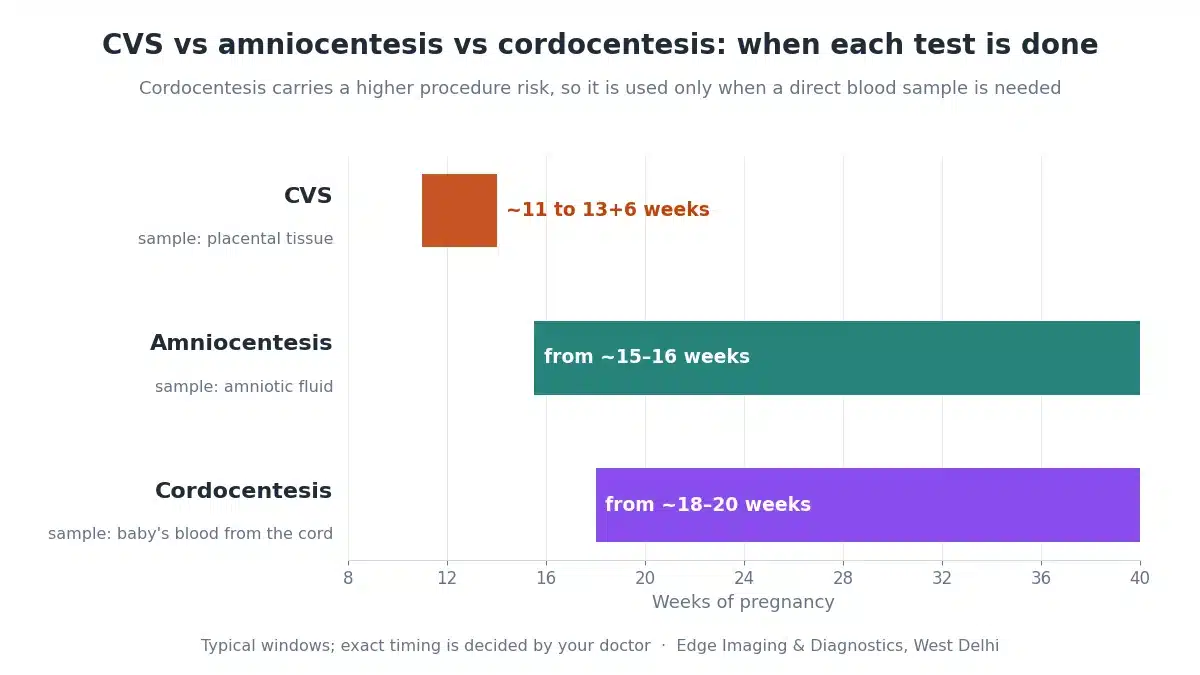
Cordocentesis vs amniocentesis vs CVS
| CVS | Amniocentesis | Cordocentesis | |
|---|---|---|---|
| What is sampled | Placental tissue | Amniotic fluid | Baby’s blood from the cord |
| Usual timing | About 11 to 13+6 weeks | From about 15–16 weeks | From about 18–20 weeks |
| Main use today | Early chromosomal / genetic diagnosis | Chromosomal / genetic diagnosis, infection | Direct blood count, transfusion, clarifying selected results |
| Results for anemia | Not applicable | Not applicable | Within minutes |
| Relative procedure risk | Low | Low | Higher than amniocentesis |
If you are weighing up screening results and diagnostic tests more broadly, our guide to a high-risk double marker, NIPT or NT scan result explains the difference between screening and diagnosis in detail.
When is cordocentesis done?
Usually from about 18 to 20 weeks onwards. Before then, the umbilical cord vessel is very small, which makes sampling technically harder and less safe. From this point the vessel is large enough to enter reliably.
In fetal anemia, the exact timing is driven by the Doppler: the procedure is done when the readings say it is needed, which in severe Rh disease can be early in that window. Later in pregnancy, once the baby would be viable if delivered, cordocentesis is planned with an obstetric team ready in case an emergency delivery becomes necessary. That is a precaution, not an expectation, and you should be told what arrangements are in place.
Preparing for cordocentesis: a checklist
- A detailed counselling conversation about why it is being recommended, what the result could show, what would happen next, the risks, and the alternatives — including the option of not having it.
- Written consent and the forms required under the PCPNDT Act.
- Your blood group and Rh status. Rh-negative mothers who are not already sensitised are normally given anti-D afterwards; if you are already sensitised, the specialist will explain why it does not apply.
- A full list of your medicines, especially any blood thinners. Tell the team about everything you take, and do not stop anything on your own.
- Previous scan reports, including all MCA Doppler readings, and any antibody or parvovirus blood test results.
- Someone to come with you and drive you home.
- Food and drink: usually no special fasting is needed, but follow the instructions you are given — particularly later in pregnancy, when the possibility of an emergency delivery is being planned for.
How cordocentesis is done, step by step
- Positioning. You lie on your back, sometimes slightly tilted, so the uterus does not press on the large blood vessels behind it.
- Mapping. A detailed ultrasound locates the cord insertion or the best alternative point, confirms the baby’s position and the placenta, and checks the baby’s heart rate.
- Cleaning. The abdomen is cleaned with antiseptic and covered with sterile drapes. Local anaesthetic may be used in the skin.
- Needle guidance. A very fine needle is inserted and followed continuously on the screen through the abdominal wall and the uterus to the cord vessel. The needle tip stays visible throughout.
- Sampling. A small volume of blood is withdrawn, and its fetal origin is confirmed.
- Transfusion, if planned. Where anemia is severe and transfusion has been planned, specially prepared donor blood is given through the same needle, with the volume calculated for the baby’s size and blood count.
- Withdrawal and monitoring. The needle is removed, and the puncture site and the baby’s heart rate are watched on the screen for any bleeding or slowing.
For sampling alone, the needle is in place for a matter of minutes. A transfusion takes longer.
Does cordocentesis hurt?
Most women describe a sharp sting as the needle enters the skin, then a feeling of pressure or cramping as it passes through the wall of the uterus. It is uncomfortable rather than severely painful for most, and general anaesthesia is not used. Occasionally, during a longer transfusion, the baby is given a medicine through the needle to keep it still, which the specialist will explain if it applies.
The emotional strain is often harder than the physical sensation. Please bring someone with you.
Cordocentesis risks: the honest numbers
You deserve real figures, explained in context.
- Pregnancy loss. The procedure-related risk of losing the pregnancy is higher than for amniocentesis. In experienced hands it is commonly quoted at roughly 1 to 2% overall, but it varies a great deal with the reason for the test: it is lower when the baby is structurally normal and substantially higher when the baby is already very unwell, for example with hydrops. Ask the specialist what the figure is in your situation.
- A temporary slowing of the baby’s heart rate (bradycardia). This is the commonest event during the procedure. It usually recovers within minutes, but it is the reason late-pregnancy procedures are planned with delivery facilities available.
- Bleeding from the puncture site in the cord. This is common, usually brief, stops on its own, and is watched for on the screen.
- Infection. Rare with sterile technique.
- Leaking of fluid, cramping or preterm labour.
- Sensitisation in Rh-negative mothers who are not already sensitised, which is why anti-D is given.
Against those risks sits the reason for doing it. In severe fetal anemia, the alternative to diagnosis and transfusion can be the loss of the baby, which is why the balance can favour the procedure despite its higher risk. In other situations the balance may not, and a good specialist will say so plainly.
Why the operator’s experience matters
Cordocentesis is technically more demanding than amniocentesis. The target is a vessel only a few millimetres wide, sometimes moving, sometimes behind the baby. Published complication rates come largely from specialist centres where these procedures are done regularly, and outcomes in less experienced hands can be worse.
So it is entirely reasonable, and not rude, to ask how many fetal blood sampling procedures the person doing yours performs, what their own complication figures are, and what backup is in place. A specialist who does them regularly will answer without hesitation.
After the procedure: recovery and warning signs
- You will be monitored for a period afterwards, and the baby’s heart rate is checked again before you leave.
- Plan to be driven home. Rest for the rest of the day and avoid heavy lifting and strenuous activity for a day or two, or as advised.
- Mild cramping and a little spotting can occur and usually settle.
- If you are Rh-negative and not sensitised, make sure you have received anti-D before you leave.
Contact your doctor or go to hospital promptly if you develop fever or chills, significant abdominal pain, bleeding, a leak of fluid, regular contractions, or reduced baby movements.
Cordocentesis results: what is tested and how long it takes
- Full blood count and haemoglobin — available within minutes, often during the procedure itself. That speed is what allows a transfusion decision to be made at the same sitting.
- Blood group and antibody tests — usually the same day.
- Platelet count, where relevant.
- Chromosome and genetic testing — rapid tests within a few days. A full karyotype from fetal blood cells usually comes faster than from amniotic fluid, although amniocentesis is still generally preferred for genetic questions because of its lower risk.
- Infection and specialised metabolic tests, in selected cases, with timing depending on the laboratory.
Ask at the time which tests have been requested and when each result is expected, and write it down.
Reading the numbers in your report
Two kinds of numbers tend to appear in reports around cordocentesis, and both are easier to understand once you know they are compared against the baby’s gestational age.
MCA Doppler, in MoM. A reading of 1.0 MoM means the blood flow speed is exactly the median for that week of pregnancy. Readings above about 1.5 MoM suggest moderate or severe anemia and are the usual trigger for sampling. A reading of, say, 1.2 MoM is above average but below the action threshold, and usually means another Doppler in a week or two rather than a procedure.
Fetal haemoglobin. The normal haemoglobin of a baby rises steadily through pregnancy, so a single number means little on its own. Specialists compare the measured value with the expected value for that gestation. Widely used categories describe anemia as mild, moderate or severe according to how far below the expected value the haemoglobin falls, and it is generally the moderate and severe range that is treated with transfusion. Your specialist will tell you which category your baby’s result falls into and what it means for the plan.
If any number in your report is not explained to you, ask. You are entitled to understand it.
If the baby is anemic: intrauterine transfusion
The established treatment for significant fetal anemia is intrauterine transfusion — giving the baby blood through the cord, often during the same procedure that confirmed the anemia. It may need to be repeated at intervals until delivery, guided by Doppler readings and blood counts. Outcomes for babies treated this way in experienced centres are generally good.
Where transfusion is needed, it is arranged and performed by your fetal medicine team with appropriate obstetric and neonatal support, and the timing of delivery is then planned around the baby’s condition. Your obstetrician will explain each step.
Questions to ask before you agree
- “What exactly is this test meant to answer, and could anything with lower risk answer it instead?”
- “What was the MCA Doppler reading, and what threshold are you using?” (if the concern is anemia)
- “What is the risk of loss in my specific situation, and how many of these do you perform?”
- “If the baby is anemic, will a transfusion be done at the same time?”
- “What happens if the baby’s heart rate drops during the procedure, and where would delivery take place?”
- “Do I need anti-D afterwards?”
- “Which results will come back today, and which later?”
A good specialist welcomes every one of these questions.
Common worries
- Did I cause this? Almost always, no. Rh antibodies come from earlier exposure to Rh-positive blood, often in a previous pregnancy, and parvovirus is a common community infection. Neither is something you did wrong.
- Can I say no? Yes. Declining is a legitimate decision. Ask what monitoring would happen instead and what the consequences of not knowing would be, so that you decide with full information.
- Will this affect my next pregnancy? If the cause is Rh or another red cell antibody, future pregnancies will need monitoring from early on. Your doctor will explain what that involves.
Cordocentesis in Delhi: where it is done
Edge Imaging & Diagnostics is a NABH-accredited diagnostic group in West Delhi, registered under the PCPNDT Act, offering ultrasound-guided fetal procedures including cordocentesis, amniocentesis and CVS, alongside fetal Doppler studies, anomaly scans, fetal echocardiography and fetal MRI. Procedures are performed under continuous ultrasound guidance by our consultant radiologists, on an obstetrician’s referral.
Before anything is booked, we review your referral and recent scans and tell you plainly whether cordocentesis is the right next step. If a repeat Doppler or a lower-risk test would answer the question instead, we will say so. We will never determine or disclose the sex of a fetus, in any circumstance.
Send a photograph of your obstetrician’s referral and your most recent scan report on WhatsApp, and we will explain the procedure being asked for, the preparation, how results are handled, and today’s actual pricing.
💬 Send your referral on WhatsApp for guidance and today’s pricing | Call 9555999960
Related reading: Amniocentesis in Delhi · CVS test · Growth scan and Doppler · Fetal echocardiography · Fetal MRI
Fetal anemia and hydrops are sometimes accompanied by too much amniotic fluid. If excess fluid is causing severe breathlessness or early contractions, see our guide to amnioreduction for polyhydramnios.
References and further reading
- Mari G, et al. Noninvasive diagnosis by Doppler ultrasonography of fetal anemia due to maternal red-cell alloimmunization. New England Journal of Medicine, 2000. The study that established the MCA peak systolic velocity threshold.
- A Review of Cordocentesis: Percutaneous Umbilical Cord Blood Sampling, PubMed Central (US National Library of Medicine).
- American College of Obstetricians and Gynecologists: Prenatal Genetic Diagnostic Tests (patient FAQ).
- Government of NCT of Delhi, Department of Health and Family Welfare: Pre-Conception and Pre-Natal Diagnostic Techniques (PCPNDT) — Delhi.
Frequently asked questions
What is cordocentesis?
Cordocentesis, also called fetal blood sampling or percutaneous umbilical blood sampling (PUBS), is a procedure in which a fine needle is guided through the mother’s abdomen under continuous ultrasound into the umbilical cord to take a small sample of the baby’s blood. It is usually done from about 18 to 20 weeks of pregnancy.
Why is cordocentesis done?
Today its main use is to measure the baby’s blood count directly when a Doppler scan suggests the baby may be anemic — for example from Rh disease or parvovirus infection — and, if needed, to give a transfusion through the same needle. It is also used occasionally to clarify an unclear genetic result or for selected blood, metabolic or infection questions.
Is cordocentesis the same as amniocentesis?
No. Amniocentesis samples the amniotic fluid around the baby; cordocentesis samples the baby’s own blood from the cord. Amniocentesis has a lower procedure risk and is preferred for chromosomal and most genetic questions. Cordocentesis is reserved for situations where a direct blood measurement is needed.
What are the risks of cordocentesis?
The procedure-related risk of pregnancy loss is higher than for amniocentesis, commonly quoted at roughly 1 to 2% in experienced hands. It varies with the reason for the test — lower in a structurally normal baby and substantially higher when the baby is already very unwell, for example with hydrops. Other risks include a temporary slowing of the baby’s heart rate, bleeding from the cord puncture site, infection, leaking fluid and preterm labour. Ask the specialist for the figure in your specific situation.
Is cordocentesis painful?
Most women describe a sharp sting at the skin and pressure or cramping as the needle passes through the uterine wall. It is uncomfortable rather than severely painful for most. General anaesthesia is not used; local anaesthetic may be used in the skin.
At what week is cordocentesis done?
Usually from about 18 to 20 weeks onwards, because before then the cord vessel is very small. In fetal anemia the exact timing is driven by Doppler readings. Later in pregnancy it is planned with delivery facilities available as a precaution.
How is fetal anemia detected before cordocentesis?
By a Doppler ultrasound measuring the peak speed of blood flow in the middle cerebral artery of the baby’s brain. Blood flows faster when the baby is anemic. A reading above about 1.5 multiples of the median for gestational age makes moderate or severe anemia likely and is the usual trigger for cordocentesis.
Can a transfusion be done during cordocentesis?
Yes. If the blood count taken during the procedure shows significant anemia and transfusion has been planned, specially prepared donor blood can be given to the baby through the same needle. It may need repeating at intervals until delivery. This is arranged by your fetal medicine team.
How long do cordocentesis results take?
The blood count is available within minutes, often during the procedure itself. Blood group and antibody tests follow the same day. Rapid genetic tests take a few days, and full chromosome analysis and specialised tests take longer depending on the laboratory.
Do I need anti-D after cordocentesis?
Rh-negative mothers who are not already sensitised are normally given anti-D afterwards. If you are already sensitised — which is often the reason for the procedure — the specialist will explain why it does not apply. Ask about it before you leave.
Can cordocentesis tell the sex of the baby?
Determining or disclosing the sex of a fetus is a criminal offence in India under the PCPNDT Act. Cordocentesis is performed only to detect genetic, chromosomal, metabolic, haematological or structural conditions. We do not determine it and do not disclose it under any circumstances.
What should I watch for after cordocentesis?
Contact your doctor or go to hospital promptly for fever or chills, significant abdominal pain, bleeding, a leak of fluid, regular contractions, or reduced baby movements. Mild cramping and a little spotting can occur. Rest for the remainder of the day and avoid strenuous activity for a day or two.
Why is cordocentesis done less often now?
Because amniocentesis with rapid genetic tests and microarray now answers most chromosomal questions with lower risk, CVS gives earlier answers, fetal infections are usually diagnosed from amniotic fluid, and Doppler ultrasound detects likely anemia without any needle. Cordocentesis is now reserved for when direct blood measurement or transfusion is needed.
Does an Rh-negative blood group mean my baby will need cordocentesis?
No. Most Rh-negative mothers never develop antibodies, particularly when anti-D is given at the right times. Cordocentesis becomes relevant only if antibodies are present at significant levels and Doppler monitoring suggests the baby is becoming anemic.
Can I refuse cordocentesis?
Yes. Declining is a legitimate decision. Ask what monitoring would happen instead and what the consequences of not knowing would be, so that your decision is fully informed.
Is cordocentesis available in Delhi?
Yes. Cordocentesis in Delhi is performed at fetal medicine and imaging centres registered under the PCPNDT Act, on a doctor’s referral. Edge Imaging & Diagnostics in West Delhi performs ultrasound-guided fetal procedures including cordocentesis, amniocentesis and CVS. Send your referral and recent scan on WhatsApp to 9555999960 and the procedure will be explained before you travel.
Do I need a referral for cordocentesis?
Yes. It is a diagnostic procedure performed on an obstetrician’s or fetal medicine specialist’s referral, at a centre registered under the PCPNDT Act, with the required documentation.
The bottom line
Cordocentesis takes a small sample of the baby’s own blood from the umbilical cord under continuous ultrasound guidance. It is rarely needed now, because amniocentesis, CVS and Doppler have taken over most of its old uses — but when a Doppler suggests the baby may be anemic, it is the test that gives the answer and, through the same needle, the treatment.
Its risk is higher than amniocentesis, and the right specialist will tell you exactly how much higher in your situation. And no prenatal test in this country will tell you the sex of your baby, because that is a crime.
Written by the clinical content team at Edge Imaging & Diagnostics, West Delhi — a NABH-accredited diagnostic centre registered under the PCPNDT Act. Medically reviewed by Dr. Nishant Thapar, Consultant Radiologist. Last reviewed: October 2026.
Medical disclaimer: this article is general information about cordocentesis. It is not medical advice, a diagnosis, or guidance on any decision about a pregnancy.
The indications, timing, procedure-related risk figures, Doppler thresholds and result timelines quoted here are approximate figures from published practice. They vary with the indication, the baby’s condition, the operator and the laboratory, and your own specialist should give you figures specific to your situation.
Decisions about whether to have cordocentesis, about transfusion and about delivery belong to you and your treating doctors. Do not start or stop any medicine on the basis of this article.
Prenatal diagnostic procedures in India are governed by the Pre-Conception and Pre-Natal Diagnostic Techniques (PCPNDT) Act. Determining or disclosing the sex of a fetus is a criminal offence, and this centre does not do so under any circumstances.
Fever, abdominal pain, bleeding, leaking fluid, contractions or reduced fetal movements after any procedure need prompt in-person assessment.