
 PV
 TG
 MN
 EM
 EI
 ND

 CT Scan
 PET CT
 Digital X-ray
 Ultrasound
 Amniocentesis

 Fetal Reduction
 Thermalytix Breast Screening
 Cardiology
 Lab Tests
 GAMCA Pre-Medical

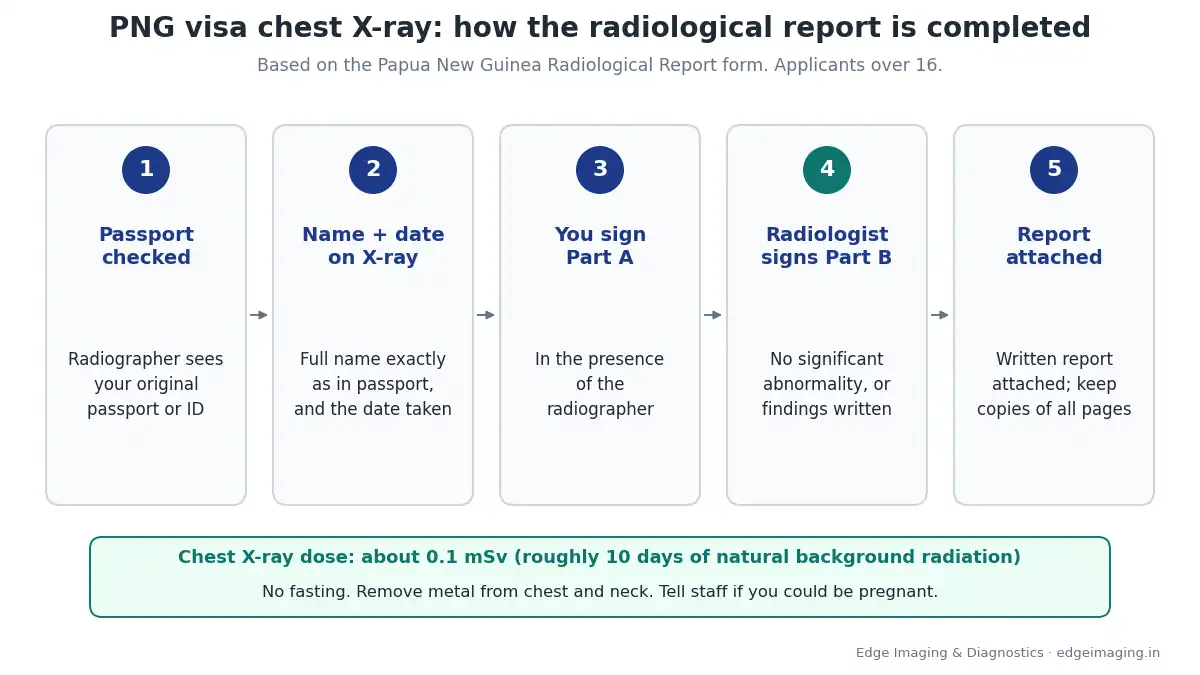
For a Papua New Guinea (PNG) visa, applicants over 16 need a chest X-ray with a radiological report on PNG’s official Radiological Report form. The X-ray must show your full name and the date it was taken, the radiographer must check your original passport, you sign the form in the radiographer’s presence, and a radiologist completes Part B with the findings. The written X-ray report (the form calls it the radiographer’s report or results) is attached to the form.
Many people moving to PNG for work get the rest of their documents right but lose time on the X-ray. A name spelt differently from the passport, a missing date on the film, a form signed at home, or a report that does not match the form can all lead to questions and delays.
This guide explains the PNG chest X-ray and radiological report step by step: what the form asks, how the X-ray should be labelled, what the radiologist writes, what common words in a chest X-ray report mean, what happens if something is found, and how safe the X-ray is. It is written for job seekers and families in India, in simple language.
People search for this as “Papua New Guinea X-ray” (or “Papua New Guinea xray”), “PNG chest X-ray for visa”, “Papua New Guinea radiology report”, “PNG radiological report form”, “PNG visa X-ray in Delhi” or, in Hinglish, “PNG visa ke liye X-ray report kaise banwaye”. All of these are answered here, with a short Hinglish section near the end.
PNG chest X-ray and radiological report: at a glance
- Who needs it: PNG visa applicants over 16 who are asked for a medical
- Form: Radiological Report, issued by PNG’s Immigration & Citizenship Service Authority
- X-ray size (as printed on the form): 70 mm, 100 mm or full-size plate chest X-ray
- Labelling: your full name and the date taken must appear on the X-ray
- ID check: original passport or identity card seen by the radiographer
- Signatures: you sign Part A in front of the radiographer; the radiologist signs Part B
- Attach: the written X-ray report (the radiographer’s report or results)
- Radiation: about 0.1 mSv, similar to roughly 10 days of natural background radiation
- Preparation: no fasting; remove metal from the chest area
What this guide covers
- Why PNG asks for a chest X-ray
- Who needs the PNG chest X-ray
- The PNG Radiological Report form at a glance
- Part A: your details and signature
- X-ray size and labelling: name and date
- The passport check by the radiographer
- Part B: what the radiologist declares
- Radiographer, radiologist and examining doctor: who does what
- The attached radiology report
- A sample report, read line by line
- Common words in a chest X-ray report, explained
- TB and the PNG chest X-ray
- Other findings on a visa chest X-ray
- Smokers, recent coughs and recent infections
- What the PNG chest X-ray does not check
- If the radiologist advises more tests
- How safe is a chest X-ray?
- Pregnancy and the PNG X-ray
- How to prepare for the X-ray
- The X-ray, step by step
- Special situations: implants, pacemakers and religious items
- When to do the Papua New Guinea X-ray
- Digital X-ray, film and CD: what to submit
- Questions to ask the X-ray centre before you book
- Lost papers, extra copies and repeat X-rays
- Common reasons PNG X-ray papers get questioned
- How the X-ray fits into the full PNG medical
- Seedhi baat: PNG visa X-ray report kaise banwaye
- PNG chest X-ray and radiological report at Edge Imaging, West Delhi
- References
- Frequently asked questions
Why PNG asks for a chest X-ray
Papua New Guinea requires people who come to live or work in the country to be of good health. A chest X-ray is a simple, quick way to screen the lungs and heart. In visa medicals, it is commonly used to look for signs of tuberculosis (TB), which many countries screen for in long-stay visa applicants.
The X-ray also shows other lung and heart conditions that a doctor may want to know about before you start a job, especially if you will be working at a remote site far from specialist care.
Who needs the PNG chest X-ray
PNG’s Immigration and Citizenship Authority (ICA) states that, where medical documents are required, applicants over 16 need a chest X-ray with a radiology report, along with an HIV test with a pathology report and a medical examination report from an approved doctor.
ICA’s 2025 visa booklet lists a “medical report including X-ray” on the work visa checklist, and a “medical including X-ray report” for working dependants. Your employer or visa agent will confirm whether your category needs it.
The PNG Radiological Report form at a glance
The form is titled Radiological Report and carries the name of the Papua New Guinea Immigration & Citizenship Service Authority, Port Moresby. It has two parts:
- Part A: instructions and your personal details, signed by you
- Part B: the radiologist’s declaration and findings, signed by the radiologist
It is a short, one-page form, but every line matters. A blank field, a missing signature or a mismatch with your passport is one of the most common reasons a file comes back.
Part A: your details and signature
Part A asks for:
- Family name, in block letters
- Given names
- Citizenship
- Date of birth
- Passport or identity document number
- Your signature
The form’s instructions say the migrant or student signs the form, and the radiographer must sight the original passport or identity card. In simple words: bring your original passport and sign Part A at the X-ray centre, in front of the radiographer, not at home.
Write your names exactly as they appear in your passport, in the same order. If your passport has only a given name and no surname, follow the same pattern as your passport and your visa application form, and tell the staff so the X-ray label matches.
X-ray size and labelling: name and date
The PNG form was written in the era of X-ray film. Its first instruction says that applicants aged 16 or over must submit a 70 mm, 100 mm or full-size plate chest X-ray, and that the X-ray must show:
- The date the X-ray was taken
- The applicant’s full name
The form says these details should preferably be printed on the X-ray at the time of exposure; otherwise the name must be written in white ink, in English.
With modern digital X-ray, your name and the date are electronically embedded in the image and printed on the film or print-out automatically. This is the cleanest way to meet the PNG requirement. Check that the printed name matches your passport letter for letter before you leave.
The passport check by the radiographer
The radiographer is the trained technologist who positions you and takes the X-ray. On the PNG form, the radiographer is responsible for seeing your original passport or identity card, so that the X-ray belongs to the right person.
This is why a photocopy is not enough on the day. Carry the original passport, and keep a photocopy for the centre’s records if they ask for one.
Part B: what the radiologist declares
Part B is completed by the radiologist, a doctor specialised in reading X-rays and scans. The radiologist writes their name and declares that a chest X-ray examination was performed on the applicant. They then mark one of two options:
- No significant abnormality, condition or illness; or
- The significant conditions found, written out on the form
The radiologist then signs, writes their address and dates the form. The form’s instructions also say that the radiographer’s report or results must be attached.
Radiographer, radiologist and examining doctor: who does what
Three different professionals are involved in a Papua New Guinea X-ray and medical, and the PNG forms give each a specific job:
- Radiographer: the trained X-ray technologist who checks your original passport, positions you, takes the X-ray and makes sure your name and the date are on the image. You sign Part A of the radiological form in front of the radiographer.
- Radiologist: a specialist doctor who reads the X-ray, writes the report and completes and signs Part B of the radiological form.
- Examining doctor: the doctor who completes the separate PNG Medical Examination form after examining you, and who looks at all your results together.
Knowing who signs what helps you check the paperwork before you leave the centre. Every signature box on both forms should be filled by the right person.
The attached radiology report
Along with the form, you receive a written radiology report describing the X-ray. A normal chest X-ray report is usually short, with lines such as:
- “Both lung fields are clear.”
- “Both costophrenic angles are clear.”
- “Cardiac size and shape are within normal limits.”
- “Bony thorax appears normal.”
- “Impression: no significant abnormality detected.”
The exact wording differs between radiologists, but the impression or conclusion at the end is the key line. It should match what is marked in Part B of the PNG form.
A sample report, read line by line
Here is how a typical normal Papua New Guinea X-ray report might read, with a plain-language note for each line. Your own report may be worded differently.
- “Chest PA view.” The X-ray was taken from back to front, the standard view for a chest X-ray.
- “Trachea is central.” The windpipe is in the middle, as it should be.
- “Both lung fields are clear.” No patch, shadow or spot is seen in the lungs.
- “Both hila are normal.” The roots of the lungs look normal.
- “Both costophrenic angles are clear.” No fluid is seen at the bottom of the lungs.
- “Cardiac size is within normal limits.” The heart does not look enlarged.
- “Domes of the diaphragm are normal.” The breathing muscle below the lungs looks normal.
- “Visualised bones are normal.” No problem is seen in the ribs, collarbones or spine.
- “Impression: no significant abnormality.” The overall conclusion, which should match Part B of the PNG form.
Common words in a chest X-ray report, explained
Chest X-ray reports use medical words that can sound worrying even when they are harmless. Here is what the common ones mean in plain language:
- Lung fields: the areas of the lungs seen on the X-ray. “Clear” means no patch or shadow is seen.
- Costophrenic (CP) angles: the sharp corners at the bottom of the lungs. “Clear” or “sharp” means there is no fluid collecting there.
- Hila / hilar shadows: the roots of the lungs, where blood vessels and airways enter. Normal hila are a usual finding.
- Cardiothoracic ratio: the width of the heart compared with the width of the chest; it helps judge whether the heart looks enlarged.
- Bronchovascular markings: the normal branching lines of airways and vessels. “Prominent” markings are often seen in smokers or after a cold and are frequently not significant on their own.
- Calcified granuloma: a tiny chalky spot from an old, healed infection. Usually harmless.
- Fibrosis or fibrotic strands: scar-like lines, often from an old infection.
- Pleural thickening: thickening of the lining of the lung, often from an old infection or injury.
- Consolidation: a patch where air spaces are filled, as in pneumonia. Needs clinical review.
- Cavity: a hollow space in the lung, which can be seen in active TB and some other conditions. Needs further tests.
- Cervical rib: an extra small rib in the neck area, present from birth. Usually harmless.
Only the radiologist and the examining doctor can say what a finding means for you. If a word in your report worries you, ask them to explain it.
TB and the PNG chest X-ray
Because TB is common in many parts of the world, including India, visa X-rays are read carefully for signs of TB. Radiologists look at two things:
- Signs that could suggest active TB: such as patches in the upper lungs, cavities, enlarged lymph nodes or fluid around the lung. These need further tests before any conclusion.
- Signs of old, healed TB or old infection: such as small calcified spots or scar lines. These are often inactive and are recorded as such.
If you had TB in the past and completed treatment, bring your old treatment records and earlier X-rays. They help the radiologist and the doctor compare and explain the findings accurately.
Remember: an X-ray finding alone does not diagnose TB. It is a screening step.
Other findings on a visa chest X-ray
A visa chest X-ray can sometimes show other things, such as:
- An enlarged heart shadow, which may need an echocardiogram or a doctor’s review
- A curve in the spine (scoliosis), usually long-standing and harmless
- Old rib fractures from an earlier injury
- A small nodule, which may need comparison with an older X-ray or a CT scan
- Signs of chronic lung disease in long-term smokers
Most of these do not stop people from working abroad, but they must be recorded honestly. The PNG authorities make the final decision.
Smokers, recent coughs and recent infections
Smokers: long-term smoking can show up on a chest X-ray as more prominent lung markings or signs of chronic lung disease. Be honest about smoking on your medical form. If you are planning to quit, now is a very good time, especially before moving to a new job.
Recent cough, fever or pneumonia: a recent chest infection, including pneumonia or COVID-19, can leave temporary changes on an X-ray for some weeks. If you have been unwell recently, tell the doctor before the X-ray. Sometimes it is better to wait until you have recovered, or to repeat the X-ray later to show that the changes have cleared.
Persistent cough: a cough lasting more than two weeks, especially with fever, weight loss or night sweats, should be checked by a doctor regardless of the visa, because it can be a sign of TB.
What the PNG chest X-ray does not check
A chest X-ray is a focused test. It looks at the lungs, the heart outline and the bones of the chest. It does not:
- Test your blood, including for HIV, which is a separate test in the PNG medical
- Check your blood pressure, sugar, eyesight or hearing, which the examining doctor records
- Look at the abdomen, kidneys or liver
- Rule out every possible lung condition; very small problems may need CT to be seen
That is why the X-ray is only one of the three parts of the Papua New Guinea medical.
If the radiologist advises more tests
If the X-ray shows something that needs clarification, the doctor may advise one or more of:
- Sputum tests, including rapid molecular tests for TB
- A CT scan of the chest, which shows the lungs in much more detail
- Comparison with an older X-ray, to show that a spot has not changed over years
- A chest physician’s opinion and a letter explaining the finding
These steps protect you as much as the visa process. If something treatable is found, getting it treated before you move is far better than facing it in a new country.
How safe is a chest X-ray?
A chest X-ray is one of the lowest-dose X-ray tests. RadiologyInfo, the patient information site of the Radiological Society of North America and the American College of Radiology, gives the effective dose of a chest X-ray as about 0.1 mSv, which it compares to about 10 days of natural background radiation that everyone receives from the environment.
Only one or two views are normally needed. Modern digital X-ray systems are designed to use as little radiation as possible while still giving a clear picture.
Pregnancy and the PNG X-ray
If you are or might be pregnant, tell the staff before the X-ray. A chest X-ray does not point the beam at the abdomen, and the dose is very small, but centres take extra care in pregnancy, for example with a lead apron over the abdomen, or by discussing whether the X-ray can wait.
The PNG medical examination form also asks the doctor to record the period of pregnancy if you are pregnant. Ask your employer or the PNG High Commission how they want pregnant applicants to proceed, and decide together with your doctor.
How to prepare for the X-ray
- Bring your original passport and a photocopy
- Bring the printed PNG Radiological Report form and any employer forms
- Bring old chest X-rays or TB treatment records if you have them
- No fasting is needed
- Wear a top that is easy to remove; you may be given a gown
- Remove chains, pendants, hair clips with metal, and anything with metal on the chest or upper back
- Tell the staff if you could be pregnant
The X-ray, step by step
- Registration: your passport is checked and your name is entered exactly as in the passport.
- Part A: you sign Part A of the PNG form in the radiographer’s presence.
- Changing: you remove metal objects and change into a gown if needed.
- Positioning: you stand with your chest against the X-ray detector, shoulders rolled forward and chin up.
- Breath-hold: you take a deep breath and hold it for a second or two while the image is taken.
- Check: the radiographer checks the image quality, and repeats only if needed.
- Reporting: the radiologist reads the X-ray, writes the report and completes Part B of the PNG form.
The X-ray itself takes only a few minutes. Ask at booking when the signed form and report will be ready.
Special situations: implants, pacemakers and religious items
- Pacemaker, heart valve or metal implants: these show clearly on a chest X-ray and are not a problem for the test. Tell the radiographer, and bring a card or letter about the device, so the radiologist can describe it correctly.
- Breast implants: they can be seen on a chest X-ray. Mention them so they are not mistaken for something else.
- Long hair or plaits: tie them up and away from the chest and upper back; hair bands with metal parts should be removed.
- Religious threads, kada or lockets: anything lying over the chest or neck can appear on the image. If you prefer not to remove an item, tell the radiographer, who can often position you so it does not cover the lungs.
- Disability or difficulty standing: tell the centre in advance. The X-ray can be taken sitting, and staff will help you.
When to do the Papua New Guinea X-ray
The best time for your Papua New Guinea X-ray is when your employer or agent tells you that your entry permit file is about to be lodged. ICA does not publish a fixed validity period, but authorities expect recent medical documents, and an X-ray done many months earlier may be questioned.
Plan to do the X-ray, the HIV test and the doctor’s examination together, and keep a few days in hand for any further tests the doctor may advise. If your file is delayed for a long time after the X-ray, ask your employer whether a fresh one is needed.
Digital X-ray, film and CD: what to submit
The PNG form mentions film sizes because it was designed when chest X-rays were taken on film. Today most centres use digital X-ray, which can be provided as a printed film or high-quality print, and often as a CD or digital file.
Ask your employer or agent exactly what they want you to submit:
- The signed Radiological Report form (always)
- The written X-ray report (the form asks for it to be attached)
- The X-ray image itself, as a printed film, and whether a CD is also wanted
Keep scans or photographs of every page, and store the film flat and dry. A creased or damaged film may be hard to read later.
Questions to ask the X-ray centre before you book
- Do you have the current PNG Radiological Report form, or should I bring a printed copy?
- Will my full name and the date appear on the X-ray image itself?
- Will a radiologist complete and sign Part B, with a written report attached?
- Can the PNG Medical Examination form and the HIV test be done in the same visit?
- When will the signed form, report and X-ray be ready for collection?
- Will I receive the X-ray as a printed film, a CD, or both?
- What should I do if my employer asks for extra tests?
Lost papers, extra copies and repeat X-rays
Keep your original signed form, report and X-ray film safe and flat. Before handing anything over, scan or photograph every page.
If you lose the original or your employer needs an extra copy, ask the centre that did your X-ray. Many centres keep the digital image and report, but a fresh signed PNG form usually needs the radiologist to complete it again. If a long time has passed, or your employer asks for a recent X-ray, a repeat Papua New Guinea X-ray may be the simplest solution.
Common reasons PNG X-ray papers get questioned
- Name on the X-ray spelt differently from the passport, or names in a different order
- Date missing from the X-ray
- Part A signed at home instead of in front of the radiographer
- Passport number or date of birth written wrongly on the form
- Part B left incomplete, or the radiologist’s signature, address or date missing
- Written report not attached, or its conclusion not matching Part B
- X-ray done many months before submission
- X-ray done at one place and the medical form at another, with mismatched details
How the X-ray fits into the full PNG medical
The chest X-ray is one of three parts of the PNG visa medical. The other two are the doctor’s examination on PNG’s Medical Examination form and the HIV test with a pathology report. For the complete picture, including who needs the medical, Part A and Part B of the medical form, police clearance and preparation, read our guide to the Papua New Guinea visa medical.
Doing all three parts at one centre on the same day keeps names, dates and details consistent across every page of your file.
Seedhi baat: PNG visa X-ray report kaise banwaye
PNG visa ke liye 16 saal se upar walon ko chest X-ray aur PNG ka “Radiological Report” form chahiye hota hai. X-ray par aapka poora naam aur X-ray ki date honi chahiye, aur naam passport se bilkul match karna chahiye.
Original passport saath laayein, kyunki radiographer ko use dekhna hota hai. Form ka Part A wahin radiographer ke saamne sign karein. Part B radiologist bharte hain, jisme likha hota hai ki X-ray normal hai ya kya mila. Radiologist ki likhit report form ke saath attach hoti hai.
X-ray me radiation bahut kam hota hai, lagbhag 10 din ke natural radiation jitna. Khaali pet aane ki zaroorat nahi. Agar pregnancy ho sakti hai toh pehle staff ko zaroor batayein.
PNG chest X-ray and radiological report at Edge Imaging, West Delhi
At Edge Imaging & Diagnostics, West Delhi, we take your chest X-ray on digital X-ray with your name and date on the image, check your original passport, and our radiologist completes the PNG Radiological Report with a written report attached. The full PNG visa medical, including the doctor’s examination form and the HIV test, can be done in the same visit.
Send your PNG forms or your employer’s checklist on WhatsApp. We will confirm the earliest slot, what to bring, and today’s actual pricing.
💬 WhatsApp your PNG form for today’s pricing | Call 9555999960
References
- Radiological Report form — PNG Immigration & Citizenship Service Authority
- Medical and character requirements — PNG Immigration and Citizenship Authority (ICA)
- Visa information booklet 2025 — ICA, Papua New Guinea
- Medical Examination form — Papua New Guinea (published by the PNG Embassy)
- Radiation dose in X-ray and CT exams — RadiologyInfo.org
Frequently asked questions
Is a chest X-ray required for a Papua New Guinea visa?
Where a medical is required, ICA asks applicants over 16 for a chest X-ray with a radiology report, along with an HIV test and a medical examination report.
What is the PNG Radiological Report form?
It is a one-page form from PNG’s Immigration & Citizenship Service Authority. Part A has your details and signature; Part B is completed and signed by the radiologist with the findings.
What must be written on the PNG X-ray?
The X-ray must show the date it was taken and your full name, preferably printed at the time of the X-ray. The name should match your passport exactly.
Do I need my original passport for the PNG X-ray?
Yes. The form requires the radiographer to see your original passport or identity card before the X-ray.
Can I sign the PNG radiological form at home?
No. You should sign Part A in the presence of the radiographer at the X-ray centre.
Who fills Part B of the PNG radiological report?
The radiologist. They declare that the chest X-ray was done, mark either no significant abnormality or the conditions found, and sign with their address and date.
What does “no significant abnormality” mean on the report?
It means the radiologist did not see any important problem in the lungs, heart or chest bones on the X-ray.
What if my X-ray shows an old TB scar?
Old, healed changes are recorded. The doctor may advise sputum tests, a CT scan or comparison with older X-rays to confirm they are inactive. Bring old TB treatment records if you have them.
Is the chest X-ray safe?
Yes, it is a very low-dose test. RadiologyInfo gives about 0.1 mSv for a chest X-ray, similar to about 10 days of natural background radiation.
Can a pregnant woman have the PNG chest X-ray?
Tell the staff first. The beam is not aimed at the abdomen and the dose is small, but extra care is taken, such as abdominal shielding, or the X-ray may be postponed after discussion.
Do I need to fast before the X-ray?
No. Eat normally. Just remove metal objects from your chest and neck area.
Is a digital X-ray accepted for the PNG visa?
The form mentions film sizes from older times. Digital X-ray with your name and date printed on the image matches the form’s preference for details printed at the time of the X-ray, and is widely used today. Ask your employer whether they also want a CD.
How old can the PNG X-ray be?
ICA does not publish a fixed validity period. Do the X-ray close to your submission date and follow any time limit your employer gives.
Do children need the PNG chest X-ray?
ICA’s chest X-ray requirement applies to applicants over 16. Younger dependants should follow the checklist for their visa category.
PNG visa ke liye X-ray par kya likha hona chahiye?
X-ray par aapka poora naam aur X-ray ki date honi chahiye. Naam passport se bilkul same hona chahiye.
PNG radiological report form kaun sign karta hai?
Part A aap radiographer ke saamne sign karte hain, aur Part B radiologist bharta aur sign karta hai, saath me likhit report attach hoti hai.
Where can I get a PNG visa chest X-ray in Delhi?
At Edge Imaging & Diagnostics, West Delhi, with digital X-ray and the PNG Radiological Report completed by our radiologist. WhatsApp or call 9555999960 for the earliest slot and today’s actual pricing.
The bottom line
The PNG chest X-ray is quick, low-dose and simple, but the paperwork has to be exact. Your full name and the date must be on the X-ray, the radiographer must see your original passport, you sign Part A at the centre, and the radiologist completes Part B with a written report attached.
Most problems come from small mismatches and missing signatures, not from the X-ray itself. Bring your original passport and old records, check every name and date before you leave, and keep copies of every page. Done this way, the Papua New Guinea radiology report becomes one of the easiest parts of your visa file.
Going to a Gulf country for work? The GCC (WAFID) medical also includes a chest X-ray, and under the GCC rules signs of active or past TB lead to an unfit result. Our GAMCA / WAFID pre-medical test lets you see your X-ray and blood results before the official medical.
Written by the medical team at Edge Imaging & Diagnostics, West Delhi. Medically reviewed by Dr. Nishant Thapar. Last reviewed: October 2026.
Disclaimer: this article is general information about the chest X-ray and radiological report for a Papua New Guinea visa, based on publicly available PNG forms and ICA requirements as of October 2026. It is not legal or immigration advice. Always follow the latest instructions from PNG’s Immigration and Citizenship Authority, the PNG High Commission, and your employer or agent.