
 PV
 TG
 MN
 EM
 EI
 ND
 NM
 SR

 CT Scan
 PET CT
 Digital X-ray
 Ultrasound
 Amniocentesis

 Fetal Reduction
 Thermalytix Breast Screening
 Cardiology
 Lab Tests
 GAMCA Pre-Medical

A pre-insurance medical checkup, also called a pre-policy medical checkup, is a health examination an insurer asks for before issuing a health or life insurance policy. It helps the insurer assess your health risk and decide whether to accept the proposal, at what premium, and with what conditions.
You have filled in the proposal form for a health insurance plan or a term life policy, and the insurer replies: “A pre-policy medical checkup is required.” Questions follow quickly. Which tests? Do I need to fast? Who pays? What if they find something? Will my premium go up? Should I mention my blood pressure tablets?
This guide answers those questions in plain language. It explains what a pre-insurance medical checkup is, the usual tests for health and term insurance, how to prepare, who pays, how underwriters read your results, the possible outcomes, and why honest disclosure is the single most important thing you can do to protect future claims. It is general information, not insurance or legal advice; your insurer’s instructions and policy wording always come first.
Pre-insurance medical checkup at a glance
- What it is: a medical examination requested by the insurer before issuing a policy
- Who decides the tests: the insurer, based on your age, the cover amount and your declared health history
- Typical tests: physical examination, blood pressure, BMI, blood sugar, lipids, kidney and liver tests, urine test, ECG; more for older applicants or higher cover
- Where: usually at a centre the insurer names, or by a home visit arranged by the insurer
- Who pays: varies; IRDAI guidance says at least 50% of the cost may be reimbursed where the insurer accepts the risk
- Possible outcomes: standard acceptance, extra premium, exclusion, postponement or decline
- The golden rule: disclose your health history honestly; non-disclosure can lead to claim rejection
What this guide covers
- What a pre-insurance medical checkup is
- Pre-insurance, pre-policy and medical underwriting: the terms
- Why insurers ask for a medical
- When a pre-policy medical is required
- Medical tests for health insurance
- Medical tests for term and life insurance
- Tele-medical and video medicals
- Home visit or diagnostic centre?
- Who pays for the pre-policy medical?
- How to prepare
- What happens on the day
- How underwriters read your results
- Common findings and what they usually mean
- Possible outcomes of the medical
- Medical test for health insurance by age group
- Medical test for term insurance: tips for smokers and higher cover
- Family floater policies and the pre-policy medical test
- Porting, renewing or increasing cover: is a new medical needed?
- Honest disclosure: why it matters more than the test
- Pre-existing diseases and waiting periods
- Senior citizens and insurance medicals
- If your proposal is postponed or declined
- Should you get your own health checkup first?
- Your right to your reports
- Myths and facts
- Questions to ask your insurer
- Your pre-policy medical checklist
- Pre-insurance medical checkup in Delhi
- References
- Frequently asked questions
What a pre-insurance medical checkup is
When you apply for health insurance or life insurance, the insurer is taking on a financial risk based on your health. A pre-insurance medical checkup gives the insurer objective information about that risk, alongside the answers you gave in the proposal form. The examination is ordered by the insurer, the tests are chosen by the insurer, and the reports go to the insurer’s medical team, called underwriters, who make the decision.
Not everyone needs one. Many younger applicants buying modest cover are accepted on their declarations alone. The medical becomes more likely as age, cover amount or declared health conditions increase.
It is important to understand what the checkup is not. It is not a diagnosis or treatment service for you, and it does not replace a visit to your own doctor. If something abnormal is found, you should follow it up with your doctor for your own health, whatever the insurance outcome.
Pre-insurance, pre-policy and medical underwriting: the terms
| Term | What it usually means |
|---|---|
| Pre-insurance medical checkup | Any medical required by an insurer before issuing cover |
| Pre-policy medical checkup (PPMC) | The same thing; the term is widely used by health insurers and their partners |
| Medical underwriting | The insurer’s process of assessing your health risk from your declarations and reports |
| Tele-medical or video medical | A recorded phone or video interview about your health, sometimes instead of a physical medical |
| Loading | An extra premium charged because of a health risk |
| Exclusion | A specific condition the policy will not cover, permanently or for a period |
| Waiting period | A period after the policy starts during which certain claims are not paid |
| Moratorium period | For health insurance, the period after which claims cannot be contested for non-disclosure, except for proven fraud |
Why insurers ask for a medical
- Pricing the risk fairly: premiums depend on age and health; the medical helps set the right premium.
- Confirming declarations: objective results support, or sometimes question, what was written in the proposal form.
- Detecting undiagnosed conditions: such as high blood pressure, diabetes or raised cholesterol that the applicant may not know about.
- Setting conditions: deciding on any exclusions, waiting periods or extra premium.
- Reducing later disputes: a clear medical record at the start can reduce arguments at the time of a claim.
When a pre-policy medical is required
There is no single rule; each insurer sets its own underwriting guidelines. In general, a medical is more likely when:
- You are older — many health insurers ask for a medical above a certain age, commonly somewhere in the 45 to 55 range
- The cover amount is high, especially for term life insurance
- You declare a health condition, such as diabetes, high blood pressure, heart disease or a past operation
- Your height and weight suggest a high or low body mass index
- You use tobacco, or your occupation carries extra risk
- Your answers in the proposal form need clarification
Some insurers waive the medical for younger applicants or lower cover, relying on declarations or a tele-medical instead. Ask your insurer or agent exactly what applies to you.
Medical tests for health insurance
The list varies by insurer, age and declared history. A typical pre-policy medical test panel — the usual medical test for health insurance — may include:
| Test | What it shows |
|---|---|
| Physical examination and history | General health, past illnesses, habits, family history |
| Height, weight, BMI, waist | Weight-related risk |
| Blood pressure and pulse | Hypertension and heart rhythm |
| Complete blood count | Anaemia, infection, blood disorders |
| Fasting blood sugar and HbA1c | Diabetes and three-month sugar control |
| Lipid profile | Cholesterol and triglycerides |
| Kidney function (creatinine, urea) | Kidney health |
| Liver function tests | Liver health, alcohol-related changes, fatty liver |
| Urine routine | Sugar, protein, blood, infection |
| ECG | Heart rhythm and signs of heart disease |
| Additional tests as needed | Thyroid tests, ultrasound, chest X-ray, echocardiogram or a treadmill test (TMT) for specific histories or older applicants |
Medical tests for term and life insurance
The medical test for term insurance, and for other life insurance, usually rises in steps with age and the sum assured. A typical pattern is:
| Level | Typical requirement |
|---|---|
| Lower age and cover | Declarations only, or a tele-medical interview |
| Moderate | Physical examination, blood pressure, BMI, urine test, basic blood tests |
| Higher | Add ECG, fuller blood panel including sugar, lipids, kidney and liver tests, sometimes HbA1c |
| Highest cover or older applicants | Add treadmill test, chest X-ray, echocardiogram or other special tests |
| Declared conditions | Specific tests or reports from your treating doctor |
Some life insurers also test for nicotine to confirm smoker or non-smoker status, because tobacco use significantly affects the premium. Declare tobacco use honestly; non-disclosure can put the whole policy at risk.
Tele-medical and video medicals
Many insurers now use a tele-medical or video medical — a recorded call in which a doctor or trained professional asks detailed questions about your health, medicines, past treatment, habits and family history. It may replace a physical medical for some applicants, or be used alongside it.
Treat the tele-medical as seriously as the proposal form. Answer accurately, keep your medicine list and reports handy, and correct any mistake immediately. The recording becomes part of your insurance record and may be referred to at the time of a claim.
Home visit or diagnostic centre?
Insurers usually arrange the medical through their own network — either a home sample collection and examination, or an appointment at a diagnostic centre on their panel. Tests such as an ECG, treadmill test or ultrasound need a centre visit. Some insurers allow you to choose from a list; a few may accept reports from a centre of your choice. Always check with the insurer before getting tests done independently, because reports from a centre outside their process may not be accepted.
Who pays for the pre-policy medical?
Practice varies between insurers and products. IRDAI’s policyholder guidance states that at least 50% of the cost of a pre-insurance medical examination may be reimbursed where the risk is accepted by the insurer. Many insurers pay for the medical in full, especially for life insurance. Ask your insurer before the medical:
- Will the insurer pay directly, or will I pay and be reimbursed?
- What happens to the cost if the proposal is declined or I withdraw?
- Are additional tests requested later also covered?
How to prepare
- Fast if asked: commonly 8 to 12 hours for blood sugar and lipids, drinking only water.
- Avoid alcohol for at least 24 hours before the test; it can affect liver tests, triglycerides and blood pressure.
- Avoid heavy exercise the day before and on the morning of the test.
- Sleep well the night before; poor sleep can raise blood pressure.
- Take your usual medicines unless told otherwise, and bring a list of them.
- Bring your ID, the insurer’s letter or reference number, and glasses if needed.
- Bring reports of any known condition and recent tests — they help the underwriter understand your history.
- Avoid caffeine and smoking just before blood pressure is measured.
- Wear comfortable clothing that allows easy access for ECG electrodes and blood pressure measurement.
Do not try to “improve” results by stopping medicines or making drastic changes the day before. Underwriters look at the whole picture, and inconsistent results can create more questions than they answer.
What happens on the day
- Your identity is verified against your ID and the insurer’s request; a photograph may be taken.
- You confirm or complete a medical questionnaire.
- Height, weight, waist and blood pressure are measured.
- Blood and urine samples are collected, usually first if fasting tests are included.
- An ECG or other tests are done as listed.
- The examining doctor completes the medical examination report.
- Reports are sent to the insurer, often directly and electronically.
The visit commonly takes one to two hours for a routine panel, longer if a treadmill test or imaging is included.
How underwriters read your results
Underwriters are trained to look at results in context, not in isolation. They consider:
- Your declarations: do the results match what you told them?
- Control: for a known condition, how well is it controlled, and for how long?
- Combinations: several mildly raised risk factors together — for example weight, blood pressure, sugar and cholesterol — may matter more than one alone.
- Trends: previous reports showing stable values are reassuring.
- Age and cover: the same finding may be viewed differently for different ages and sums insured.
This is why bringing previous reports and treatment records often helps: they show stability and good control.
Common findings and what they usually mean
| Finding | What it may lead to |
|---|---|
| Mildly raised blood pressure on the day | A repeat reading, a request for your doctor’s records, or a small loading |
| Newly found raised sugar or HbA1c | Further tests, loading, an exclusion or postponement until assessed |
| Raised cholesterol | Often minor on its own; matters more alongside other risk factors |
| Abnormal liver enzymes | Questions about alcohol or fatty liver; sometimes an ultrasound or repeat test |
| High BMI | Possible loading, especially with other risk factors |
| ECG changes | Further cardiac tests such as an echocardiogram or treadmill test |
| Protein or blood in urine | Repeat test or kidney assessment |
| Positive nicotine test without declared tobacco use | Smoker premium, and questions about disclosure |
Whatever the insurance outcome, an abnormal result is important for your own health. Ask for your reports and discuss them with your doctor.
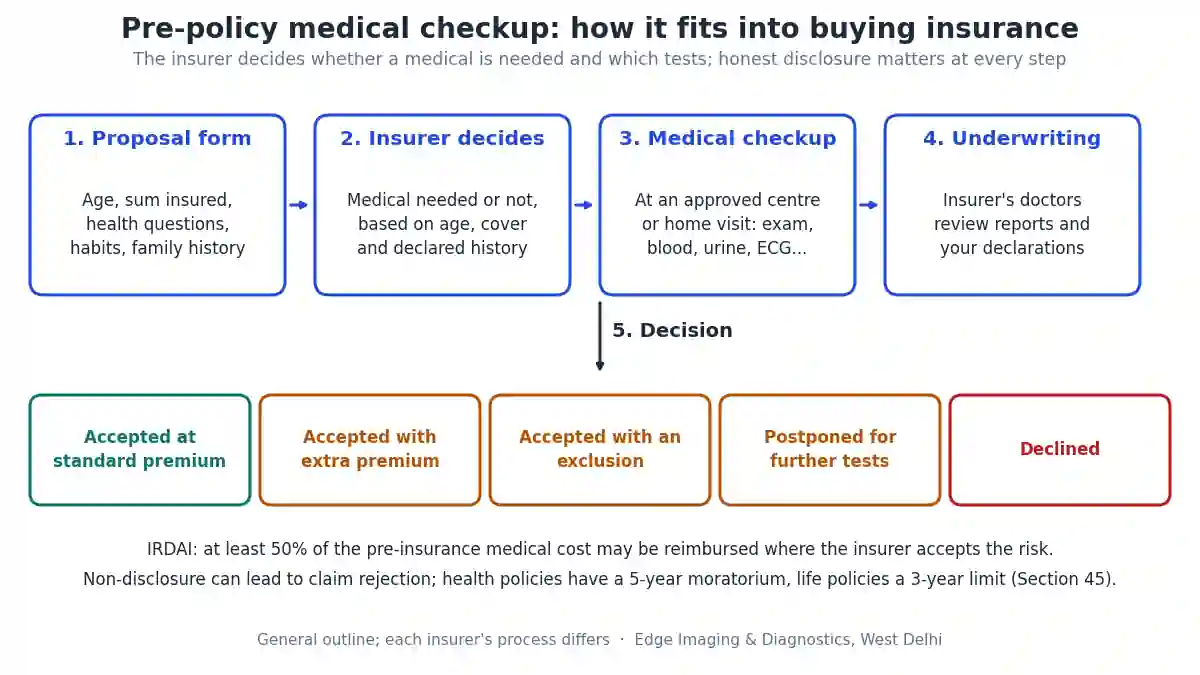
Possible outcomes of the medical
- Accepted at standard premium: the most common outcome for healthy applicants.
- Accepted with extra premium (loading): because of an identified risk.
- Accepted with an exclusion or a specific waiting period for a particular condition.
- Postponed: the insurer wants further tests, treatment or time before deciding — for example after a recent operation or a newly found abnormality.
- Declined: the insurer does not offer cover on this proposal.
If the outcome includes a loading or exclusion, ask the insurer to explain it in writing so that you understand exactly what is and is not covered before you pay the premium.
Medical test for health insurance by age group
Every insurer has its own grid, but the general pattern of the medical test for health insurance by age looks like this:
- Young adults with no declared conditions: often no medical, or a short tele-medical, for standard cover.
- Middle age: a core panel becomes more likely — blood pressure, BMI, sugar, lipids, kidney and liver tests, urine and an ECG.
- Older applicants: a fuller panel, sometimes with a treadmill test or echocardiogram, plus records of any treatment.
- Any age with a declared condition: tests and reports focused on that condition, such as HbA1c for diabetes or an echocardiogram for heart disease.
Medical test for term insurance: tips for smokers and higher cover
For a large term cover, the medical test for term insurance is usually more detailed, and the insurer may also look at income and existing cover. If you use tobacco in any form, declare it; smoker premiums are higher, but an undeclared habit discovered later can be far more costly. If you have quit, tell the insurer when you stopped — some insurers treat long-term ex-smokers differently. Arrive rested, and bring any recent cardiac or diabetes reports, as these often decide whether further tests are needed.
Family floater policies and the pre-policy medical test
In a family floater health policy, the insurer may ask for a pre-policy medical test for one or more members — often the eldest, or anyone who has declared a condition. Each member’s health history must be disclosed accurately. A finding in one member can affect the premium or terms of the whole policy, so read the offer carefully before accepting.
Porting, renewing or increasing cover: is a new medical needed?
Continuous renewal of the same health policy generally does not require a fresh medical. However, an insurer may ask for a medical when you port to a new insurer, increase the sum insured, or add a new member. Any increase in cover may come with its own waiting periods for the additional amount. Ask before you switch or upgrade, and never let an existing policy lapse while a new one is being underwritten.
Honest disclosure: why it matters more than the test
The most common reason for disputes at claim time is not a test result but non-disclosure — a condition, medicine, operation or habit that was not mentioned in the proposal form. Insurers can investigate the history when a claim is made, and undisclosed conditions can lead to the claim being rejected or the policy being cancelled.
The law gives policyholders some protection over time:
- Life insurance: under Section 45 of the Insurance Act, 1938, a life insurance policy cannot be called in question on any ground after three years. Within those three years, it can be questioned on grounds of fraud, or of misstatement or suppression of a material fact, subject to the conditions in the section.
- Health insurance: under IRDAI rules effective from April 2024, the moratorium period was reduced to five years (60 months) of continuous cover, after which claims generally cannot be contested for non-disclosure, except in cases of proven fraud.
The practical lesson is simple: disclose everything, even if it seems minor or was a long time ago — past operations, hospital admissions, regular medicines, abnormal reports, tobacco and alcohol use. A condition that is declared and accepted, even with a loading or waiting period, is far better than a policy that fails when you need it most.
Pre-existing diseases and waiting periods
Health insurance policies usually have waiting periods: an initial waiting period for most illnesses, longer waiting periods for specified conditions and procedures, and a waiting period for pre-existing diseases that you declared. The exact periods depend on the policy and should be stated clearly in the policy wording. Read them before buying and compare products; some plans offer shorter waiting periods for an extra premium.
The pre-policy medical can identify a condition that then becomes a declared pre-existing disease with its own waiting period. That may feel like a disadvantage, but it protects you: a declared condition will be covered after the waiting period, whereas an undeclared one may never be.
Senior citizens and insurance medicals
Older applicants are more likely to be asked for a medical and for additional tests such as an ECG, treadmill test or echocardiogram. IRDAI’s policyholder guidance for senior citizens states that any rejection of a proposal for health insurance of a senior citizen should be in writing with reasons. Senior applicants should bring all their reports and prescriptions to the medical, and read the policy’s waiting periods, co-payment and sub-limits carefully.
If your proposal is postponed or declined
- Ask for the reason, ideally in writing.
- Follow up the medical finding with your own doctor; treatment may change the picture.
- Ask whether the insurer will reconsider after treatment or after a set period.
- Consider other insurers, whose underwriting guidelines may differ.
- Check whether you are eligible for group health cover through an employer or association, which may have different underwriting.
- Keep copies of all reports for future applications.
Should you get your own health checkup first?
Many people choose to have their own health checkup before applying for insurance. This can be useful:
- You know your numbers and are not surprised by the insurer’s medical.
- You can start treatment for anything abnormal and show control.
- You can answer the proposal form accurately.
But be careful about one thing: if your own checkup finds a condition, you must disclose it in the proposal form. Using a checkup to know what to hide is exactly the kind of non-disclosure that leads to rejected claims. For a broader preventive check for your own health, see our full body health checkup guide.
Your right to your reports
The insurer’s medical is ordered for the insurer’s assessment, but the results are about your health. Ask the insurer or the examining centre how you can obtain a copy of your reports. Having them helps you follow up any abnormal finding with your doctor and keeps your health record complete.
Myths and facts
| Myth | Fact |
|---|---|
| If the medical is normal, I don’t need to disclose my history | The proposal form declarations are separate and must be complete; non-disclosure can still lead to claim rejection |
| Skipping my BP tablets will get a better result | It usually makes the reading worse; take your medicines and bring your records |
| Any abnormal result means rejection | Most findings lead to acceptance, sometimes with a loading or exclusion |
| The insurer always pays the full cost | Practice varies; ask in advance who pays and what happens if the proposal is declined |
| A test at any lab will be accepted | Insurers usually require their own process or panel centres; check first |
| Small habits like occasional smoking don’t matter | Tobacco use significantly affects life premiums and must be declared |
Questions to ask your insurer
- Which tests are required for my age, cover and history?
- Where can the medical be done — home visit, or which centres?
- Who pays, and what happens to the cost if the proposal is declined?
- Do I need to fast, and for how long?
- Can I get a copy of my reports?
- If there is a loading or exclusion, can you explain it in writing?
- What are the waiting periods for my declared conditions?
Your pre-policy medical checklist
- Insurer’s letter or reference number and list of tests
- Government photo ID
- Fasting as instructed (usually 8 to 12 hours)
- No alcohol for at least 24 hours
- Usual medicines taken, and a written list of them
- Previous reports and prescriptions for any condition
- Glasses, comfortable clothing, a good night’s sleep
Pre-insurance medical checkup in Delhi
Edge Imaging & Diagnostics, a NABH-accredited diagnostic group in West Delhi, performs the tests commonly listed for pre-insurance and pre-policy medicals — blood and urine tests, ECG, treadmill test (TMT), 2D echocardiography, chest X-ray and ultrasound — under one roof. Insurers usually decide where the medical is done, so first check whether your insurer has listed our centre or allows a centre of your choice. If it does, send us the insurer’s letter on WhatsApp and we will confirm the tests, preparation, timing and today’s actual pricing.
For your own health checkup before applying, or to follow up a finding from an insurance medical, we can help with that too.
💬 Send your insurer’s letter on WhatsApp for tests and today’s pricing | Call 9555999960
Related reading: Pre-employment medical test · Full body health checkup · TMT test · 2D echocardiography · Lab tests
References
- Senior Citizens — Policyholder — Insurance Regulatory and Development Authority of India (IRDAI) policyholder portal.
- Section 45 of the Insurance Act, 1938: incontestability — text reproduced by ICICI Prudential Life.
- Moratorium period in health insurance — ICICI Lombard, on the IRDAI change effective April 2024.
Frequently asked questions
What is a pre-insurance medical checkup?
It is a health examination requested by an insurer before issuing a health or life insurance policy, to assess your health risk and decide whether to accept the proposal, at what premium and with what conditions.
What is the difference between pre-insurance and pre-policy medical checkup?
They mean the same thing. “Pre-policy medical checkup” is the term widely used by health insurers and their partners; “pre-insurance medical” is a general term for any medical required before cover.
Which tests are done in a pre-policy medical checkup?
Typically a physical examination, blood pressure, BMI, blood count, fasting sugar and HbA1c, lipid profile, kidney and liver tests, urine test and ECG. Older applicants or those with higher cover or declared conditions may need a treadmill test, echocardiogram, chest X-ray or other tests.
Is a medical test required for health insurance?
Not always. Many insurers accept younger applicants with modest cover on declarations alone. A medical becomes more likely with age, higher cover, declared health conditions or other risk factors. Each insurer sets its own rules.
Is a medical test required for term insurance?
Often, especially for higher sums assured and older applicants. Requirements rise in steps, from a tele-medical to a physical examination, blood and urine tests, ECG and sometimes a treadmill test.
Who pays for the pre-policy medical checkup?
It varies. IRDAI guidance states that at least 50% of the cost of a pre-insurance medical examination may be reimbursed where the insurer accepts the risk. Many insurers pay in full. Ask in advance, including what happens if the proposal is declined.
Do I need to fast before a pre-insurance medical?
Usually yes, for 8 to 12 hours, if fasting blood sugar or lipids are included. Drink only water, avoid alcohol for at least 24 hours, and take your usual medicines unless told otherwise.
Can I take my blood pressure or diabetes medicines before the test?
Yes, unless the insurer specifically tells you otherwise. Skipping medicines usually makes results worse. Bring a list of your medicines and your previous reports.
What happens if my pre-policy medical shows a problem?
Most findings lead to acceptance, sometimes with an extra premium, an exclusion or a waiting period. Some lead to postponement for further tests, and a few to a decline. Follow up any abnormal result with your own doctor.
What is loading in insurance?
Loading is an extra premium charged because of a health risk identified from your declarations or medical reports, such as high blood pressure, diabetes or a high BMI.
What happens if I hide a medical condition?
Non-disclosure can lead to claim rejection or cancellation of the policy. Life policies can be questioned within three years under Section 45 of the Insurance Act, and health policies within the five-year moratorium period, except that proven fraud can be acted on later.
What is the moratorium period in health insurance?
Under IRDAI rules effective from April 2024, after five years (60 months) of continuous cover, claims generally cannot be contested on grounds of non-disclosure, except for proven fraud.
Can I choose where to do my insurance medical?
Usually the insurer arranges it through a home visit or its panel centres. Some allow a choice from a list, and a few accept reports from a centre of your choice. Check with the insurer before getting tests done.
Can I get a copy of my pre-policy medical reports?
Ask the insurer or the examining centre how to obtain a copy. Your reports are useful for following up any abnormal finding with your doctor and for future applications.
Should I do a health checkup before buying insurance?
It can help you know your numbers and start treatment early, but any condition found must be disclosed in the proposal form. A checkup should never be used to decide what to hide.
Does a nicotine test happen in life insurance medicals?
Some life insurers test for nicotine to confirm smoker or non-smoker status, because tobacco use significantly affects premiums. Always declare tobacco use honestly.
Where can I get a pre-insurance medical checkup in Delhi?
Insurers usually decide the centre. If your insurer lists Edge Imaging & Diagnostics in West Delhi or allows a centre of your choice, send the insurer’s letter on WhatsApp to 9555999960 for the tests, preparation and today’s pricing.
The bottom line
A pre-insurance or pre-policy medical checkup helps the insurer price your risk and set the terms of your cover. Prepare by fasting as instructed, avoiding alcohol, taking your usual medicines and bringing your reports.
Most importantly, disclose your health history completely and honestly. A declared condition accepted with a loading or waiting period is far better than a policy that fails at claim time. Ask questions, read the terms, and follow up any abnormal result for your own health. Keep copies of every report and declaration, so that you can answer any future question about your cover with confidence.
Written by the clinical content team at Edge Imaging & Diagnostics, West Delhi — a NABH-accredited diagnostic centre. Medically reviewed by Dr. Nishant Thapar, Consultant Radiologist. Last reviewed: October 2026.
Disclaimer: this article is general information about insurance medical examinations. It is not insurance, financial, medical or legal advice. Underwriting rules, tests, costs, waiting periods and terms differ between insurers and products and can change; always rely on your insurer’s instructions and policy wording, and consult a qualified adviser for decisions about cover.