
 PV
 TG
 MN
 EM
 EI
 ND

 CT Scan
 PET CT
 Digital X-ray
 Ultrasound
 Amniocentesis

 Fetal Reduction
 Thermalytix Breast Screening
 Cardiology
 Lab Tests
 GAMCA Pre-Medical

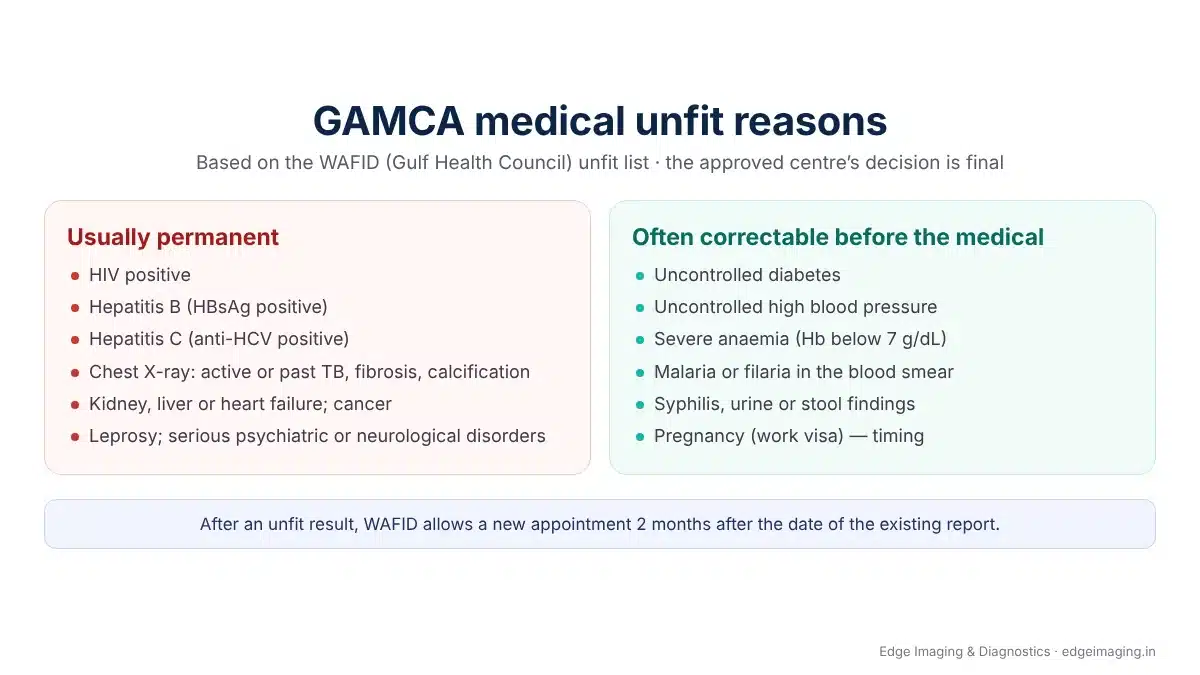
In the GCC (GAMCA / WAFID) medical, you are declared “unfit” if the approved centre finds one of the conditions on the Gulf Health Council’s list: HIV, hepatitis B, hepatitis C, signs of active or past TB on the chest X-ray, malaria or filaria, leprosy, uncontrolled diabetes or blood pressure, very low haemoglobin, organ failure, cancer, certain psychiatric or neurological disorders, a disability that affects work, or pregnancy for a work visa. Some of these are permanent. Others can be treated or controlled before you take the medical.
An unfit result is stressful. The job offer is ready, the agent has been paid, and suddenly the report says “unfit”. This guide explains every unfit reason in plain language, which ones can be corrected, what happens after an unfit result, and how to avoid a surprise the next time.
GAMCA unfit: at a glance
- Who decides: only the GCC-approved medical centre assigned through WAFID
- Permanent reasons: HIV, hepatitis B, hepatitis C, old or active TB changes on X-ray, organ failure, cancer
- Often correctable: uncontrolled sugar or BP, severe anaemia, malaria, some infections, pregnancy timing
- Re-booking: the WAFID FAQ says a new appointment can be booked 2 months after the date of the existing report
- Best protection: know your results before you book the official medical
What this guide covers
- The official GCC list of unfit conditions
- Infections: HIV, hepatitis B and C, malaria, filaria
- Chest X-ray findings
- Diabetes, blood pressure and anaemia
- Organ failure, cancer, mental health and disability
- Pregnancy and other points for women
- Tests that are checked but not on the unfit list
- Temporary vs permanent: a simple table
- What happens after an unfit result
- What to do next, step by step
- How to avoid an unfit surprise
- Seedhi baat: GAMCA me unfit kyun aate hain
- Frequently asked questions
The official GCC list of unfit conditions
The GCC expatriate medical is run by the Gulf Health Council through its WAFID programme (the centres were long known in India as GAMCA). The WAFID FAQ lists the conditions that make an applicant unfit. In short:
- Infectious diseases: HIV/AIDS, hepatitis B (HBsAg positive), hepatitis C (anti-HCV positive), microfilaria, malaria and leprosy
- Chest X-ray: any abnormal finding, including active or past evidence of TB, pulmonary fibrosis or calcification, pleural effusion and lymphadenopathy
- Non-infectious conditions: kidney failure, liver failure, heart failure, uncontrolled hypertension, uncontrolled diabetes, cancer of all types, psychiatric and neurological disorders, and a disability that affects the ability to work
- Blood count: haemoglobin below 7 g/dL under the GHC regulations
- Women: pregnancy, for work visas
The rules are updated from time to time. The Gulf Health Council approved a new version of its regulations, which Kuwait put into force in May 2026, with updated laboratory, X-ray and vaccination standards. The approved centre always applies the rules in force on the day of your examination.
Infections: HIV, hepatitis B and C, malaria, filaria
HIV
A positive HIV test leads to an unfit result. This cannot be changed by treatment for GCC purposes. If a pre-check or any test shows HIV, the most important step is your own health: modern treatment is very effective, and a confirmed diagnosis should always be discussed privately with a doctor.
Hepatitis B (HBsAg positive)
HBsAg is the hepatitis B surface antigen. A positive result means the virus is present and leads to an unfit result. Many people carry hepatitis B without symptoms, which is why it is often first found in a job medical. See a liver specialist for evaluation and follow-up.
Hepatitis C (anti-HCV positive)
The GCC medical tests for hepatitis C antibodies (anti-HCV). Hepatitis C can now be cured with tablets, but the antibody test usually stays positive for life even after cure, so for GCC purposes it is generally treated as a permanent finding. Treatment is still important for your liver.
Malaria and filaria
A blood smear that shows malaria parasites or microfilaria leads to an unfit result. Unlike the infections above, these are treatable. After full treatment and a clear repeat test, the finding should no longer be present.
Leprosy
Leprosy is on the unfit list. It is curable with multi-drug therapy, but it is listed as an unfit condition in the GCC rules, so discuss it with your doctor before you plan a Gulf job.
Chest X-ray findings
The chest X-ray is one of the most common reasons for an unfit result, because the GCC rules treat past evidence of TB, not only active TB, as unfit. Fibrosis (scarring), calcification (small chalky spots), fluid around the lung and enlarged lymph nodes are also on the list.
That means a person who had TB years ago and finished treatment can still be declared unfit if the X-ray shows the old scar. We explain this in detail, including what you can and cannot do, in our guide to the GAMCA chest X-ray and TB scars.
Diabetes, blood pressure and anaemia
These are the findings most worth checking early, because they can often be controlled.
- Diabetes: the rule says uncontrolled diabetes. A person with diabetes that is well controlled on treatment is not automatically unfit. Very high sugar on the day, or sugar in the urine, can count against you.
- Blood pressure: again, the rule says uncontrolled hypertension. Take your medicines as prescribed, rest before the reading and do not stop treatment before the medical.
- Anaemia: haemoglobin below 7 g/dL is unfit under the GHC regulations. Severe anaemia has a cause, such as iron deficiency, worms or blood loss, and treating that cause usually brings haemoglobin up over a few weeks.
The GCC rules do not publish exact sugar or BP cut-offs for applicants, and the approved centre decides. Do not rely on anyone who promises a “safe number”.
Organ failure, cancer, mental health and disability
Kidney failure, liver failure, heart failure and cancer of any type are unfit conditions. So are significant psychiatric and neurological disorders, and a deformity, amputation or disability that affects the ability to do the job. These are not issues a pre-check can fix; they need a specialist’s care.
Pregnancy and other points for women
Pregnancy is a reason for an unfit result for a work visa. The medical for women also includes questions and an examination for conditions such as abnormal bleeding or prolapse. If you are planning a pregnancy, time your medical with your doctor’s advice.
Tests that are checked but not on the unfit list
Some tests are part of the GCC medical but are not named on the short unfit list in the FAQ: syphilis screening (VDRL, with TPHA if VDRL is positive), urine sugar and albumin, and stool tests for parasites. How these are judged can differ by country and by the centre’s doctor. They are usually treatable, so it is sensible to treat any problem before the official test.
Temporary vs permanent: a simple table
| Finding | Can it be corrected before the medical? |
|---|---|
| HIV positive | No |
| Hepatitis B (HBsAg positive) | No |
| Hepatitis C (anti-HCV positive) | Usually no for GCC purposes, even after cure |
| Old TB scar, fibrosis or calcification on X-ray | Usually no |
| Active TB | Needs full treatment; old changes may remain |
| Malaria or filaria | Yes, with treatment and a clear repeat test |
| Uncontrolled diabetes | Often yes, with good control |
| Uncontrolled blood pressure | Often yes, with treatment |
| Haemoglobin below 7 g/dL | Often yes, by treating the cause |
| Pregnancy (work visa) | Timing |
| Syphilis, urine or stool findings | Usually yes, with treatment |
| Organ failure, cancer | No; needs specialist care |
What happens after an unfit result
- The result is recorded centrally. Official results are uploaded to the WAFID system and can be looked up by passport number. Read how to check your WAFID medical status.
- You cannot simply re-test the next day. The WAFID FAQ says: “The applicant may rebook a new appointment 2 months after the date of the existing report.” Some reports, including the migrant-rights group MRRORS, mention a 3-month bar.
- Permanent conditions stay unfit at a repeat medical, and also at the medical many GCC countries do after you arrive.
- Complaints and appeals: the Gulf Health Council’s 2026 regulations are reported to include a grievance committee for appeals. The procedure has not been published in detail, so ask the centre or your employer.
What to do next, step by step
- Get the reason in writing. Ask the centre which test caused the unfit result.
- See a doctor about that finding. Treat what can be treated: sugar, BP, anaemia, malaria, infections.
- Re-check privately before you re-book. A GAMCA / WAFID pre-medical test shows whether the problem is really sorted, without anything being uploaded.
- Re-book only after the waiting period, on wafid.com.
- If the finding is permanent, talk honestly with your employer or agent about other options, and look after your health first.
Know your results before the official medical — ₹4,999, same-day report
Edge Imaging & Diagnostics in West Delhi runs the same panel of tests as the GCC medical: chest X-ray, HIV, hepatitis B and C, VDRL, CBC, malaria, sugar, liver and kidney tests, urine and stool. Your report is given only to you. We are not a GAMCA / WAFID-approved centre, and our report is not a visa certificate.
See the GAMCA / WAFID pre-medical test · WhatsApp 9599941470
How to avoid an unfit surprise
- Get a pre-check a few weeks before you book, so there is time to treat anything found.
- If you have diabetes or high BP, keep taking your medicines and get them reviewed before the medical.
- If you ever had TB, get your chest X-ray reviewed by a radiologist before you spend money on the official medical.
- Fast 8–10 hours before the blood tests, sleep well and avoid alcohol for a day or two before.
- Never pay anyone who promises a “guaranteed fit” certificate. In 2024–25 Kerala police uncovered a racket that misused a centre’s WAFID login to sell fake fit certificates, and GCC countries test again after arrival.
Seedhi baat: GAMCA me unfit kyun aate hain
GAMCA / WAFID medical me sabse zyada unfit in wajahon se aate hain: HIV, Hepatitis B, Hepatitis C, chest X-ray me TB ka nishaan (purana bhi), malaria, sugar ya BP control me na hona, aur khoon ki bahut kami (Hb 7 se kam). HIV, Hepatitis B/C aur purane TB ke nishaan jaisi cheezein theek nahi hoti. Lekin sugar, BP, khoon ki kami aur malaria ka ilaaj ho sakta hai.
Unfit aane ke baad WAFID FAQ ke hisaab se naya appointment purani report ki date se 2 mahine baad hi book hota hai. Isliye official medical se pehle apna pre-medical karwa lena samajhdaari hai — report sirf aapko milti hai aur problem ka pehle se pata chal jaata hai.
Frequently asked questions
What are the most common GAMCA medical unfit reasons?
The most common are chest X-ray changes from active or past TB, hepatitis B, hepatitis C, HIV, uncontrolled diabetes or blood pressure, and severe anaemia. Malaria, filaria and pregnancy (for work visas) are also on the list.
Can I become fit after being declared unfit in GAMCA?
It depends on the reason. Treatable findings such as uncontrolled sugar or BP, severe anaemia or malaria can be corrected, and you can book again after the waiting period. Permanent findings such as HIV, hepatitis B, hepatitis C or an old TB scar usually stay unfit.
How long after an unfit result can I take the GAMCA medical again?
The WAFID FAQ says a new appointment can be booked 2 months after the date of the existing report. Some sources mention 3 months.
Is hepatitis C still unfit after treatment?
Usually yes for GCC purposes, because the medical tests for hepatitis C antibodies, which normally stay positive after cure. Treatment is still important for your liver health.
Does high blood pressure make you unfit in GAMCA?
The rule says uncontrolled hypertension. Well-controlled blood pressure on treatment is not automatically unfit, but the approved centre decides on the day.
Can an old TB scar make me unfit?
Yes. The GCC rules list active or past evidence of TB, fibrosis and calcification on the chest X-ray as unfit findings.
GAMCA medical me unfit aane ke baad kya karein?
Pehle centre se unfit hone ki wajah poochein, phir doctor se uska ilaaj karwayein. 2 mahine baad dobara book karne se pehle pre-medical karwa kar check kar lein ki problem theek hui ya nahi.
The bottom line
Most GAMCA unfit results come from a short list of findings. Some are permanent, but several of the most common ones — sugar, blood pressure, anaemia, malaria — can be dealt with if you know about them in time. Check first, treat what you can, and book the official medical only when your results are where they need to be.
Written by the medical team at Edge Imaging & Diagnostics, West Delhi. Last reviewed: October 2026. Sources: WAFID (Gulf Health Council) FAQ and regulations for expatriate medical examination, and published news reports.
Disclaimer: this article is general information about the GCC (GAMCA / WAFID) medical as of October 2026. It is not medical or immigration advice. Edge Imaging & Diagnostics is not a GAMCA / WAFID-approved medical centre. Rules can change; the approved centre’s decision is final.