
 PV
 TG
 MN
 EM
 EI
 ND

 CT Scan
 PET CT
 Digital X-ray
 Ultrasound
 Amniocentesis

 Fetal Reduction
 Thermalytix Breast Screening
 Cardiology
 Lab Tests
 GAMCA Pre-Medical

Amnioreduction in Delhi for severe polyhydramnios
Ultrasound-guided drainage of excess amniotic fluid, performed by our consultant radiologists on your obstetrician’s referral. The fluid is removed slowly under local anaesthesia, with your baby’s heart rate checked throughout.
Send your referral and latest scan report — we explain the preparation and today’s actual pricing.
When is amnioreduction needed?
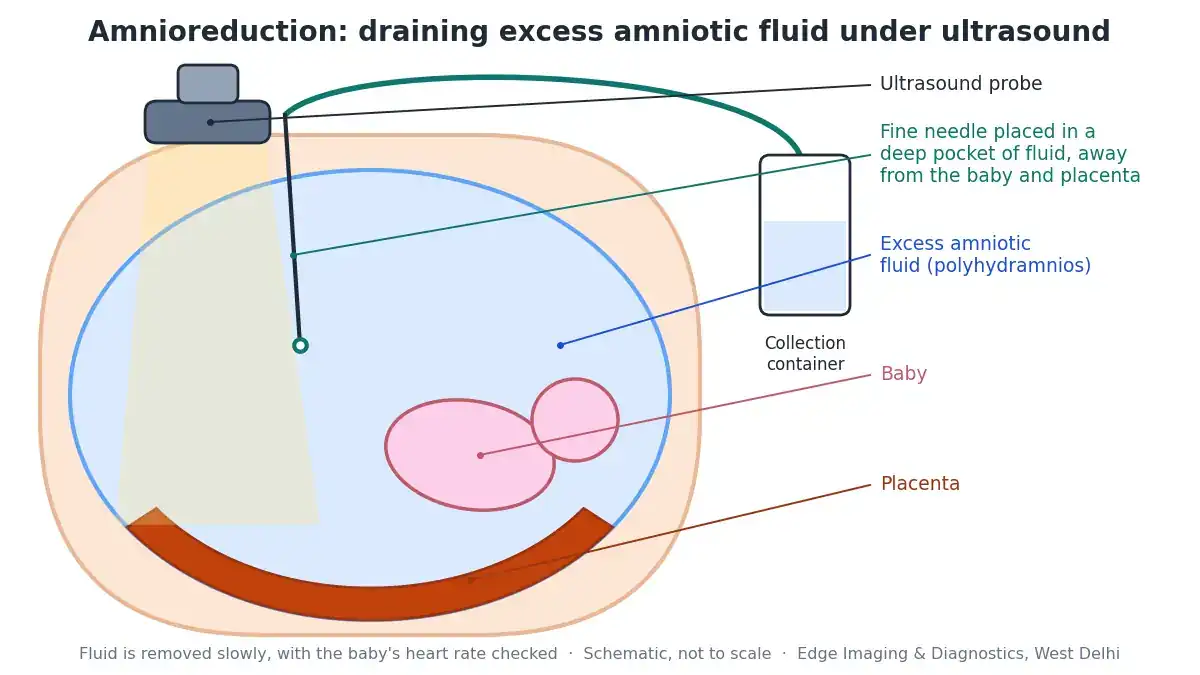
Amnioreduction (also called therapeutic amniocentesis or amniodrainage) removes excess amniotic fluid through a fine needle passed into the womb under continuous ultrasound guidance. It treats the extra fluid when that fluid is severe and genuinely troublesome — most women with “high fluid” on a scan never need it.
Usually considered when
- Polyhydramnios is severe on ultrasound (see the table below)
- The fluid is causing significant breathlessness, pain or tightness, or you cannot lie down or eat comfortably
- There are preterm contractions or a raised risk of early labour
- In some twin complications, such as twin-to-twin transfusion syndrome, in particular situations decided by your fetal medicine specialist
Usually not needed when
- Polyhydramnios is mild or moderate and not causing troublesome symptoms
- A treatable cause such as diabetes is found — better sugar control often reduces the fluid by itself
- A single borderline measurement needs a repeat scan rather than a procedure
Before anything is booked, we review your referral and recent scans. If a repeat scan is the right next step rather than a procedure, we will tell you that plainly.
| Category | Deepest vertical pocket (DVP) | Amniotic fluid index (AFI) |
|---|---|---|
| Normal range | 2 to 7.9 cm | 5 to 24.9 cm |
| Mild polyhydramnios | 8 to 11.9 cm | 25 to 29.9 cm |
| Moderate polyhydramnios | 12 to 15.9 cm | 30 to 34.9 cm |
| Severe polyhydramnios | 16 cm or more | 35 cm or more |
Fluid measurements vary with the baby’s position and between scans. Your report will say whether DVP or AFI was used. The decision to drain fluid is always taken by your obstetrician or fetal medicine specialist, not by a number alone.
How amnioreduction is done at Edge
A calm, unhurried procedure. Allow a good part of the day and do not plan to drive yourself home.
- Step 01
Referral and report review
Send your obstetrician’s referral and latest scan on WhatsApp. We check what has been asked for and explain the preparation before you come in.
- Step 02
Counselling and consent
The reasons, risks, chance of needing a repeat and the alternatives are explained, and consent forms are signed. If fluid is to be tested, PCPNDT documentation is completed.
- Step 03
Baseline scan
The fluid is measured, your baby’s heartbeat and position are checked, and the safest pocket of fluid, away from the baby and placenta, is chosen.
- Step 04
Numbing and needle placement
The abdomen is cleaned and draped, the skin is numbed with local anaesthetic, and a fine needle is guided into the pocket on the ultrasound screen.
- Step 05
Slow, monitored drainage
Fluid is drained slowly — usually over half an hour to an hour — while the baby’s heart rate and the needle position are checked repeatedly. Drainage stops as the fluid nears the upper part of the normal range.
- Step 06
Recheck, rest and follow-up
The fluid is re-measured and the baby and placenta checked again. You rest before going home (or are observed in hospital if your obstetrician advises), with a clear plan for your next scan.
Why families and obstetricians refer to us
Experienced hands
Performed by our consultant radiologists — the same team that does ultrasound-guided amniocentesis and CVS at our centre.
Complete work-up in one place
Amniotic fluid assessment, anomaly scan, fetal Doppler and fetal echocardiography — the scans that matter in polyhydramnios.
Testing without a second needle
If your doctor wants genetic or infection testing, a sample of the drained fluid can be sent to the laboratory, avoiding a separate amniocentesis.
Honest advice first
We coordinate with your obstetrician and tell you plainly if a repeat scan, not a procedure, is the right next step.
What to bring on the day
- Your obstetrician’s or fetal medicine specialist’s referral
- Previous reports — earlier fluid measurements, anomaly scan, Doppler and any sugar test results
- Your blood group — Rh-negative mothers who are not already sensitised are usually given anti-D afterwards
- A list of your medicines, especially blood thinners (do not stop anything on your own)
- Someone to accompany you and take you home
Honest risks, explained
Amnioreduction is generally considered a low-risk procedure in experienced hands, but it is not risk-free. Published series report complications in a small percentage of procedures, including:
- Leaking of fluid or rupture of the membranes
- Preterm labour
- Placental abruption, uncommon but serious — the main reason fluid is drained slowly
- Infection, rare with sterile technique, and a temporary change in the baby’s heart rate
It treats the excess fluid, not its cause, so the fluid often re-accumulates and the procedure may need repeating. Risks are higher with repeated procedures and in complex twin pregnancies.
Amnioreduction cost in Delhi
The final charge depends on what your obstetrician has advised — for example, whether a fluid sample is to be sent for testing and which scans are needed alongside. Send your prescription or referral on WhatsApp to know today’s actual pricing, with no obligation to book.
Amnioreduction FAQs
What is amnioreduction?
Amnioreduction is a procedure that removes excess amniotic fluid from around the baby through a fine needle passed into the womb under continuous ultrasound guidance. It is used for severe polyhydramnios that is causing significant symptoms or raising the risk of preterm labour, and in some twin complications.
Is amnioreduction the same as amniocentesis for polyhydramnios?
Not quite. Diagnostic amniocentesis takes a small sample, typically around 15 to 20 ml, to test the baby’s chromosomes, genes or for infection, and takes a minute or two. Amnioreduction, also called therapeutic amniocentesis, drains a large volume, often a litre or more, slowly over about half an hour to an hour to relieve severe polyhydramnios. If testing is needed, a sample of the drained fluid can be sent to the laboratory at the same time.
When is amnioreduction needed for polyhydramnios?
Most polyhydramnios, especially mild and moderate, is managed by treating any cause such as diabetes and by monitoring with repeat scans. Amnioreduction is generally reserved for severe polyhydramnios causing significant breathlessness, pain or preterm contractions, or for specific twin complications. The decision is made by your obstetrician or fetal medicine specialist.
Is amnioreduction painful?
Most women feel a sharp sting with the local anaesthetic, then pressure and sometimes cramping during drainage. General anaesthesia is not used. Many women notice immediate relief of breathlessness and abdominal tightness as the fluid is removed.
How long does amnioreduction take, and can I go home the same day?
The drainage itself usually takes around half an hour to an hour, because the fluid is removed slowly. Afterwards the fluid is re-measured and you rest for a period before going home, or you are observed in hospital if your obstetrician has advised it, for example if you were having contractions. Allow a good part of the day and do not drive yourself home.
How much fluid is removed?
Commonly a litre or more is removed, sometimes considerably more, depending on how much is present. Drainage is stopped when the fluid measurement approaches the upper part of the normal range, or earlier if needed.
What are the risks of amnioreduction?
Published series report complications in a small percentage of procedures, including leaking of fluid or rupture of the membranes, preterm labour, placental abruption, infection, and temporary changes in the baby’s heart rate. Fluid is drained slowly specifically to reduce the risk of abruption. Risks are higher with repeated procedures and in complex twin pregnancies.
Will the fluid come back after amnioreduction?
Often, yes. Amnioreduction removes the excess fluid but usually not its cause, so fluid can re-accumulate over days or weeks and the procedure may need repeating. Where a cause such as diabetes can be treated, the fluid may settle without further procedures.
Do I need a referral for amnioreduction?
Yes. It is performed on an obstetrician’s or fetal medicine specialist’s referral after the cause of the excess fluid has been assessed, and with consent covering the risks, the likelihood of repeat procedures and the alternatives.
Can the removed fluid be tested?
Yes. If genetic or infection testing is needed, a sample of the drained fluid can be sent to the laboratory at the same time, avoiding a separate amniocentesis. This is done within the PCPNDT Act and never to determine the sex of the baby.
What is the amnioreduction cost in Delhi?
The final charge depends on what your obstetrician has advised, for example whether a fluid sample is to be sent for testing and which scans are needed alongside. Send your prescription or referral and latest scan report on WhatsApp to 9555999960 to know today’s actual pricing.
Pregnancy me pani jyada ho to kya amnioreduction zaroori hai?
Har baar nahi. Mild ya moderate polyhydramnios me aksar sirf cause ka ilaj (jaise sugar control) aur repeat scan se kaam chal jaata hai. Amnioreduction tab socha jaata hai jab paani bahut zyada ho aur saans phoolna, dard ya time se pehle contractions ho rahe hon. Faisla aapke gynaecologist ya fetal medicine specialist karte hain.
Amnioreduction ka kharcha kitna hai?
Kharcha is baat par depend karta hai ki doctor ne kya advise kiya hai, jaise fluid ki testing bhi karni hai ya nahi. Apne doctor ki referral ya prescription aur latest scan report WhatsApp (9555999960) par bhejiye, hum preparation aur aaj ka actual price bata denge.
When to seek urgent care
Before or after the procedure, get prompt in-person assessment for regular contractions before 37 weeks, a gush or steady leak of fluid, bleeding, severe abdominal pain, fever, reduced baby movements or breathlessness at rest. Sudden severe breathlessness or chest pain is an emergency. Do not take any medicine to reduce amniotic fluid except under specialist supervision.
PCPNDT note: Edge Imaging & Diagnostics is registered under the PCPNDT Act. Any testing of amniotic fluid is done only to detect genetic, chromosomal, metabolic or structural conditions. Prenatal sex determination is strictly prohibited by law and is never performed or disclosed under any circumstances. Registration No. DL/W/2020/1629
Has your obstetrician advised amnioreduction?
Send a photo of the referral and your latest scan report. We will explain the procedure, the preparation and today’s actual pricing.