
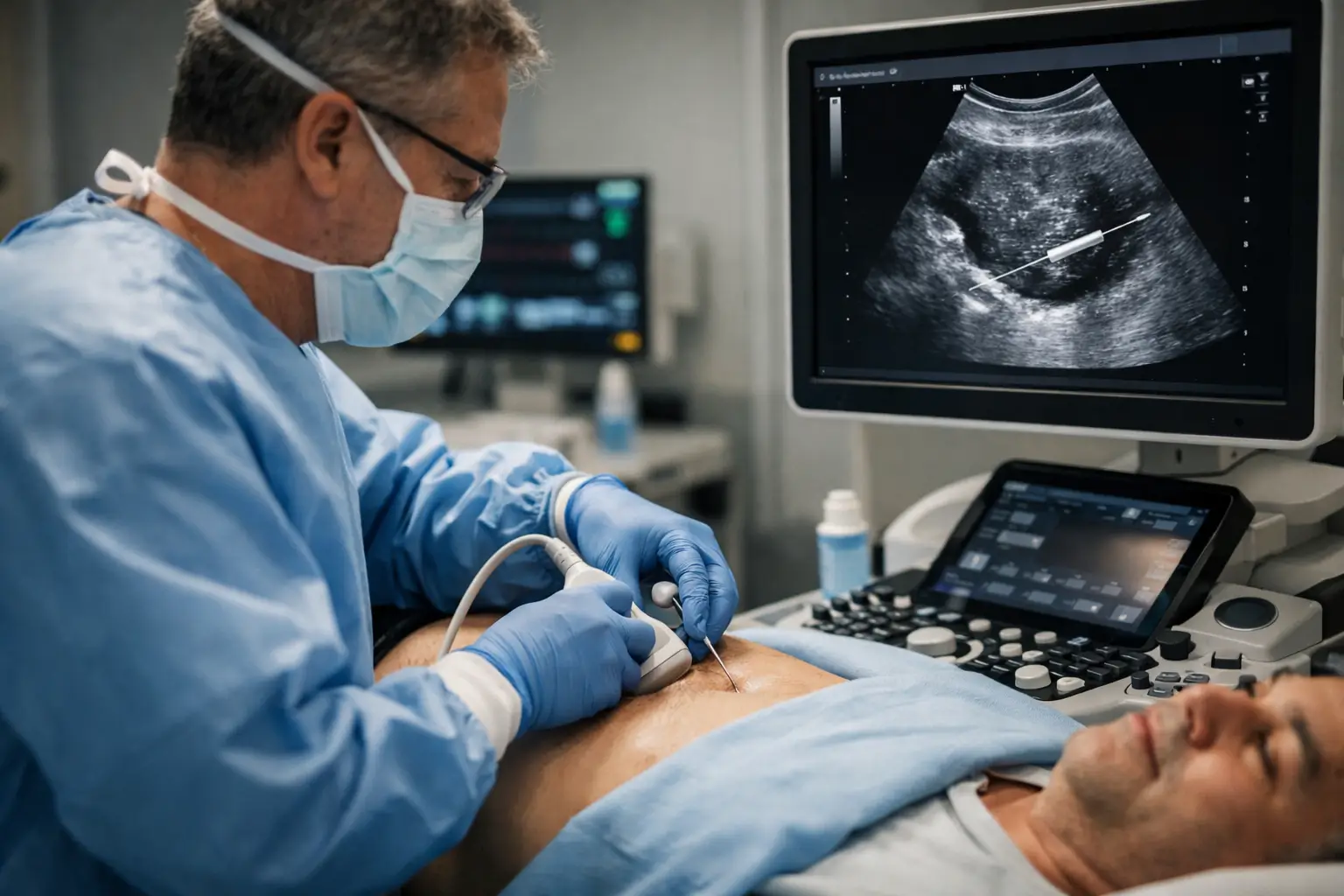
Liver Abscess Drainage in Delhi — The cornerstone treatment for moderate to large liver abscesses. Rather than waiting weeks for antibiotics alone to work — or undergoing major open surgery — image-guided drainage removes the infected pus directly and rapidly, dramatically speeding recovery. At Edge Imaging & Diagnostics in Delhi, our interventional radiology team performs ultrasound-guided liver abscess drainage as a minimally invasive, same-day procedure.
Table of Contents
When Is Liver Abscess Drainage Needed?
- Abscess diameter >5 cm on ultrasound or CT
- Abscess not responding to antibiotics after 3–5 days
- Patient in severe sepsis requiring immediate source control
- Amoebic abscess with risk of rupture (thin-walled, peripheral location)
- Left lobe abscess (higher rupture risk into pericardium)
- Pyogenic abscess (usually requires drainage even if <5 cm)
- Diagnostic aspiration needed to identify the causative organism
- Thick-walled abscess unlikely to resolve with antibiotics alone
Two Types of Liver Abscess Drainage
1. Needle Aspiration (Percutaneous Aspiration)
A single needle insertion under ultrasound guidance is used to aspirate (draw out) as much pus as possible in one session. The needle is removed after aspiration. Best for: unilocular (single chamber) abscesses that are accessible and have thin, liquid pus. May require repeat aspiration in 3–5 days if abscess re-accumulates.
2. Pigtail Catheter Drainage
A flexible drainage catheter (pigtail tube, typically 8–12 French) is placed inside the abscess cavity under ultrasound guidance and left in place for several days to allow continuous drainage. Best for: large abscesses (>8–10 cm), thick viscous pus, multiple loculated collections, abscesses that re-accumulate after needle aspiration. The catheter is connected to a drainage bag and flushed regularly with saline.
Liver Abscess Drainage Procedure at Edge Imaging — Step by Step
Step 1: Pre-Procedure Evaluation
Ultrasound and CT scan are reviewed to plan the safest drainage route. Blood tests including INR and platelet count are checked. Blood thinners are stopped if needed. IV access is established for antibiotics and medications.
Step 2: Patient Positioning
You lie on the ultrasound/procedure table on your back or left side. Monitoring equipment (blood pressure, pulse oximetry) is attached.
Step 3: Ultrasound-Guided Planning
The radiologist performs real-time ultrasound to map the abscess and identify the safest path to the abscess cavity, avoiding blood vessels (visualised with Doppler) and bile ducts.
Step 4: Skin Preparation & Anaesthesia
Skin cleaning with betadine/chlorhexidine. Local anaesthetic injected at the entry point and along the planned needle track to the abscess.
Step 5: Needle Insertion & Drainage
For aspiration: A trocar needle (18–20 gauge) is inserted into the abscess under continuous ultrasound guidance. Pus is aspirated into a syringe. The cavity is irrigated with normal saline. For pigtail placement: A guidewire is passed through the needle into the abscess cavity. The pigtail catheter is advanced over the guidewire using the Seldinger technique. The pigtail curl retains the catheter inside the cavity. Connected to a drainage bag.
Step 6: Sample Collection
Pus samples are sent for gram stain, culture and sensitivity, and microscopy (looking for Entamoeba). This guides antibiotic selection.
Step 7: Post-Procedure Monitoring
You are monitored for 1–2 hours. A chest X-ray may be obtained to check for any complication. The catheter (if placed) is reviewed daily and removed when drainage is <10 ml per day and follow-up imaging confirms resolution.
What to Expect After Liver Abscess Drainage
- Immediate improvement in fever and pain within 24–72 hours of drainage
- Mild discomfort at the drainage site for 2–3 days
- Pigtail catheter is typically removed in 3–7 days
- Antibiotics continue for 4–6 weeks after drainage
- Follow-up ultrasound in 2 weeks to confirm resolution
- Diet: light, easily digestible foods for the first few days
Liver Abscess Drainage Cost in Delhi 2026
At Edge Imaging, ultrasound-guided Liver Abscess Drainage in Delhi (needle aspiration) is priced at ₹3,000–₹6,000 inclusive of ultrasound guidance and procedure. Pigtail catheter placement is priced at ₹6,000–₹12,000 including catheter material and placement. CGHS/DGHS rates are available for eligible patients. These prices are significantly lower than large private hospitals (₹20,000–₹50,000 for the same procedure).
Liver Abscess Drainage at Edge Imaging: Why Choose Us?
- Performed by specialist interventional radiologists with daily experience in abscess drainage
- High-resolution Doppler ultrasound for real-time guidance
- Sterile, dedicated interventional procedure suite
- Same-day or next-day appointments for urgent cases
- Post-procedure follow-up and catheter management
- NABH accredited — highest standards of infection control and patient safety
- Multiple West Delhi locations for convenience
Frequently Asked Questions for Liver Abscess Drainage in Delhi
Q1. How painful is liver abscess drainage?
Local anaesthesia makes the procedure comfortable. You will feel pressure and mild discomfort but not significant pain. Post-procedure soreness is managed with standard oral analgesics. Most patients describe the experience as ‘uncomfortable but not painful.’
Q2. How quickly will I feel better after liver abscess drainage?
Most patients experience significant improvement in fever and pain within 24–72 hours of drainage. Appetite improves within 3–5 days as the infection comes under control.
Q3. Is one drainage session enough?
For smaller, well-defined unilocular abscesses, a single Liver Abscess Drainage in Delhi session is often sufficient. Larger or complex abscesses with thick pus often require a pigtail catheter for continuous drainage over 3–7 days.
Q4. Can I go home after liver abscess drainage?
Depending on the severity of your infection and the type of drainage, you may go home the same day with a pigtail catheter in place, managed at home or with daily clinic visits. Severely ill patients may need hospitalisation.
Q5. What are the risks of liver abscess drainage?
Risks include bleeding (rare, <2%), bile duct injury (very rare), pneumothorax if the liver is approached from above (rare), and infection of the entry site. These risks are minimised by careful ultrasound-guided planning and strict sterile technique.
Q6. What is pigtail catheter drainage?
A pigtail catheter is a flexible tube (the tip curls like a pigtail) placed inside the abscess cavity to allow continuous pus drainage. It is connected to a drainage bag and removed when drainage is minimal and imaging confirms cavity resolution.
Q7. What should I eat after liver abscess drainage?
Start with clear liquids and light foods (khichdi, dal, boiled vegetables). Avoid spicy, fatty, or heavy foods for 1–2 weeks. Maintain adequate hydration. Alcohol must be completely avoided during antibiotic treatment and recovery.
Q8. Where can I get liver abscess drainage in West Delhi?
Edge Imaging & Diagnostics in Tagore Garden, Paschim Vihar, and Moti Nagar offers expert Liver Abscess Drainage in Delhi with ultrasound guidance by interventional radiologists. Urgent same-day drainage is available for serious cases.
Need Liver Abscess Drainage? Contact Edge Imaging Delhi Today
Don’t wait for complications. Edge Imaging’s interventional radiology team offers expert, image-guided Liver Abscess Drainage in Delhi as a safe, minimally invasive procedure — with significantly faster recovery than open surgery.
📍 Locations: Tagore Garden | Paschim Vihar | Moti Nagar | New Multan Nagar
✅ NABH Accredited | CGHS & DGHS Empanelled | Same-Day Reporting
📞 Call or WhatsApp to book your appointment today.
For more information, explore our related guide: Biopsy Test in Delhi
For more information on this procedure, refer to the World Health Organization (WHO) guidelines on medical procedures.
Medical Disclaimer: This article is for educational purposes only. Always consult a qualified medical professional for diagnosis and treatment advice.