A biopsy test in Delhi is one of the most important and accurate diagnostic procedures in modern medicine. Whether you or a loved one has been advised a biopsy test in Delhi, understanding what the test involves — why it is done, how it works, the different types available, and what to expect — is key to making an informed decision. At Edge Imaging & Diagnostics in Paschim Vihar, West Delhi, we perform a comprehensive range of ultrasound-guided and CT-guided biopsy procedures, providing accurate tissue diagnosis for our patients across Delhi NCR.
This complete guide to biopsy test in Delhi covers everything patients need to know — from the basics of what a biopsy is to the different types, body sites, preparation steps, procedure details, results interpretation, risks, benefits, and costs. Patients choosing Edge Imaging & Diagnostics for their biopsy test in Delhi benefit from expert radiologist-led procedures and fast, detailed pathology reporting.
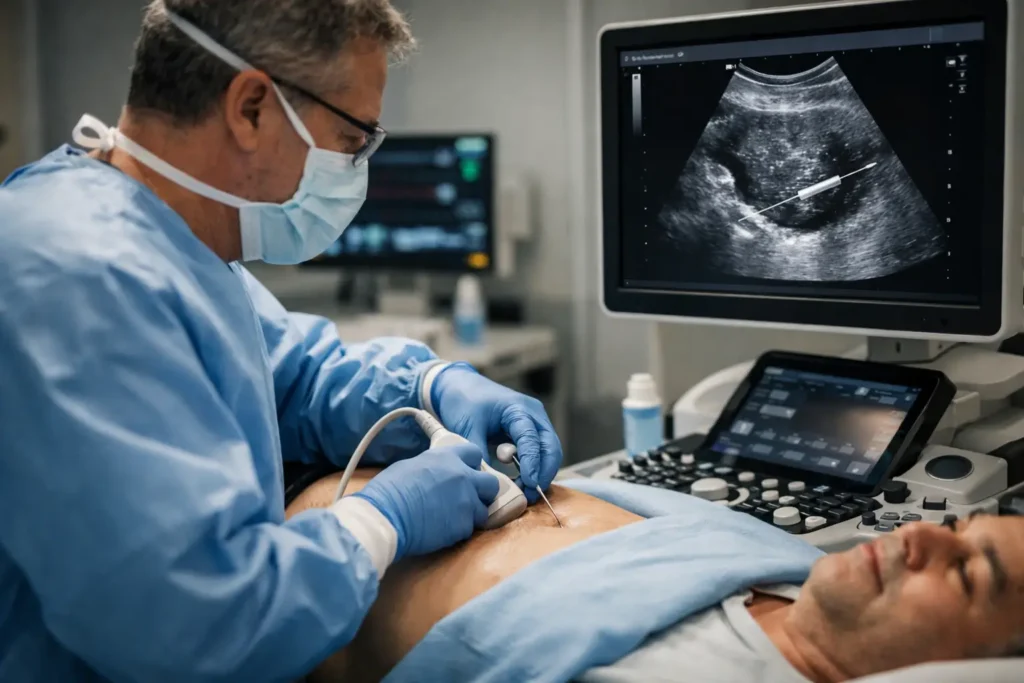
Table of Contents
What is a Biopsy Test?
A biopsy test is a medical procedure in which a small sample of tissue is removed from the body and examined under a microscope by a pathologist to determine whether abnormal, pre-cancerous, or cancerous cells are present. The word “biopsy” comes from the Greek words meaning “life” (bios) and “to see” (opsis) — literally “seeing life” at a microscopic cellular level.
A biopsy is the definitive investigation that provides a tissue diagnosis. Unlike blood tests or imaging (ultrasound, CT, MRI, PET-CT) which can identify abnormalities, a biopsy determines exactly what those abnormalities are at the cellular and molecular level — providing the information needed to guide precise, effective treatment.
Modern image-guided biopsy techniques — using real-time ultrasound or CT guidance — allow tissue samples to be taken accurately and safely from almost any organ in the body through minimally invasive needle techniques, avoiding the need for open surgery in most cases.
Types of Biopsy Tests Available in Delhi
Multiple types of biopsy procedures are performed at Edge Imaging & Diagnostics in Paschim Vihar, Delhi, each suited to different clinical situations:
- Fine Needle Aspiration Cytology (FNAC): Uses a 22–25 gauge needle to aspirate cells from superficial lumps, lymph nodes, thyroid nodules, or breast masses. Quick, minimally invasive, and provides cytological diagnosis.
- Core Needle Biopsy (CNB): Uses a 14–18 gauge spring-loaded biopsy needle to obtain tissue cylinders (cores) preserving tissue architecture — essential for histological diagnosis, grading, and immunohistochemistry.
- TRUS-guided Prostate Biopsy: Transrectal ultrasound-guided systematic sampling of the prostate gland for prostate cancer diagnosis.
- Ultrasound-guided Liver Biopsy: Percutaneous core needle biopsy of the liver for hepatitis staging, NAFLD assessment, or liver mass characterisation.
- CT-guided Biopsy: For deep lesions not visible on ultrasound — lung masses, retroperitoneal nodes, bone lesions, adrenal masses.
- Bone Marrow Biopsy: Trephine biopsy of the posterior iliac crest for haematological diagnosis — leukaemia, lymphoma, myeloma staging.
- Skin Biopsy: Punch or incisional biopsy of skin lesions for dermatological diagnosis.
- Endoscopic Biopsy: Tissue sampling during endoscopy (gastroscopy, colonoscopy, bronchoscopy) from the gastrointestinal tract or airways.
- Excisional Biopsy: Surgical removal of an entire lesion for both diagnosis and treatment — commonly used for lymph nodes.
Why is a Biopsy Test Done?
A biopsy test is performed whenever a definitive tissue diagnosis is needed. Common reasons for biopsy in Delhi include:
- Cancer diagnosis: To confirm or exclude cancer in any organ — prostate, liver, breast, kidney, lung, lymph node, bone, or soft tissue.
- Cancer staging: To determine the grade and aggressiveness of diagnosed cancer to guide treatment intensity.
- Benign disease confirmation: To confirm that a mass is benign (e.g., fibroadenoma, lipoma, haemangioma) and no further intervention is needed.
- Inflammatory conditions: Diagnosing conditions such as sarcoidosis, autoimmune hepatitis, or inflammatory bowel disease.
- Infection diagnosis: Confirming tuberculosis, fungal infections, or other chronic infections — particularly in lymph nodes and liver.
- Treatment monitoring: Assessing response to treatment — for example, repeat liver biopsy after antiviral therapy or prostate biopsy on active surveillance.
Who Needs a Biopsy Test?
You may need a biopsy test in Delhi if you have:
- A new, growing, or unusual lump or mass anywhere in the body
- Abnormal findings on ultrasound, CT, MRI, or PET-CT scan
- Elevated tumour markers (PSA, AFP, CA-125, CEA) requiring tissue confirmation
- Enlarged lymph nodes without clear infectious cause lasting more than 4 weeks
- Liver disease requiring staging (hepatitis B/C, NAFLD, autoimmune hepatitis)
- Suspected tuberculosis involving lymph nodes, liver, or other organs
- A known primary cancer with suspected spread to another organ (metastasis)
- Need to determine cancer grade and molecular markers to select targeted therapy
Symptoms That May Lead to a Biopsy
- A new or unexplained lump, swelling, or mass anywhere in the body
- Unexplained weight loss, fever, or night sweats combined with a mass
- Persistent pain in a specific body area without obvious cause
- Abnormal bleeding not explained by routine investigations
- Jaundice, abdominal distension, or right upper abdominal pain with liver findings
- Urinary symptoms combined with elevated PSA
- A skin lesion changing in size, shape, colour, or texture
Preparation Before a Biopsy Test
Preparation varies by biopsy type and site. Here are the general preparation guidelines followed at Edge Imaging & Diagnostics in Paschim Vihar, Delhi:
- Blood tests: Coagulation profile (PT/INR, platelets, aPTT) required for most core needle and organ biopsies. Results must be within safe ranges before proceeding.
- Stop blood thinners: Aspirin, warfarin, clopidogrel, and NOACs typically stopped 5–7 days before, as directed by your doctor.
- Fasting: Required for 4–6 hours before organ biopsies (liver, kidney). Not required for superficial FNAC or core biopsy of lymph nodes.
- Informed consent: You will sign a detailed consent form explaining the procedure, alternatives, and possible risks.
- Imaging: A pre-biopsy ultrasound or CT is performed to confirm the target and plan the safest approach.
- Documents: Bring all relevant imaging reports, previous biopsy reports, and your referral letter.
- Transport: Arrange for a companion to take you home after organ biopsies. You should not drive.
Step-by-Step Biopsy Test Procedure
While the exact steps vary by biopsy type and body site, the general sequence for an ultrasound-guided core needle biopsy at Edge Imaging & Diagnostics in West Delhi follows these steps:
- Patient positioning: Positioned for optimal access to the target organ or lesion.
- Pre-biopsy imaging: Ultrasound or CT used to visualise the target, plan the needle path, and identify structures to avoid.
- Skin sterilisation: The overlying skin is cleaned with antiseptic and sterile drapes applied.
- Local anaesthesia: Lidocaine injected to numb the skin, subcutaneous tissue, and tissue surrounding the target organ.
- Needle insertion: Under real-time guidance, the biopsy needle is advanced to the target lesion or organ.
- Core sampling: 2–4 tissue cores collected from the target, labelled, and placed in formalin for pathological processing.
- Needle removal and haemostasis: The needle is withdrawn and pressure applied to the puncture site.
- Post-biopsy imaging: Quick post-procedure scan to confirm no immediate complications.
- Recovery: Patient rests for 30 minutes to 2 hours depending on the site.
- Discharge: Discharged with written instructions and a contact number for any concerns.
What Happens After a Biopsy Test?
- Rest: Avoid strenuous activity for 24–48 hours after an organ biopsy.
- Pain management: Mild soreness at the biopsy site is normal. Paracetamol is recommended. Avoid aspirin and NSAIDs.
- Activity: Return to desk work in 24–48 hours; heavy lifting in 1 week.
- Warning signs: Seek immediate medical care for fever above 38°C, heavy bleeding, severe pain, or inability to breathe normally after a thoracic biopsy.
- Results: Histopathology reports take 3–7 working days depending on the biopsy type and tests ordered (routine histology, immunohistochemistry, molecular testing).
Risks and Complications of Biopsy
Modern image-guided biopsy techniques are very safe. General risks include:
- Bleeding: Minor bruising or haematoma at the biopsy site — the most common complication, usually resolving without treatment.
- Infection: Very rare with strict sterile technique. Antibiotic cover is used for prostate and certain organ biopsies.
- Organ-specific complications: Pneumothorax for lung biopsy; bile leak for liver biopsy; post-void bleeding for kidney biopsy — all managed promptly when recognised.
- Inadequate sample: Occasionally insufficient tissue obtained — a repeat procedure may then be needed.
- Allergic reaction: To local anaesthetic or contrast agent — extremely rare.
Benefits of Biopsy Test
- Provides definitive tissue diagnosis — no other test can replicate this
- Determines cancer grade and biological behaviour for accurate treatment planning
- Enables molecular and genetic profiling for targeted therapy selection
- Avoids unnecessary surgery for benign lesions confirmed on biopsy
- Guides treatment decisions across oncology, hepatology, haematology, and other specialties
- Most procedures are minimally invasive, safe, and outpatient-based
Biopsy Test Accuracy and Reliability
Biopsy is the gold standard for tissue diagnosis in medicine. The diagnostic accuracy of modern image-guided core needle biopsy ranges from 90–98% for most body sites including liver, kidney, lymph nodes, soft tissue, and prostate. At Edge Imaging & Diagnostics in Paschim Vihar, Delhi, we ensure high diagnostic yield through real-time imaging guidance, appropriate needle selection, adequate core numbers, and proper tissue triage (histology + immunohistochemistry + special stains + molecular studies as indicated).
Cost of Biopsy Test in Delhi
| Type of Biopsy | Approximate Cost in Delhi |
|---|---|
| FNAC (Palpable lesion) | ₹500 – ₹1,500 |
| Ultrasound-guided Core Biopsy (Superficial) | ₹3,000 – ₹8,000 |
| Ultrasound-guided Liver Biopsy | ₹6,000 – ₹15,000 |
| TRUS-guided Prostate Biopsy | ₹8,000 – ₹15,000 |
| CT-guided Biopsy (Deep lesion) | ₹12,000 – ₹25,000 |
| MRI-Fusion Prostate Biopsy | ₹18,000 – ₹30,000 |
At Edge Imaging & Diagnostics in West Delhi, we offer competitive biopsy test prices with complete cost transparency. We accept all major insurance and TPA cashless facilities. Patients from Paschim Vihar, Punjabi Bagh, Rajouri Garden, and across Delhi NCR are welcome.
Why Choose Edge Imaging & Diagnostics for Biopsy in Delhi?
- Full range of biopsy procedures: FNAC, core needle, TRUS, liver, CT-guided, and more
- State-of-the-art ultrasound and CT guidance for safe, accurate tissue sampling
- Experienced interventional radiologists performing hundreds of biopsies annually
- Comprehensive pathology including immunohistochemistry and molecular testing
- Fast turnaround — histopathology results in 3–7 working days
- Conveniently located in Paschim Vihar — accessible from Punjabi Bagh, Rajouri Garden, and all of Delhi NCR
- Insurance and TPA cashless accepted
- Transparent pricing with no hidden charges
- Dedicated patient support before, during, and after the procedure
Frequently Asked Questions About Biopsy Test
1. Is a biopsy test painful?
Most biopsies are performed under local anaesthesia. You will feel a brief sting from the anaesthetic injection. The biopsy needle itself is usually felt as pressure rather than pain. Most patients tolerate the procedure well as an outpatient.
2. How long does a biopsy test take?
The actual needle biopsy procedure takes 15–30 minutes. Including preparation, imaging guidance, sampling, post-procedure observation, and dressing, plan for 1–2 hours at the diagnostic centre.
3. When will I get my biopsy results?
Standard histopathology results take 3–5 working days. Additional tests like immunohistochemistry take 5–7 days. Molecular/genetic profiling may take 10–14 days. FNAC cytology results are usually available within 24–48 hours.
4. Does a biopsy confirm cancer?
Yes. A biopsy is the only test that can definitively confirm or rule out cancer. A positive biopsy showing malignant cells confirms the diagnosis. A negative biopsy showing only benign tissue provides reassurance — though a repeat biopsy may occasionally be needed if clinical suspicion remains high.
5. Is biopsy safe?
Modern image-guided biopsy is very safe with major complication rates below 1% at experienced centres. At Edge Imaging & Diagnostics in Paschim Vihar, Delhi, we follow strict pre-procedural safety protocols, use real-time imaging guidance, and have experienced teams to manage any complications promptly.
6. What is the difference between core biopsy and FNAC?
FNAC uses a fine needle to aspirate cells for cytological examination — fast, minimally invasive. Core biopsy uses a larger needle to take a tissue cylinder for histological examination — provides architectural tissue information essential for complete grading, staging, and molecular profiling.
7. Can biopsy be avoided?
In some cases, imaging features on CT, MRI, or PET-CT are characteristic enough for a diagnosis without biopsy (e.g., typical HCC on contrast MRI in a cirrhotic liver). However, for most situations, biopsy provides the definitive answer that imaging alone cannot.
8. Can a biopsy be done as an outpatient procedure?
Yes. The vast majority of biopsies — FNAC, core needle, TRUS prostate biopsy, and ultrasound-guided liver biopsy — are performed as outpatient procedures at Edge Imaging & Diagnostics in Paschim Vihar. You arrive, have the procedure, rest briefly, and return home the same day.
9. What happens if biopsy results are inconclusive?
Inconclusive biopsy results (inadequate sample, borderline findings) may require a repeat biopsy from a different site, additional immunohistochemistry tests, molecular studies, or a surgical excisional biopsy. Your radiologist and pathologist will discuss the best next step for your specific case.
10. How do I book a biopsy test in Delhi?
Book your biopsy test at Edge Imaging & Diagnostics in Paschim Vihar, West Delhi by calling our centre or visiting edgeimaging.in. Bring your referral letter, recent imaging reports, blood test results, and a list of all medications you are currently taking.
Best Diagnostic Centre for Biopsy Test in Delhi
For a safe and accurate biopsy test in Delhi, Edge Imaging & Diagnostics in Paschim Vihar, West Delhi, is the premier choice. Our centre performs all types of biopsy test in Delhi — including ultrasound-guided, CT-guided, and TRUS-guided biopsies — for patients from Punjabi Bagh, Rajouri Garden, Moti Nagar, and across Delhi NCR. When you need a reliable biopsy test in Delhi, our experienced radiologists ensure precise tissue sampling with detailed pathology reporting. Schedule your biopsy test in Delhi at Edge Imaging & Diagnostics today for expert diagnosis and compassionate care.
Medical References: For evidence-based information on biopsy procedures, refer to the National Cancer Institute (NCI) — Biopsy Fact Sheet and the Royal College of Pathologists — Histopathology Guidelines.
Conclusion
A biopsy test in Delhi is medicine’s most powerful diagnostic tool — providing the definitive tissue evidence that drives accurate diagnosis, precise staging, and personalised treatment planning across virtually all areas of medicine. Modern image-guided biopsy techniques make the procedure safer, more accurate, and less invasive than ever before.
At Edge Imaging & Diagnostics in Paschim Vihar, West Delhi, we offer the full spectrum of biopsy procedures — from FNAC to complex CT-guided deep organ biopsies — all performed by experienced interventional radiologists with a focus on patient safety and diagnostic accuracy. We serve patients from Punjabi Bagh, Rajouri Garden, Moti Nagar, and all of Delhi NCR.
Book your biopsy test in Delhi today at Edge Imaging & Diagnostics — because accurate diagnosis is the foundation of effective treatment.
Also read: Prostate Biopsy in Delhi | Liver Biopsy in Delhi | FNAC Test in Delhi | Lymph Node Biopsy in Delhi