Dog CT Scan in Delhi — Your dog’s health matters as much as your own, and modern veterinary medicine now has access to the same advanced diagnostic imaging tools used for humans. A dog CT scan (veterinary CT scan) provides detailed three-dimensional images of your dog’s internal organs, brain, spine, and bones — enabling accurate diagnosis of conditions that X-rays or ultrasound simply cannot reveal. At Edge Imaging & Diagnostics in Delhi, we offer veterinary CT scanning for dogs and cats in partnership with veterinary specialists.
Table of Contents
What Is a Dog CT Scan?
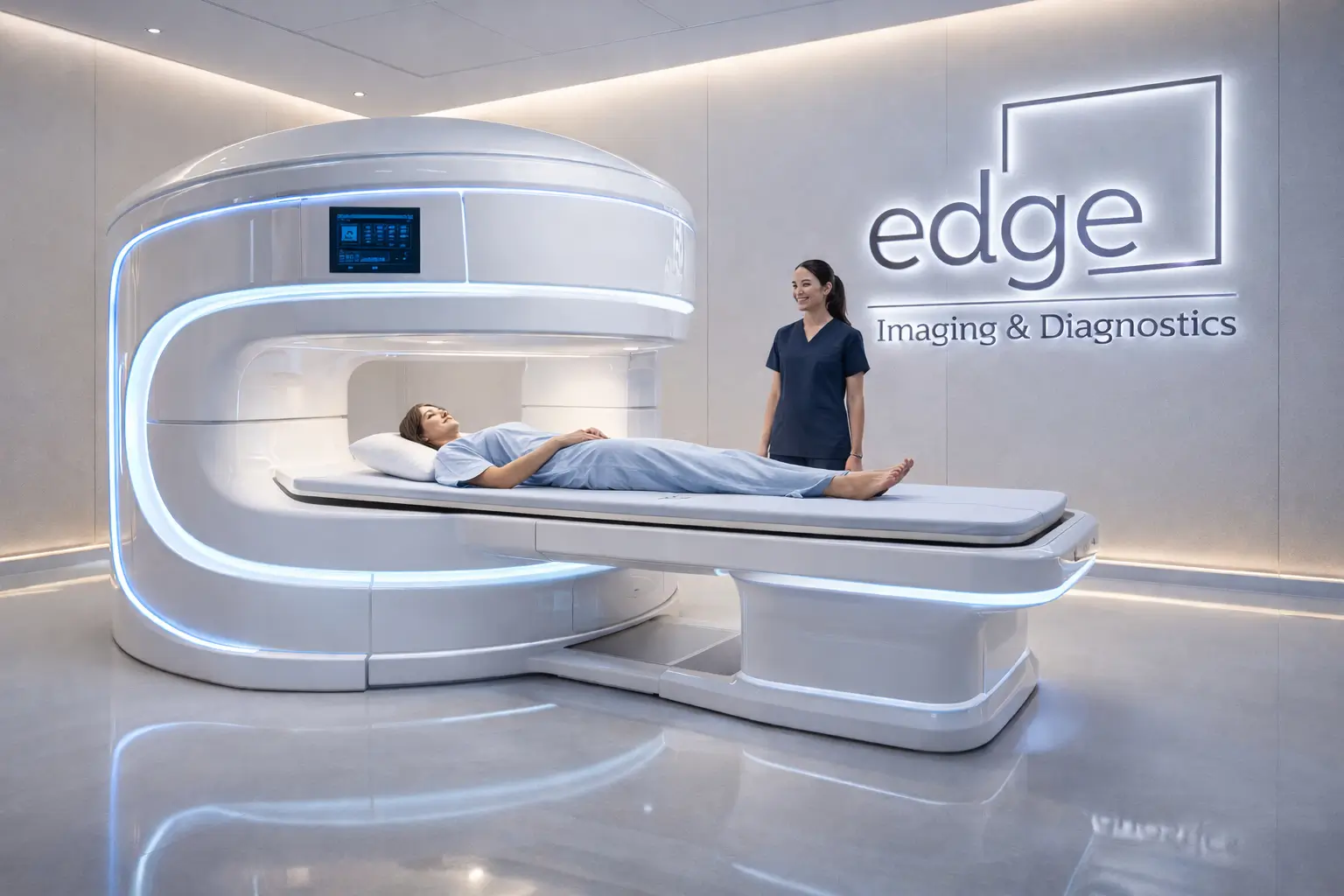
A veterinary CT (Computed Tomography) scan for dogs works exactly like a human CT scan. Your dog lies on a motorised table that passes through a doughnut-shaped scanner. Multiple X-ray beams rotate around your dog, and a computer assembles the data into detailed cross-sectional images and 3D reconstructions of internal structures. Because dogs cannot remain still for the 5–15 minutes required, they are given a short-acting general anaesthetic (or heavy sedation) for the procedure.
When Does a Dog Need a CT Scan? for Dog CT Scan in Delhi
Neurological Conditions
- Seizures or epilepsy — to detect brain tumours, malformations, or inflammatory lesions
- Disc disease (IVDD) — CT is excellent for detecting herniated intervertebral discs
- Wobbly gait or weakness (ataxia) — spinal cord compression
- Head tilt, circling — vestibular or central nervous system disease
- Suspected skull fracture after trauma
Orthopaedic Conditions
- Elbow dysplasia — CT is the gold standard for detecting fragmented coronoid process (FCP)
- Hip dysplasia — detailed joint evaluation
- Bone tumours — osteosarcoma staging, surgical planning
- Complex fractures requiring surgical planning
- Osteoarthritis — extent and distribution assessment
Chest & Abdominal Conditions
- Lung tumours or metastases — detecting cancer spread to lungs
- Nasal tumours or chronic nasal discharge — CT shows nasal cavity detail better than any other modality
- Liver, spleen, kidney masses — characterisation and surgical planning
- Adrenal gland tumours (Cushing’s syndrome)
- Bladder stones or tumours (when ultrasound is inconclusive)
- Vascular anomalies (portosystemic shunts)
Head & Neck Conditions
- Dental disease — CT dental imaging is far superior to standard dental X-rays
- Ear canal tumours or otitis media/interna
- Salivary gland mucoceles
- Retrobulbar (behind the eye) masses
- Brachycephalic airway disease (bulldogs, pugs) — airway planning
Dog CT Scan Procedure at Edge Imaging
Pre-Scan Preparation
Your dog must fast for 6–8 hours before the scan (food) and 2–4 hours (water) to reduce aspiration risk during anaesthesia. A blood test (pre-anaesthetic screen) may be required for older dogs or those with health conditions. Bring all previous X-rays, ultrasound reports, and veterinary records.
Anaesthesia
A veterinary anaesthetist administers a short-acting intravenous induction agent followed by maintenance anaesthesia via gas (isoflurane) through an endotracheal tube. Vital signs (heart rate, oxygen saturation, blood pressure, temperature) are monitored continuously throughout.
The CT Scan
Once your dog is anaesthetised and positioned on the table, the CT scan takes only 5–15 minutes to acquire images. Contrast medium (iodinated contrast) may be administered intravenously to highlight blood vessels, tumours, and inflammatory lesions.
Recovery
Your dog recovers from anaesthesia in a warm, supervised environment. Most dogs are fully awake within 30–60 minutes and can go home the same day. Post-anaesthetic instructions will be provided.
Dog CT Scan vs Dog X-Ray vs Dog MRI
X-Ray
Fast, widely available, no anaesthesia needed for cooperative dogs. Shows bone detail and major soft tissue outlines. Misses subtle bone changes, brain/spinal cord disease, and soft tissue tumours. Best for: routine fractures, dental X-rays, chest screening.
Ultrasound
No anaesthesia, real-time, portable. Excellent for abdominal organs (liver, spleen, kidneys, bladder). Cannot visualise brain, spinal cord, or bone cortex. Best for: abdominal organs, guided aspiration.
CT Scan
Requires anaesthesia. Excellent for bones, lungs, soft tissue, and abdominal organs. 3D reconstruction for surgical planning. Best for: bone disease, lung mets, nasal tumours, orthopaedic planning.
MRI
Requires anaesthesia. Best for: brain, spinal cord, soft tissue tumours. Gold standard for neurological conditions. Takes longer than CT.
Dog CT Scan Cost in Delhi 2026
Dog CT scan cost in Delhi depends on the body region scanned and whether contrast is used. At Edge Imaging, veterinary CT scans are priced at ₹8,000–₹20,000 per study depending on region and protocol. This includes anaesthesia monitoring, contrast medium if needed, and the radiology report reviewed by a veterinary imaging specialist.
What Breeds Benefit Most from CT Scanning? for Dog CT Scan in Delhi
- Brachycephalic breeds (Bulldog, Pug, Shih Tzu, French Bulldog): airway, nasal, and dental disease
- Large breeds (Labrador, Golden Retriever, German Shepherd): elbow dysplasia, hip disease, bone cancer
- Chondrodystrophic breeds (Dachshund, Beagle, Basset Hound): IVDD (disc disease)
- Older dogs of any breed: cancer screening, dental disease, organ tumours
- Working/police dogs: trauma assessment, joint disease
Frequently Asked Questions
Q1. Is CT scan safe for dogs?
Yes — the CT scan itself is completely safe. The main consideration is the general anaesthesia required for most dogs. Modern veterinary anaesthesia is very safe, and risk is minimised with pre-anaesthetic screening and continuous monitoring.
Q2. How long does dog CT scan take?
CT scanning: 5–15 minutes. Induction and recovery from anaesthesia: 30–60 minutes each. Total visit: approximately 2–3 hours.
Q3. Can my dog have CT without general anaesthesia?
A very small number of extremely calm, trained dogs may tolerate CT without full anaesthesia. However, any movement during the scan degrades image quality to the point of being non-diagnostic. Heavy sedation or general anaesthesia is required in the vast majority of cases.
Q4. How do I prepare my dog for CT scan?
Fast your dog for 6–8 hours (food) and 2–4 hours (water) before the appointment. Bring your dog on a leash or in a carrier. Bring all veterinary records, previous imaging, and your vet’s referral letter.
Q5. What age can a dog have a CT scan?
Dogs of any age can have CT scans. Very young puppies (<8 weeks) and very old or systemically unwell dogs require extra anaesthetic precautions.
Q6. Will my dog get a report after the CT scan?
Yes — at Edge Imaging, CT images are reviewed by a radiologist experienced in veterinary imaging, and a detailed written report is provided, which your veterinarian will then discuss with you.
Q7. Does my dog need a referral for CT scan?
A veterinarian’s referral with clinical history is recommended for optimal scan protocol planning. Walk-ins are welcome but please call ahead so we can prepare the appropriate scanning protocol.
Q8. Where can I get a dog CT scan in Delhi?
Edge Imaging & Diagnostics in West Delhi offers veterinary CT scanning for dogs and cats. Contact us to schedule your pet’s appointment and discuss their specific clinical needs.
Book Dog CT Scan at Edge Imaging Delhi
Your pet deserves world-class diagnostic care. Edge Imaging’s veterinary CT service provides the same advanced imaging quality used for human patients — delivering accurate diagnoses that help your vet provide the best possible treatment.
📍 Locations: Tagore Garden | Paschim Vihar | Moti Nagar | New Multan Nagar
✅ NABH Accredited | CGHS & DGHS Empanelled | Same-Day Reporting
📞 Call or WhatsApp to book your appointment today.
For more information, explore our related guide: Dog MRI Scan in Delhi
For more information on this procedure, refer to the World Health Organization (WHO) guidelines on medical procedures.
Medical Disclaimer: This article is for educational purposes only. Always consult a qualified medical professional for diagnosis and treatment advice.