
 PV
PV TG
TG MN
MN EM
EM EI
EI ND
ND
 CT Scan
 PET CT
 Digital X-ray
 Ultrasound
 Amniocentesis
 Fetal Reduction
 Thermalytix Breast Screening
 Cardiology
 Lab Tests
 GAMCA Pre-Medical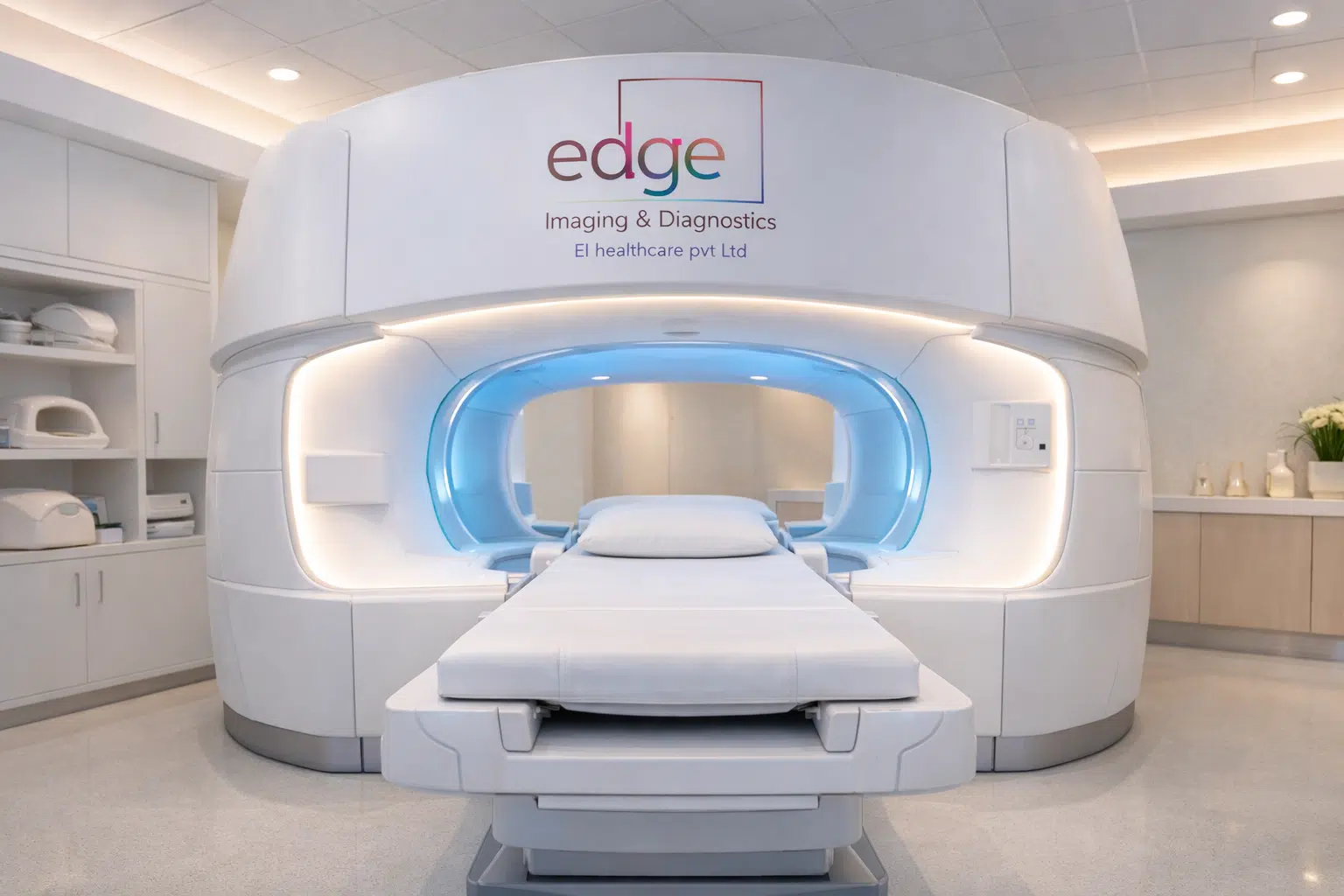
CT Scan: Everything You Need to Know About This Life-Saving Diagnostic Tool
What a CT scan actually shows, when contrast is needed and why your kidney function is checked first, how much radiation is involved in plain numbers, and what a CT still cannot tell your doctor. You are on the table for about ten minutes.
A CT scan is the test doctors reach for when they need to see inside the body quickly and in detail — after an accident, when a chest X-ray is not clear enough, when a stone or a bleed has to be found in minutes. It is also the test people are most anxious about, usually because of two things nobody explained properly: the contrast injection and the radiation.
This Edge Imaging & Diagnostics guide covers both honestly, along with what the scan can and cannot show. If you already know which scan you need and only want the rate, that is on the CT scan prices page.
Looking for the price of a particular CT scan? Head, chest, abdomen, KUB, angiography and the rest are each listed with their own rate on the CT scan page. This guide explains the test itself.
What is a CT Scan?
A CT (Computed Tomography) Scan is an advanced imaging test that uses X-rays and computer technology to create detailed cross-sectional images of the body. Unlike a standard X-ray that shows a flat 2D image, a CT scan provides a 3D view of your bones, organs, and soft tissues, allowing doctors to detect issues with high precision.
The simplest way to picture the difference: an X-ray is one shadow of your whole chest, with the ribs, lungs and heart overlapping each other. A CT is a stack of thin slices through the same chest, each one showing a single level with nothing in front of it. That is why a shadow on a chest X-ray so often ends with the doctor asking for a CT — the shadow is real, but only slices can say what it is and exactly where it sits.
How Does a CT Scan Work?
During a CT Scan, the patient lies on a table that slides into a donut-shaped scanner. The scanner rotates around the patient, sending X-rays through the body. These rays are then picked up by detectors, and a computer creates detailed images from the signals.
Two things surprise most people. First, the scanner is a ring, not a tunnel — only a short section of you is inside it at any moment, and both ends are open, so a CT is far easier than an MRI if you dislike enclosed spaces. Second, it is quiet. You hear a fan and a soft whirr as the ring spins, nothing like the hammering of an MRI.
The actual X-ray exposure lasts seconds. Almost all of your time in the room goes on positioning you correctly and, when contrast is being used, placing the cannula.
Why is a CT Scan Important?
CT Scans are crucial in diagnosing and managing a variety of medical conditions. They provide vital insights that help in:
-
Detecting tumors or cancers
-
Assessing traumatic injuries (e.g., internal bleeding, fractures)
-
Planning surgeries
-
Monitoring the effectiveness of treatments (especially cancer therapies)
-
Detecting infections, blood clots, and blockages
-
Guiding biopsies or other medical procedures
Speed is the reason CT dominates emergencies. A head CT after a fall or a suspected stroke takes minutes and answers the one question that changes treatment immediately: is there bleeding inside the skull? An MRI would show more, but it takes far longer, and in those minutes the answer matters more than the extra detail.
Types of CT Scans
CT technology can scan various parts of the body. Common types include:
-
Head CT: Used to detect brain injuries, strokes, tumors, or bleeding.
-
Chest CT: Helps assess lungs, heart, or chest injuries.
-
Abdomen and Pelvis CT: Detects organ problems like kidney stones, infections, or tumors.
-
CT Angiography: Visualizes blood vessels and detects blockages or aneurysms.
-
Low-dose CT: Commonly used in lung cancer screenings for smokers.
A few names you may see written on your prescription that are variations of the above:
-
HRCT Chest — a high-resolution chest CT with very thin slices, used for lung tissue itself: fibrosis, interstitial disease, bronchiectasis, and the lung changes seen after infections.
-
CT KUB — kidneys, ureters and bladder, done without contrast. This is the standard test for renal stones and is usually the fastest way to explain sudden severe flank pain.
-
CT PNS — the paranasal sinuses, for long-standing sinusitis and before sinus surgery.
-
Contrast-enhanced CT (CECT) — any of the above done with an iodine-based dye injected into a vein, covered in the next section.
Which one you need is written by your treating doctor, and the difference matters: a CT KUB and a CECT abdomen look at the same region but answer different questions, cost differently, and only one of them needs a blood test first. If the prescription is unclear, send us a photo before you come in and we will confirm exactly which study is being asked for.
CT scan with contrast — and why we ask for a kidney test first
Contrast is an iodine-based liquid given through a small cannula in your arm. Blood carrying it lights up brightly on the images, so blood vessels, the walls of the bowel, and the blood supply of a tumour or an abscess become visible in a way they simply are not on a plain scan. Some studies — CT angiography above all — cannot be done without it.
What it feels like is worth knowing in advance, because it alarms people who were not told: as the injection runs you feel a wave of warmth spreading through the body, often a metallic taste, and a strong sensation of having passed urine even though you have not. All three are normal, last under a minute, and are not an allergic reaction.
Before a contrast study we ask for a recent serum creatinine. Iodinated contrast is cleared by the kidneys, so if kidney function is already reduced, the dose and the decision to inject at all need to be reviewed by the radiologist. This is not a formality; it is the single most important safety check in the whole process. Tell us as well if you:
-
have ever reacted to X-ray contrast dye before — a rash, wheezing, swelling or fainting during a previous scan;
-
are asthmatic, or have significant allergies;
-
take metformin for diabetes — your doctor may advise pausing it around the scan;
-
have thyroid disease, kidney disease, or are on dialysis;
-
are pregnant, or think you might be.
Serious reactions to modern contrast agents are uncommon, but they are not impossible, which is why the injection is given where staff and emergency drugs are present rather than anywhere else in the building. A plain CT needs none of this — if your prescription says CT KUB or a plain head CT, you can simply walk in.
How to prepare for a CT scan
-
Plain CT — no preparation. Eat normally, take your usual medicines, walk in.
-
Contrast CT — stay empty stomach for about four hours beforehand, though you should keep drinking water. Bring your creatinine report, or come early enough for us to do it.
-
Do not stop prescribed medicines on your own. Take them with a sip of water unless your own doctor, or ours after seeing your reports, has told you otherwise. Metformin is the usual exception and that instruction should come from a doctor, not from a website.
-
Wear something without metal near the area being scanned. Zips, hooks, chains, coins and belts create bright streaks across the images. You may be given a gown.
-
Bring your previous films and reports, especially any earlier CT or MRI of the same region. Comparison is often what turns a cautious report into a confident one.
-
Tell us if you are pregnant or might be, before anything else is done.
For an abdominal study you may be asked to drink an oral contrast solution over an hour before the scan. It tastes bland rather than unpleasant, and it outlines the bowel so it is not mistaken for something else.
What happens during the scan
You lie on a narrow table, usually on your back, and the technologist positions you with the help of a light line. If contrast is being used, a cannula goes into a vein in the arm at this point.
The table then moves slowly through the ring while the scan runs. For chest and abdominal studies you will be asked to hold your breath for a few seconds at a time — this is the only thing you actively have to do, and it matters, because breathing blurs the slices. The instructions come through a speaker and the staff can see and hear you throughout.
A plain scan is over in about five to ten minutes from the time you lie down. With contrast, allow twenty to thirty minutes, since images are usually taken before the injection and again at set intervals afterwards. Nothing hurts apart from the pinprick of the cannula.
Afterwards you can eat, drive and go back to work immediately. If you were given contrast, drink plenty of water through the rest of the day to help your kidneys clear it.
Radiation in a CT scan — the honest numbers
A CT scan uses X-rays, so it does involve a real radiation dose, and it is a larger dose than a plain X-ray. Nobody is served by pretending otherwise. The useful thing is the scale.
-
A chest X-ray is roughly 0.02 mSv.
-
A head CT is in the region of 2 mSv.
-
A chest CT is in the region of 7 mSv.
-
An abdomen and pelvis CT is in the region of 8–10 mSv.
-
Natural background radiation, from the ground and the air, gives everyone about 2–3 mSv every year without anyone doing anything.
So a chest CT is somewhere near two to three years of ordinary background exposure, delivered in seconds. For a person with a symptom their doctor needs explained, that is a small price for an answer. For a person with no symptoms who wants a scan out of curiosity, it is not — and that is the whole reason CT is prescribed rather than sold over the counter.
Dose is kept as low as the diagnosis allows: the scanned length is limited to the region asked for, protocols are adjusted for children and thin adults, and low-dose protocols are used where they are adequate. If you have had several CT scans recently, say so; comparing an existing scan is sometimes better than repeating one.
CT scan vs MRI vs X-ray — which one does your doctor need?
These three are not ranked from worse to better. They answer different questions, and the right one is the one that answers yours.
-
X-ray — fastest and lowest dose. First choice for fractures, chest infections and a general look at bones and lungs.
-
CT — unmatched for bone detail, fresh bleeding, stones, lung tissue, and any emergency where the answer is needed in minutes. Uses X-rays.
-
MRI — unmatched for soft tissue: brain and spinal cord detail, ligaments and cartilage in joints, discs, and the internal structure of many tumours. Uses no radiation at all, but takes far longer and cannot be done with certain implants.
Two practical examples. A knee injury: CT shows the bone beautifully but tells you little about the torn ligament, so an MRI is usually the correct test. A sudden severe headache: CT is done first, because ruling out fresh bleeding fast is what changes treatment that hour.
If you are choosing between them on your own, do not — take the prescription back to the doctor who wrote it. If you would like to compare the options we offer, see MRI, digital X-ray and ultrasound.
What a CT scan cannot tell you
Being clear about the limits is part of reading the report properly.
-
A CT cannot always say whether something is cancer. It shows size, shape, position and blood supply. Distinguishing a tumour from an infection, tuberculosis or scar tissue often needs a biopsy, and in India tuberculosis mimics malignancy on imaging often enough that this caution is not theoretical.
-
It shows structure, not function. A kidney can look entirely normal on CT while working poorly, which is why blood tests are not replaced by scans.
-
Soft tissue detail is limited compared with MRI — ligaments, cartilage, discs and the fine structure of the brain and spinal cord are MRI territory.
-
A normal CT does not rule out every disease. Early inflammation, small lesions and many functional disorders can be invisible. A normal report means nothing was seen on these images, not that nothing is wrong.
-
Incidental findings are common. Small cysts, nodules and calcifications turn up in healthy people and are reported because they are visible, not because they are dangerous. Your doctor decides which ones need anything done.
Your report, and what happens next
Images are read and reported by a radiologist, not by the machine and not by the technologist in the room. Routine scans are reported the same day; complex studies, comparisons with older films and cases discussed with the referring doctor can take longer, and we will tell you the expected time when you book. Reports can be sent on WhatsApp.
Take the report and the images back to the doctor who ordered the scan. A radiology report describes what is visible and gives an opinion on what it is most likely to be; it is one input into a diagnosis rather than the diagnosis itself, and it is written in the expectation that the treating doctor will read it alongside your symptoms and blood tests.
Keep the film and the CD. The single most useful thing at any future scan is the previous one.
CT scans — common questions
Is a CT scan painful?
No. You lie still on a table and the scanner ring passes around you without touching you. The only sensation is the pinprick of the cannula if contrast is being given, and the brief wave of warmth as that injection runs. There is nothing to feel from the X-rays themselves.
How long does a CT scan take?
A plain CT takes about five to ten minutes from lying down to getting up, and the X-ray exposure itself lasts only seconds. A contrast study takes twenty to thirty minutes, because images are taken before the injection and again at set intervals after it.
Do I need to be empty stomach for a CT scan?
Only for contrast studies, where about four hours without food is advised — keep drinking water. Plain scans such as a CT KUB or a plain head CT need no fasting at all. Do not stop your prescribed medicines to fast unless a doctor has specifically told you to.
Why do I need a creatinine test before a CT scan with contrast?
Because the iodine-based contrast is cleared by your kidneys. Serum creatinine tells the radiologist how well they are working, so the dose can be adjusted or the injection reconsidered if function is reduced. It is the main safety check before a contrast study, which is why it is asked for even when you feel perfectly well.
How much radiation does a CT scan involve? Is it safe?
It is a real dose, larger than an X-ray. A head CT is around 2 mSv, a chest CT around 7 mSv and an abdomen-pelvis CT around 8 to 10 mSv, against roughly 2 to 3 mSv of natural background radiation everyone receives each year. For someone with a symptom that needs explaining, that dose is a reasonable trade for a clear answer, which is why CT is done on a doctor’s advice and not out of curiosity.
Can I have a CT scan during pregnancy?
CT is generally avoided in pregnancy unless the information cannot be obtained any other way and is genuinely needed. Ultrasound or MRI is usually preferred instead. Tell the staff before anything is done if you are pregnant or think you might be, so the referring doctor and the radiologist can decide together.
What is the difference between a CT scan and an MRI?
CT uses X-rays and is fastest and best for bone, fresh bleeding, stones and lung tissue. MRI uses no radiation and is better for soft tissue — brain and spinal cord detail, ligaments, cartilage and discs — but takes far longer and is not possible with certain implants. They answer different questions, so the choice belongs to your treating doctor.
Can a CT scan detect cancer?
It can find a mass and describe its size, position and blood supply, and it is central to staging and to monitoring treatment. It cannot by itself confirm that a mass is cancer, because infection, tuberculosis and scar tissue can look similar. Confirmation usually needs a biopsy, and sometimes further imaging such as a PET-CT.
Will I feel claustrophobic in a CT scanner?
Far less than in an MRI. A CT scanner is an open ring rather than a tunnel, only a short section of you is inside it at a time, and both ends are open. Most people who cannot tolerate an MRI manage a CT without difficulty.
How much does a CT scan cost in Delhi?
It depends on the region being scanned and on whether contrast is used, so a single figure would be misleading. Our rate for each CT study is listed on the CT scan page. Because most prescriptions specify a particular study, the quickest way to get your exact price is to send a photo of the prescription to 9555999960 on WhatsApp and we will reply with the rate, whether you need to be empty stomach, and the earliest slot.
Have a CT scan prescription in hand? Send us a photo on WhatsApp — we will confirm the exact study, today’s price, whether you need to be empty stomach or bring a creatinine report, and the earliest slot.