
CT-guided biopsy is one of the most important advances in modern diagnostic medicine. It allows doctors to obtain tissue samples from deep-seated masses — in the lungs, liver, kidneys, retroperitoneum, mediastinum, or spine — without surgery, using a thin needle guided by CT scanning. At Edge Imaging & Diagnostics in Delhi, we perform CT-guided biopsies using our state-of-the-art 128-slice CT scanner to deliver accurate diagnoses with minimal patient discomfort.
Table of Contents
What Is CT-Guided Biopsy?
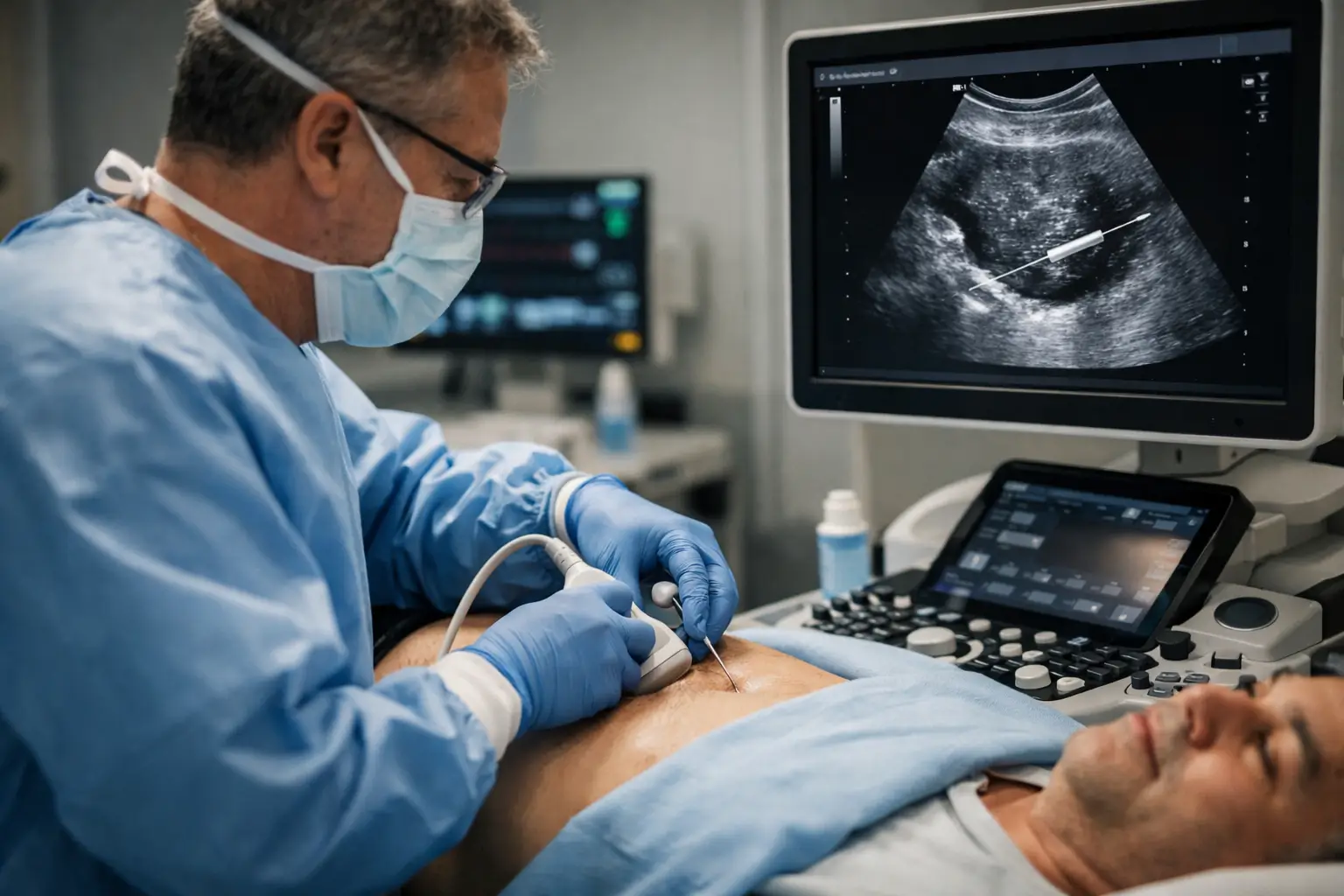
CT-guided biopsy is a minimally invasive procedure in which a biopsy needle is inserted into a target lesion using real-time CT (Computed Tomography) scanning for guidance. The CT scanner creates detailed cross-sectional images that show precisely where the needle tip is at all times, allowing the radiologist to navigate safely through surrounding tissues and vital structures to reach the target.
Why CT Guidance Instead of Ultrasound? for CT-Guided Biopsy in Delhi
When Ultrasound Cannot See the Lesion
Ultrasound cannot visualise lesions hidden behind bones (spine, ribs), air-filled structures (lungs), or very deep in the abdomen. CT imaging penetrates all body parts and provides superior detail for deep lesions.
When Precise Depth and Angle Calculation Is Critical
CT shows the exact three-dimensional coordinates of a lesion. The radiologist calculates the precise depth, angle, and approach to ensure the needle enters the lesion without touching vessels, nerves, or organs. This level of precision is not possible with ultrasound alone.
Conditions Diagnosed by CT-Guided Biopsy
- Lung masses or pulmonary nodules suspicious for cancer
- Liver masses or hepatocellular carcinoma
- Kidney tumours — renal cell carcinoma diagnosis
- Retroperitoneal masses — lymphoma, sarcoma, metastases
- Adrenal masses — adrenal cortical carcinoma, metastasis
- Bone lesions — primary bone tumours or metastases
- Mediastinal masses — thymoma, lymphoma, germ cell tumours
- Pancreatic masses (when endoscopic approach not suitable)
- Spinal lesions — vertebral tumours or infections
- Pleural masses — mesothelioma, metastatic pleural disease
CT-Guided Biopsy Procedure Step-by-Step
Step 1: Pre-Biopsy CT Planning Scan
A planning CT scan is performed to precisely locate the lesion and plan the needle path. The radiologist selects the safest entry point and calculates the exact angle and depth required.
Step 2: Patient Positioning
You are positioned on the CT table in the optimal position to access the lesion (back, front, or side depending on lesion location). Monitoring equipment is attached (oxygen saturation, blood pressure).
Step 3: Skin Preparation & Local Anaesthesia
The skin at the planned entry point is cleaned with antiseptic. A small amount of local anaesthetic (lignocaine) is injected to numb the skin and underlying tissue — making the procedure comfortable.
Step 4: Needle Insertion with CT Verification
The biopsy needle is inserted through the skin. A CT scan is obtained to verify the needle position relative to the target. The needle is advanced in increments with repeated CT scans confirming position until the tip is inside the lesion.
Step 5: Tissue Sampling
Once the needle tip is confirmed inside the target lesion, tissue is obtained. For FNAC: suction aspiration. For core biopsy: a spring-loaded mechanism fires to capture a small tissue core. Multiple samples (2–4) are taken to ensure adequacy.
Step 6: Post-Procedure CT
A final CT scan is obtained immediately after the procedure to check for any immediate complications (e.g., pneumothorax for lung biopsies, haematoma). You are monitored for 1–2 hours before discharge.
CT-Guided Biopsy: What to Expect on the Day
- Wear comfortable, loose-fitting clothing
- Fast for 4–6 hours before the procedure
- Stop blood thinners 5–7 days before (as instructed by your doctor)
- A family member or companion should accompany you
- The procedure takes 30–60 minutes; total hospital time is 2–3 hours
- No sedation needed in most cases; mild sedation available on request
- You can go home the same day in most cases
CT-Guided Biopsy Cost in Delhi 2026
Price at Edge Imaging
CT-guided FNAC: ₹3,000–₹6,000. CT-guided core needle biopsy: ₹6,000–₹12,000. All-inclusive: CT guidance, procedure, and pathology. CGHS/DGHS rates applicable.
Why Edge Imaging Is More Affordable
Large private hospitals in Delhi charge ₹15,000–₹30,000 for the same CT-guided biopsy. As a dedicated diagnostic centre with efficient operations and doctor-led procedures, Edge Imaging delivers identical quality at 40–60% lower cost.
CT-Guided Biopsy Risks
- Bleeding/haematoma: Small risk, managed with pressure. Significant bleeding is rare (<1%)
- Pneumothorax: Air leak after lung biopsy occurs in 15–20% but requires treatment in only 3–5%
- Infection: Rare (<0.5%) with proper sterile technique
- Pain: Mild to moderate, managed with oral pain relief
- Non-diagnostic sample: Occurs in 5–10%; may require repeat procedure
Frequently Asked Questions for CT-Guided Biopsy in Delhi
Q1. Is CT-guided biopsy safe?
CT-guided biopsy is a well-established, safe procedure with complication rates below 5% in experienced centres. Serious complications are rare. The risk-to-benefit ratio is highly favourable compared to surgical biopsy.
Q2. How long does CT-guided biopsy take?
The needle procedure itself takes 30–60 minutes. Including preparation and post-procedure monitoring, expect to spend 2–3 hours at the centre.
Q3. Can I go home after CT-guided biopsy?
Yes — most CT-Guided Biopsy in Delhi procedures are outpatient. You are monitored for 1–2 hours after the procedure and discharged the same day if no complications develop.
Q4. When will CT biopsy results be available?
FNAC results: 24–48 hours. Core needle biopsy: 3–5 working days. Immunohistochemistry (IHC) staining for subtyping: additional 3–5 days.
Q5. Do I need to be hospitalised for CT-guided biopsy?
No, in most cases. CT-guided biopsy is performed as a day procedure. Hospitalisation may be required for very complex deep biopsies or in patients with higher bleeding risk.
Q6. Can I eat before CT-guided biopsy?
Fast for 4–6 hours before your procedure. This is a safety precaution in case sedation is needed. Clear fluids (water, clear juice) are usually permitted up to 2 hours before.
Q7. Does CT-guided biopsy hurt?
Local anaesthetic makes the procedure comfortable. You may feel pressure and mild discomfort as the needle advances, but significant pain is uncommon. Post-procedure soreness is managed with standard oral pain relief.
Q8. What is the best CT-guided biopsy centre in Delhi?
Edge Imaging & Diagnostics uses a 128-slice CT scanner with interventional radiology capabilities. Our team of specialist radiologists perform CT-Guided Biopsy in Delhi — CT-guided biopsies daily with same-day or next-day reporting and free post-procedure consultation.
Book CT-Guided Biopsy at Edge Imaging Delhi
Get a definitive diagnosis with CT-Guided Biopsy in Delhi at Edge Imaging — without surgery with precision, safety, and compassion — so you get answers fast and can start treatment without delay.
📍 Locations: Tagore Garden | Paschim Vihar | Moti Nagar | New Multan Nagar
✅ NABH Accredited | CGHS & DGHS Empanelled | Same-Day Reporting
📞 Call or WhatsApp to book your appointment today.
For more information, explore our related guide: Biopsy Test in Delhi
For more information on this procedure, refer to the World Health Organization (WHO) guidelines on medical procedures.
Medical Disclaimer: This article is for educational purposes only. Always consult a qualified medical professional for diagnosis and treatment advice.