Cat MRI Scan in Delhi — Feline MRI is the most powerful diagnostic tool available for cats with neurological symptoms — seizures, sudden blindness, progressive paralysis, or unexplained behavioural changes. While cats share many diseases with dogs, their unique physiology and susceptibility to specific conditions (like ischaemic encephalopathy, hyperthyroid-related changes, and intracranial lymphoma) makes feline MRI interpretation a specialised field. Edge Imaging & Diagnostics in Delhi offers veterinary MRI for cats using our advanced wide-bore MRI system.
Table of Contents
Why Cats Often Need MRI for Cat MRI Scan in Delhi
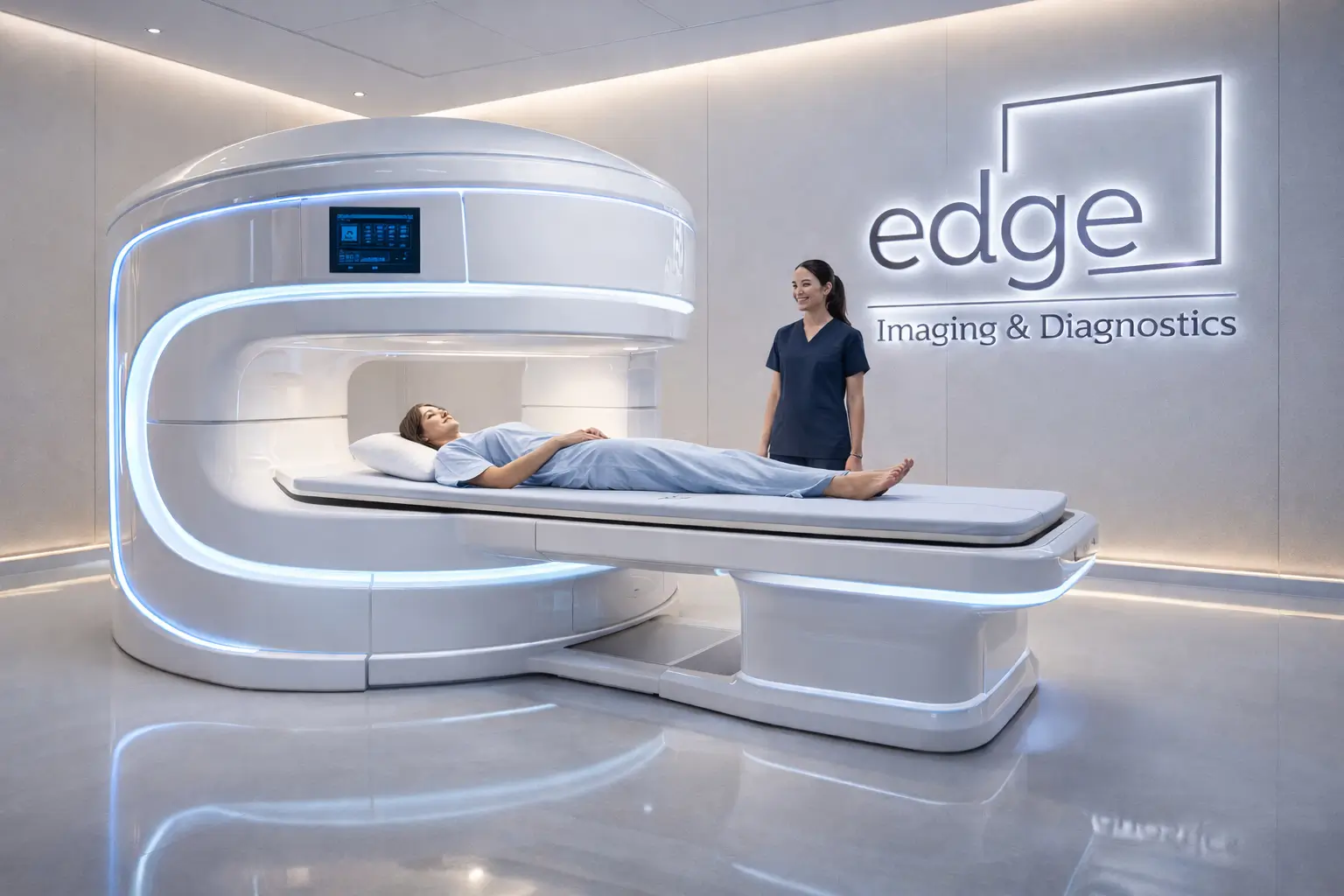
Cats are the ultimate stoics — they rarely show obvious neurological signs until disease is quite advanced. When symptoms do appear (seizures, head tilt, sudden blindness, progressive hindlimb weakness), the cause can be challenging to determine without advanced imaging. MRI gives veterinarians a definitive picture of what is happening inside the brain and spinal cord.
Medical Conditions in Cats That Require MRI for Cat MRI Scan in Delhi
Brain Disease
- Feline meningioma — the most common brain tumour in cats. Well-defined, surgically accessible in many cases
- Feline ischaemic encephalopathy (FIE) — caused by Cuterebra larval migration
- Intracranial lymphoma — high-grade brain lymphoma in cats
- Feline infectious peritonitis (FIP) — granulomatous brain lesions
- Cryptococcosis — fungal infection causing granulomas
- Thiamine deficiency — metabolic encephalopathy with distinct MRI changes
- Hydrocephalus
- Vascular accident (feline stroke)
Spinal Cord Disease
- Intervertebral disc disease (IVDD) — less common than in dogs but does occur
- Spinal lymphoma — diffuse or focal cord compression
- Discospondylitis — vertebral infection
- Feline aortic thromboembolism (FTE) — ischaemic myelopathy from aortic saddle thrombus
- Spinal meningioma
Inner Ear Disease
- Vestibular syndrome — differentiating peripheral (inner ear) from central (brain) disease
- Nasopharyngeal polyps extending to middle ear
- Otitis media/interna — inflammatory middle ear disease
Cat MRI Procedure at Edge Imaging
Feline Anaesthesia
Cats are the most anaesthetic-sensitive common veterinary patient. Our protocol uses a combination of an alpha-2 agonist (medetomidine) and ketamine or alfaxalone for induction, followed by isoflurane maintenance. Fluid support, active warming, capnography, and blood pressure monitoring are provided throughout.
MRI Protocol for Cats
Standard brain protocol: T2, T1 (pre and post-gadolinium), FLAIR, DWI. Spinal protocol: Sagittal and axial T2 through affected segments. Total scan time for brain: 25–45 minutes. Full brain + spinal: 45–75 minutes.
Special Feline Considerations
Cats are prone to hypothermia during anaesthesia — we use active warming blankets throughout. Feline tracheas are narrow — endotracheal tubes are carefully sized to prevent mucosal damage. Recovery is in a warm, dark, quiet environment as cats are stressed by bright light and noise post-anaesthesia.
Cat MRI Cost in Delhi 2026
Brain only: ₹10,000–₹18,000. Brain + cervical spine: ₹16,000–₹26,000. Full spine: ₹18,000–₹30,000. Prices include anaesthesia monitoring, gadolinium contrast if required, and expert radiology report.
Common Feline MRI Findings
- Meningioma: Well-defined, strongly contrast-enhancing mass. Often at the convexity or olfactory bulb. Surgical removal can provide months to years of quality life.
- Ischaemic encephalopathy (FIE): Wedge-shaped non-enhancing lesion in grey matter. Caused by Cuterebra larval migration.
- FIP (Feline Infectious Peritonitis): Periventricular contrast enhancement, hydrocephalus, meningeal enhancement.
- Thiamine deficiency: Symmetric T2 hyperintensity in vestibular nuclei and caudal colliculi.
- Stroke: DWI shows restricted diffusion. T2/FLAIR shows oedema in acute phase.
- Spinal lymphoma: Extradural or intradural enhancing mass causing cord compression.
After Cat MRI: What to Expect
- Mild drowsiness for several hours is normal
- Hypothermia risk — keep warm for 12 hours post-scan
- Do not feed for 2 hours post-anaesthesia
- Keep indoors and supervise
- Contact your vet if: vomiting, weakness, abnormal eye movements, or distress
Frequently Asked Questions
Q1. Is cat MRI safe?
The MRI itself is completely safe — no radiation, no adverse tissue effects. The main consideration is anaesthesia. Feline anaesthesia in experienced hands with proper monitoring is safe for the vast majority of cats.
Q2. Can a cat with heart disease have MRI?
Cats with hypertrophic cardiomyopathy (HCM) — the most common feline heart disease — can often have MRI with appropriate precautions and cardiac monitoring. A pre-anaesthetic echocardiogram helps risk stratification.
Q3. My cat had a seizure — should I get an MRI immediately?
After a seizure, stabilise your cat with your veterinarian first. If seizures are ongoing or recurring, or if the neurological examination is abnormal, MRI is recommended to identify the cause. A single generalised seizure in a young-middle aged cat is less urgent than a focal seizure or one associated with abnormal neurological examination.
Q4. What is feline meningioma and can it be treated?
Meningioma is the most common brain tumour in cats. It is a slow-growing tumour arising from the brain’s covering membranes. Surgery can provide excellent quality of life for 1–3+ years in many cases. MRI is essential for surgical planning — confirming location, size, and blood supply.
Q5. Can MRI detect FIP in cats?
Yes — FIP (feline infectious peritonitis) causing neurological signs has characteristic MRI findings: periventricular enhancement, leptomeningeal enhancement, and hydrocephalus. Combined with clinical signs and laboratory tests (albumin:globulin ratio, feline coronavirus antibody titres), MRI supports FIP diagnosis.
Q6. How do I prepare my cat for MRI?
Fast for 4–6 hours. Bring all veterinary records and previous imaging. Bring your cat in a secure carrier for the Cat MRI Scan in Delhi. Inform Edge Imaging if your cat has any health conditions, medications, or prior surgeries.
Q7. Where can I get cat MRI in Delhi?
Edge Imaging & Diagnostics in West Delhi offers Cat MRI Scan in Delhi using our state-of-the-art wide-bore MRI system with expert feline anaesthesia and continuous monitoring.
Q8. What if my cat’s MRI shows a brain tumour?
A meningioma diagnosis opens the option of surgical referral to a veterinary neurosurgeon, radiation therapy, palliative corticosteroid management, or newer targeted medical options. Your veterinarian will discuss all options with full information.
Book Your Cat’s MRI at Edge Imaging Delhi
Your cat deserves an accurate diagnosis. Edge Imaging’s Cat MRI Scan in Delhi service uses the same advanced technology as human neurological MRI — giving feline patients the diagnostic precision they need for the best possible outcome.
📍 Locations: Tagore Garden | Paschim Vihar | Moti Nagar | New Multan Nagar
✅ NABH Accredited | CGHS & DGHS Empanelled | Same-Day Reporting
📞 Call or WhatsApp to book your appointment today.
For more information, explore our related guide: Dog MRI Scan in Delhi
For more information on this procedure, refer to the World Health Organization (WHO) guidelines on medical procedures.
Medical Disclaimer: This article is for educational purposes only. Always consult a qualified medical professional for diagnosis and treatment advice.